
After I Refused to Pay for My Daughter’s Extravagant Wedding, She Cut Me Out of Her Life Without a Second Thought. Five Days Later, She Invited Me to a “Fresh Start” Dinner. I Walked In Hoping to Get My Family Back… Only to Find Three Attorneys Waiting Beside a Stack of Legal Documents. Then My Daughter Looked Me Straight in the Eye and Said, “Sign Everything… Or You’ll Never See Your Grandson Again.”
So I reached into my purse, unlocked my phone, and quietly replied, “Before I make any decision… someone else deserves to be part of this conversation.”
My name is Evelyn Carter. I’m fifty-nine years old, and until recently I believed nothing could hurt more than burying my husband.
I was wrong.
The deepest wound came from the only child I had left.
Everything unraveled about a month earlier.
My daughter, Megan, asked me to meet her for lunch at a trendy café downtown. The moment I sat down, she spun a glossy wedding brochure toward me.
Across the front was one sentence.
Signature Celebration Package – $72,000.
She smiled as if the number were perfectly ordinary.
“That’s what weddings cost now,” she said. “Everyone Andrew works with had celebrations like this.”
I looked from the brochure back to her.
“Megan, I can help. Maybe fifteen thousand dollars if I rearrange some investments. But I’m not spending seventy-two thousand on one day.”
Her smile disappeared.
“You own your condo outright.”
“Yes.”
“You’ve got retirement savings.”
“Yes.”
“So why won’t you do this for your own daughter?”
“I am helping you,” I answered calmly. “I’m just not willing to empty everything I’ve worked for.”
She leaned back in her chair.
“You’ve always been obsessed with saving money.”
“I call it planning.”
“I call it embarrassing.”
Then she delivered the sentence that cut deeper than anything else.
“Dad always said you’d push everyone away someday.”
My husband had been gone for seven years.
Hearing his name used like a weapon left me speechless.
She stood, grabbed her purse, and looked down at me.
“If this is your final answer… don’t bother coming to the wedding.”
She walked away before I could respond.
By that evening she’d blocked my number.
My messages never delivered.
My calls went straight to voicemail.
Even the photos of my five-year-old grandson, Ethan, disappeared from social media.
The silence inside my apartment became unbearable.
Five days later an unfamiliar number texted me.
Mom…
Can we fix this?
Dinner Friday. 8:30.
I’ll explain everything.
Love you.
I stared at the screen for several minutes.
The words felt strangely formal.
But that final sentence…
Love you.
It was enough to make me believe my daughter had come to her senses.
Friday evening I arrived twenty minutes early at an upscale steakhouse she’d chosen.
The hostess smiled politely.
“Mrs. Carter? They’re waiting for you.”
She led me into a private dining room tucked away from the main restaurant.
The moment I stepped inside, every hope I had vanished.
Megan sat at the far end of the table.
Andrew sat beside her.
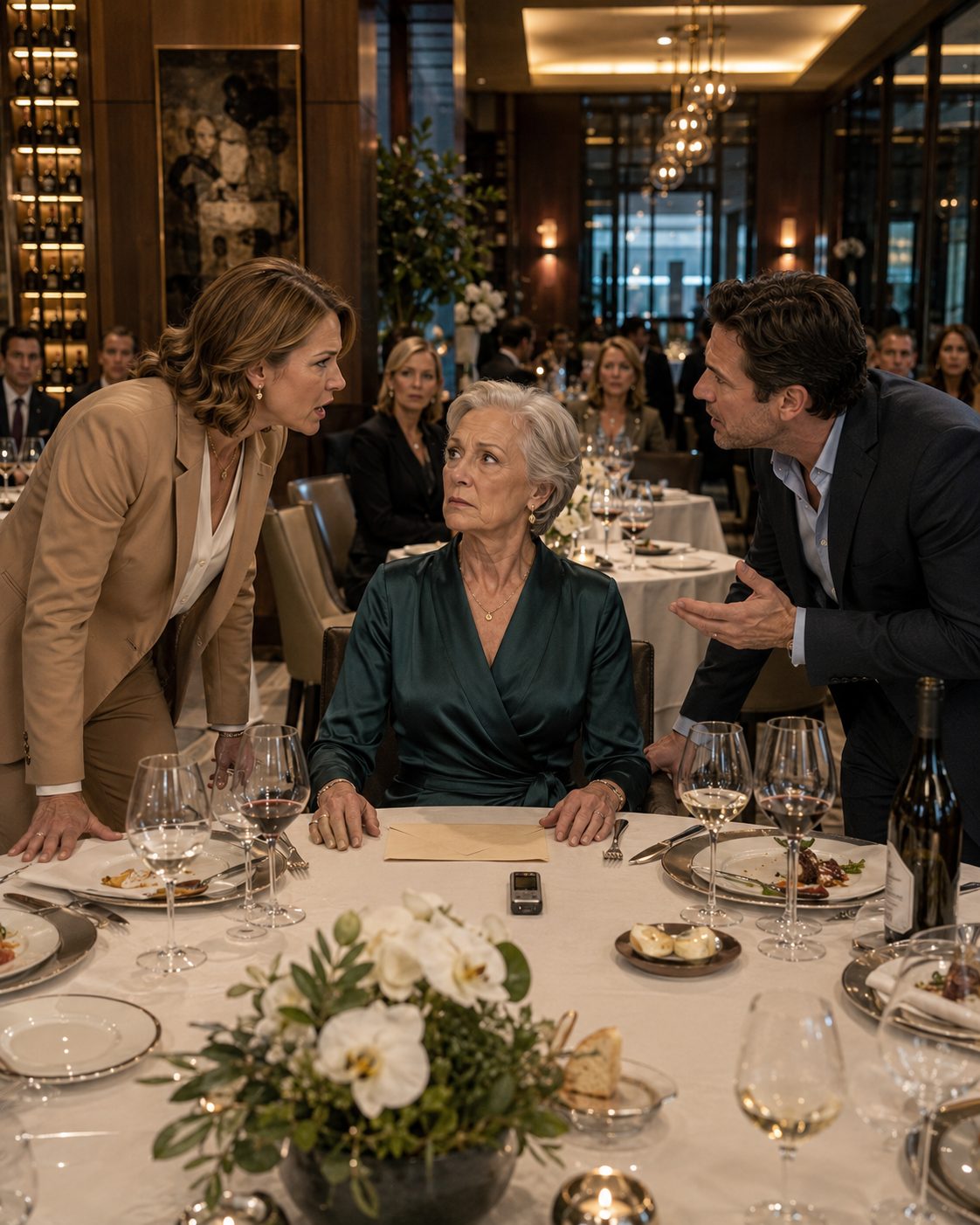
Across from them were three attorneys in tailored suits with leather briefcases already open.
No one stood.
No one smiled.
“Mom,” Megan said evenly, “please sit down.”
One attorney slid a thick folder toward me.
“Mrs. Carter, these are straightforward estate planning documents.”
I didn’t touch them.
He continued.
“A durable financial power of attorney… along with property management authorization. It simply allows your daughter to oversee your affairs.”
My eyes drifted across the pages.
Checking accounts.
Investment portfolio.
Condominium ownership.
Everything I’d spent forty years building.
Reduced to signatures waiting at the bottom of each page.
I slowly looked back up.
“And if I refuse?”
Megan didn’t hesitate.
“Then you’re making your choice.”
“What choice?”
“You won’t be part of Ethan’s life anymore.”
The room fell silent.
She folded her hands together.
“If you don’t trust me with your assets, I don’t trust you around my son.”
Andrew leaned back comfortably, almost entertained by the conversation.
One of the attorneys quietly uncapped a pen and placed it beside the papers.
I inhaled slowly.
Then opened my purse.
For a second, everyone seemed to relax.
They thought I’d accepted defeat.
Instead, I pulled out my phone.
“I’ll sign,” I said softly.
Relief flashed across Megan’s face.
“But before I do…”
I unlocked the screen and tapped a single contact.
“I think someone should hear this first.”
I pressed the speaker button…
Placed the phone gently in the center of the table…
And waited for the other voice to answer.
The Voice They Didn’t Expect
It rang twice.
Then a man answered.
“Evelyn?”
Megan’s face changed first. Not guilt. Not yet. Just confusion.
I kept my eyes on her.
“Hello, Richard. You’re on speaker.”
The oldest of the three attorneys stiffened so slightly most people would’ve missed it. I didn’t. His nameplate on the leather pad in front of him read Richard Bell, Senior Partner. I had known that name for twenty-three years.
Not socially.
Professionally. And, more than once, uncomfortably.
“Evelyn,” he said again, slower this time. “I wasn’t aware we’d be speaking tonight.”
“No,” I said. “I imagine you weren’t.”
Megan turned to him. “You know my mother?”
He cleared his throat. “Mrs. Carter’s late husband retained our firm years ago.”
That landed on the table with a dull little thud.
Andrew stopped smirking.
I said, “Not just years ago. Repeatedly. For wills, trusts, medical directives, probate for my husband’s mother, and a sealed set of instructions my husband asked to be released under one specific condition.”
Now all three attorneys were looking at Richard.
He knew exactly where this was going. I could tell by the way he touched his cuff and then forgot to move his hand back.
Megan gave a tiny laugh. Mean. Sharp. “This is ridiculous. Dad died seven years ago.”
“Yes,” I said. “And six years ago I updated my own estate documents. With witnesses. With copies sent where they needed to go. Including one instruction that if any person attempted to coerce me into signing over control of my assets under threat, a second file would be opened.”
The younger woman on the attorney side, dark bob, navy suit, finally spoke. “Mr. Bell, is that true?”
Richard didn’t answer her. He answered me.
“You brought a copy?”
I reached into my purse again and took out a plain manila envelope with my handwriting on the front. My hand had trembled when I sealed it that afternoon, but the letters were clear.
In case of pressure.
I set it beside the untouched steak knife.
Megan blinked at it. “What is this supposed to be?”
“Insurance,” I said.
What Frank Knew
My husband, Frank, sold commercial refrigeration units for thirty-one years. Not glamorous. He wore cheap ties and always had a pen leaking in his shirt pocket. But Frank paid attention.
Especially to men like Andrew.
I hadn’t thought of that in months. Maybe years. Then, after Megan’s text, something in me started itching. Not fear exactly. Memory.
Frank met Andrew only twice before he died.
The first time was at a Sunday cookout in our old split-level in Maple Glen. Andrew was still in pressed college-boy khakis then, trying too hard with everybody, laughing half a second too late. He shook Frank’s hand and kept talking about “opportunity” and “upside” and “networking” like he was reciting from a brochure.
After Andrew left, Frank scraped burned corn off the grill and said, “That boy’s got finance teeth.”
I laughed because it was such a Frank phrase.
“What does that even mean?”
He shut the grill lid. “Means he smiles with the part of him that wants something.”
At the time, Megan was twenty-six and dazzled. Andrew had a leased German car, expensive watch, stories about the firm, rooftop bars, clients in Chicago. He knew which fork to use, which wine to order, how to act bored by things the rest of us still thought were a treat.
Frank never liked him.
He wasn’t rude. He just watched.
The second time was at the hospital, three weeks before Frank died. Andrew came with Megan carrying a fruit basket so polished it looked fake. Frank was weak then, voice all sandpaper, but his brain was still there. Andrew stayed twenty minutes. Maybe less.
After Megan went to the restroom, Frank motioned for me to lean close.
“Don’t let him near your accounts,” he said.
I remember almost scolding him. I thought he was being unfair, suspicious because he was sick.
Frank looked at the hallway where Andrew had gone to take a call. “I’m serious, Evie. He asks questions that sound casual. They aren’t.”
I didn’t know until later that Andrew had spent that hospital visit asking about the condo, my pension, whether Frank had life insurance outside his employer package, whether our wills were “modernized.”
Modernized. That was his word.
When Frank died in October, he left me enough to live carefully, not lavishly. Condo paid off. Some investments. A pension from the school district where I’d spent thirty-four years doing payroll. Numbers. Spreadsheets. Quiet work. The kind of money greedy people call “sitting on” because they didn’t earn it.
Two months after the funeral, Richard Bell came to my apartment with a sealed letter from Frank.
I hadn’t thought about that letter in a long time either.
Until dinner.
The Letter I Was Supposed to Keep
I opened the manila envelope.
Inside was a photocopy of Frank’s note and a typed page from Richard’s office. I slid the note out first.
Megan made an irritated sound. “Mom, are we really doing this performance?”
I ignored her and read aloud.
“Evie. If you’re hearing this read in a room where someone’s trying to scare you into giving up control, do not sign a damn thing. If it’s Megan, then God help us, I was right to worry. If it’s that smooth little bastard she’s with, tell him I said he can buy his own life. Love you. Frank.”
No one moved.
Andrew’s face drained so fast it was almost ugly.
Megan stared at me. “You made that up.”
Richard spoke quietly. “I drafted the memo attached to it. Mr. Carter dictated the letter in my office on September 14th. Two witnesses were present.”
I slid over the typed page.
It was on Bell & Harkness letterhead, dated two months before Frank died.
If Mrs. Evelyn Carter ever reports an attempt by any family member, spouse of family member, caregiver, or associate to obtain control of her assets through emotional coercion, threats of estrangement, or duress, the firm is instructed to suspend any transfer activity and notify the parties listed in Attachment C.
Megan looked down the page.
“What parties?”
I said, “Read.”
She did. I watched her lips stop at the first name.
State elder abuse intake division.
Then local police financial crimes unit.
Then Ethan’s guardian ad litem backup designation.
Then one more.
Andrew Halpern’s employer compliance office.
That one got his attention.
He sat up so fast his chair legs dragged.
“What the hell is this?”
Richard finally found his voice. “Mr. Halpern, sit down.”
But Andrew was already on his feet. “No, I want to know why my employer is listed on some insane document from before I even married into this family.”
“Because Frank asked questions before he got sick,” I said.
The Thing Andrew Thought No One Knew
Three weeks before the wedding money conversation, I had lunch with my friend Louise at the food court in Willow Plaza because Louise likes the pretzels there and hates paying for parking downtown.
We were carrying our trays when I saw Andrew near the corridor by the old jewelry kiosk. He wasn’t alone.
He was with a woman in a cream coat, late forties maybe, expensive haircut, crying without wiping her face because she’d forgotten she was doing it. Andrew kept one hand on her elbow and the other on a folder.
I would’ve kept walking. I don’t enjoy scenes. But then I heard him say, “Brenda, if you don’t sign today, the trust review gets ugly.”
Trust review.
That phrase stuck.
Not because I understood it, but because of his tone. Smooth. Low. The same voice men use on used cars and frightened dogs.
The woman said, “You told me this was just temporary access.”
“It is temporary.”
“You said that last time.”
Andrew glanced up then, saw me, and for one weird second his whole face went blank. Like an actor who forgot his line.
At dinner with Megan that night, I mentioned it. Just mentioned it.
Saw Andrew today at Willow Plaza. He looked busy.
Megan put down her fork. “Why were you spying on my husband?”
I almost laughed. Spying. In a mall.
A week after that, Louise called me.
“You know that slick son-in-law of yours?” she asked.
I was standing in my kitchen rinsing blueberries. “Unfortunately.”
“My niece works at Hancock Private Wealth. She says a guy named Andrew Halpern got walked out of a branch in Naperville last year. Not charged. Not publicly, anyway. Internal mess. Some widow complaining he’d mixed personal relationships with client paperwork.”
That’s when my stomach started that slow turn.
I didn’t accuse him. Not then. I looked him up instead. Not on social media. On public records. State licensing. Court filings. Old business registrations. Boring places where sloppy people leave fingerprints.
I found two civil complaints that had been settled and sealed enough to hide details, but the docket lines were there. Undue influence. Asset transfer dispute. Family contest.
I printed everything.
Not because I thought I’d need it at a steakhouse while my own daughter threatened me.
But because Frank’s old warning had started scratching at the back of my skull.
Where Megan Went Wrong
Megan had always been easy to flatter.
That sounds cruel. It’s true anyway.
As a little girl she’d come home from dance class ruined for a week if the teacher praised another child. In high school she changed friend groups every year, chasing whichever girls had the right shoes. After college, when she got that marketing job and started spending lunch breaks on wedding blogs before she even had a serious boyfriend, I should’ve known status had gotten into her blood like dye.
After Frank died, she got worse.
Not mean at first. Just… hungry.
She’d come by the condo and stand in the doorway of my bedroom asking if I’d ever “thought about upgrading the place.” She wanted me to travel more, spend more, lease a luxury car because “you don’t have to act poor just because you grew up poor.”
I did grow up poor.
South Dayton. Two-bedroom apartment over a hardware store. My mother counted grocery money on the table using a cigarette tin and always paid cash because she distrusted banks. I don’t romanticize that life. Being poor is boring and ugly and hard on your teeth.
So yes, I saved.
Frank saved too.
We took one real vacation every four years and drove our cars until the radios died. We clipped coupons. We fixed things. We bought Megan braces, then college textbooks, then her first month’s rent when she moved to Cincinnati. I never once told her no when she truly needed something.
Need.
That word had gotten stretched all to hell by the time she sat me down with that seventy-two-thousand-dollar brochure.
But here’s the part I hadn’t understood until the steakhouse.
This dinner wasn’t Megan’s idea.
Or not all hers.
She was cruel enough to go along with it, yes. But the machinery of it, the timing, the lawyers, the private room, the prepared documents, the unnatural text from an unfamiliar number. That had Andrew all over it.
I looked at her then, really looked, and saw she was tired. Concealer packed under her eyes. Cuticle bitten raw on one thumb. She kept touching the stem of her water glass and pulling her hand back like she’d forgotten what to do with it.
There are moments when a mother hates her child and wants to gather her up at the same time.
It’s a sick feeling.
The younger attorney turned pages in the document stack. Faster now. Not composed anymore.
“Mr. Bell,” she said, “why were these powers prepared in advance without an independent capacity review? Why is the beneficiary named here as immediate co-signer on liquidation authority?”
Megan snapped, “Because it’s efficient.”
The attorney looked at her the way people look at a lit stove someone just called decorative.
Richard took off his glasses. “Who drafted the intake memo for this matter?”
No one answered.
Then the third attorney, who’d barely spoken all night, said, “It came through Andrew’s office referral. We were told Mrs. Carter requested expedited family planning documents.”
I almost smiled.
Requested.
The Part That Broke Her
I tapped my phone screen and brought up one more file.
Audio.
Andrew heard the first second and went pale again.
The recording was from my voicemail. Saved automatically three nights before the dinner. I’d almost deleted it because I didn’t recognize the number.
It was Megan.
Not to me.
To someone else. She’d pocket-dialed me by mistake.
At first there was rustling, car noise, her purse zipper scraping against something. Then Andrew’s voice, clear as day.
“You don’t need to cry every time this comes up.”
Megan said, “I don’t like threatening her with Ethan.”
“You like being broke less.”
Silence. Turn signal ticking.
Then Megan again. Small voice. “What if she calls Richard?”
Andrew laughed.
“She’s not that smart.”
I played exactly that much and stopped.
Megan’s hand flew to her mouth.
Andrew said, “That’s out of context.”
“How much context do you need?” I asked.
He turned to Megan fast. “Tell them your mother manipulates you. Tell them she’s unstable.”
The room shifted right there.
Not dramatically. No gasps. But every attorney at the table looked at him like they’d finally seen the card up his sleeve.
Megan whispered, “Andrew.”
He kept going.
“Say it. You told me she forgets things. You told me she drinks wine every night. You said she gets confused about money.”
“I said she has one glass of chardonnay and writes everything down in notebooks because she likes lists.”
Her voice cracked on the last word.
He blinked at her. Once.
Then he made a mistake greedy men always make. He got impatient.
“Fine. Then we do it the hard way.”
Richard sat straighter. “Excuse me?”
Andrew shoved the unsigned folder toward me with two fingers. “Mrs. Carter has been freezing out her family and making erratic financial choices. If she won’t cooperate voluntarily, there are still avenues for protective intervention.”
Conservatorship.
He didn’t say it. He didn’t have to.
Megan looked at him as if she’d never heard that word in his voice before, even though I was sure he’d planted it gently over weeks. Maybe months.
“You told me this was just so I could help with bills if something happened,” she said.
Andrew didn’t answer fast enough.
That was the crack.
I watched my daughter’s whole face rearrange itself around the truth she had been dodging because the truth was ugly and she’d married it.
The Last Paper on the Table
Richard asked all three junior attorneys to leave the room.
They did. Quickly.
Then he asked Andrew for his copy of the file.
Andrew refused.
Richard said, “Give me the file or I’ll call building security and the police from this table.”
Andrew slid it over.
Richard opened the back pocket of the folder and pulled out a second set of documents Megan hadn’t seen. I knew she hadn’t because her eyes widened in that stupid animal way children still do when they realize the magician has a second hand.
There was a post-it on top, yellow, crooked, with handwriting that wasn’t Richard’s.
After signature, transfer condo to LLC within 14 days. Delay mother-grandson contact until psych eval petition filed.
Megan read it twice.
Then a third time.
“Psych eval?” she said. Not loud. Just dead.
Andrew started talking fast, finally dropping the polished voice.
“It’s procedural. Megan, listen to me, you are overreacting. Her age, the isolation, the emotional volatility after your father, these are factors, okay? It protects us from her changing her mind later.”
Us.
That word did it.
Megan stood so hard her water tipped and ran across the white tablecloth. “You said this was about planning.”
“It is.”
“You said if she signed, we’d all calm down and start over.”
“That’s still possible if you stop making this dramatic.”
She slapped him.
Not a movie slap. Not elegant. Open palm, ugly angle, hard enough his chair jerked.
No one said a thing.
Then Megan started crying the way she had when she was eleven and her rabbit died: furious, leaking, almost choking on it.
I wanted to feel triumph.
Mostly I felt old.
After the Dinner
Police did come.
Not with sirens. Two officers in dark uniforms took statements in a side office near the coat check while diners kept eating ribeyes twenty feet away. One of them had mustard on his cuff. The whole thing felt cheap and unreal.
Andrew left with them for questioning, not in handcuffs, but not free either.
Richard looked fifteen years older by then. He apologized three times, each worse than the last. His firm had accepted the matter through an internal business development channel Andrew had cultivated through a banking contact. The paperwork should never have made it into a signing room without independent review. Heads would roll, as people like Richard say when they don’t want to use simpler words.
Megan sat in the corner holding a cloth napkin in both hands until it tore.
I nearly left without speaking to her.
Then she said, “Mom.”
Just that.
I stopped.
She looked up with mascara half gone and said, “I used Dad against you because I knew it would work.”
“Yes,” I said.
“I told myself you were being selfish. That you cared more about money than me. And then when Andrew said maybe you needed help managing things, I…” She looked down at the torn napkin. “I liked the idea that I wasn’t the bad guy.”
That was honest enough to sting.
“What about Ethan?” I asked.
She started crying harder. “He’s with my neighbor. He doesn’t know anything. I swear.”
I believed her on that part.
Then she said, “I don’t know how to fix this.”
Neither did I.
That’s the thing people don’t like about real life. Sometimes the apology isn’t the bridge. It’s just the first brick, and the river is still there.
So I didn’t hug her.
I didn’t say it was okay.
I said, “You’re going to tell every investigator the truth. All of it. You’re going to get your own lawyer, not one a husband hands you like a menu. And if you ever use my grandson as a bargaining chip again, I will spend every last decent year I have making sure you regret it.”
She nodded like a child.
I left her sitting there.
The Call I Got on Tuesday
Dinner was Friday.
On Tuesday morning, at 9:12, while I was wiping down the kitchen counters and pretending bleach could clean my head out, my phone rang.
Megan.
I considered letting it ring. Then I answered.
“Ethan wants to talk to you,” she said.
No hello. Fair enough.
His little voice came on, all bright and crooked with five-year-old breath. “Grandma, Mommy says you were at a fancy food place.”
I sat down on the closed toilet lid because my knees had gone soft.
“I was.”
“Did you eat cake?”
“No, sweetheart.”
Pause. Then, very serious: “I saved you my dinosaur sticker.”
I put my hand over my eyes.
When Megan came back on, neither of us said anything for a second.
Finally she said, “Andrew moved out.”
I looked at the crack in the bathroom tile Frank had always meant to fix.
“Good.”
“He opened two credit cards in my name,” she said. “And there are loans. I didn’t know about all of them.”
Of course there were.
The wedding venue deposit she’d bragged about? Borrowed. The honeymoon she posted and then deleted? Borrowed. The stroller with leather handles, the watch Andrew gave her after Ethan was born, the “investment condo” he claimed he was about to close on in Nashville. Paper. Smoke. Somebody else’s money.
“Do you remember that woman from Willow Plaza?” I asked.
Megan was quiet. “Brenda?”
So she did know.
“She called me yesterday,” Megan said. “Apparently my number was in Andrew’s phone under legal. She thought I was another client.”
I shut my eyes.
“What did she want?”
“To tell me he’s done this before. And to tell me I’m not special.”
That was maybe the cruelest useful thing she could’ve heard.
The Envelope Frank Left Behind
A week later Megan came to my condo alone.
No makeup. Hair tied back badly. She looked younger and rougher without all the careful polish. She brought Ethan, who immediately lay on my living room rug driving a plastic dump truck over the fringe like it was mountain terrain.
We sat at my kitchen table.
Same table Frank had assembled wrong the first time and cursed at for an hour.
I took one last envelope from the drawer beside the refrigerator. This one had been there the whole time. Frank’s actual sealed note to Megan, the one Richard delivered with mine after the funeral. She’d never opened it. She told me then she wasn’t ready and took it home.
Now she set it in front of me.
“I found it in my safe box,” she said. “Still sealed. I want to read it here.”
So she did.
Her father had written in blocky print because chemo had made his hands unreliable by then.
Meg, if you’re reading this after choosing money over your mother, stop. Go back. Apologize before you become the kind of person who can explain anything to herself. That’s the danger in our family. We can all make a case. Love isn’t a case. It’s what you do when the numbers don’t flatter you.
She folded the letter once.
Then again.
Ethan drove his truck into the leg of my chair and announced, “Crash.”
Neither of us corrected him.
Would you have picked up that call at the table, or walked out? Tell me.
For more tales of family drama and unexpected turns, dive into My Father Gave Me an Ultimatum, So I Opened the Accounts or discover the secrets in I Opened My Wife’s Forgotten Cottage and Found She’d Hidden More Than Grief. And if you’re curious about swift career comebacks, check out I Got Fired at 8:46. By 9:06, Their Biggest Competitor Called Me..