
I wasn’t supposed to be in Texas.
My brother Terrence called me on a Tuesday night, voice cracking like I hadn’t heard since our mama’s funeral. “They took it, Denise. All of it. Every dollar.”
$4,300. Cash. His entire fall semester tuition, because the financial aid office at his school only took money orders and he hadn’t converted it yet. He was driving from Shreveport to his campus near Temple when he got pulled over on Highway 79 for a “wide right turn.”
The officer told him the cash was “suspicious.” No drugs. No warrants. No arrest. Just a twenty-three-year-old Black kid with Louisiana plates and an envelope full of hundreds.
They wrote him a civil asset forfeiture receipt and sent him on his way. Told him he could “petition to get it back” in six to eight months.
Terrence didn’t even fight. He just drove to campus and sat in the parking lot for four hours.
That’s when I got involved.
See, what that officer didn’t know, what he had absolutely no way of knowing, is that Terrence’s older sister isn’t a schoolteacher. I’m not a nurse. I’m not the kind of woman you scare into silence on a back highway in Milam County.
I took three days off work. Rented a car with out-of-state plates. Put my hair down. Wore a sundress. Threw a duffel bag on the passenger seat with $2,000 in marked bills sitting right on top, visible through the half-open zipper.
And I drove that same stretch of Highway 79 at 4:47 in the afternoon, right at shift sweet spot.
Mile marker 14. Blue and red in my mirror.
My hands were shaking but my dashcam was steady. Had been recording since I crossed the county line. Second camera was pinned inside the duffel bag, angled at the driver-side window. Third was in a glasses case on the dash, lens no bigger than a pencil eraser.
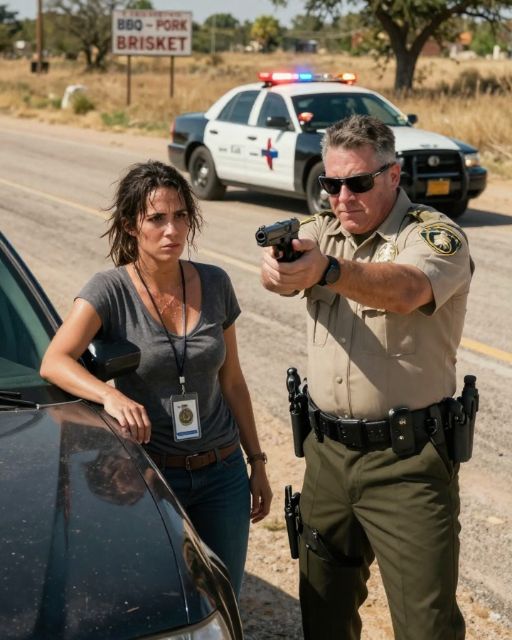
He walked up slow. Tan uniform. Mirrored sunglasses. Name tag read HUNNICUTT.
Same name on Terrence’s forfeiture receipt.
“License and registration, darlin’.”
I handed them over. Louisiana license. He looked at it. Looked at me. Looked at the duffel bag.
“Where you headed?”
“Temple. Visiting my brother at school.”
“That’s a lot of road for a visit.” He leaned in closer. “What’s in the bag?”
“Personal items.”
“Mind if I take a look?”
“I’d prefer you didn’t.”
That’s when his whole posture changed. He unsnapped his holster. Put his hand on the grip. I could feel the shift in the air like a weather front.
“Step out of the vehicle.”
I stepped out.
He told me to put my hands on the hood. I did. The metal was burning from the Texas sun and I pressed my palms flat anyway.
He reached into the car. Unzipped the duffel bag. Saw the cash.
“Well now,” he said. And I swear he almost smiled.
He pulled me off the hood, walked me to the back of the car, and that’s when he drew the Glock. Not pointed at my head. At my chest. Center mass. Like they teach you.
“You’re going to tell me where this money came from, or we’re going to have a very different kind of afternoon.”
My voice was calm. I don’t know how.
“Officer Hunnicutt,” I said. “There’s something in that bag underneath the cash that you need to see before you do anything else.”
He kept the gun up. Walked back to the passenger side. Moved the bills.
I watched his face in my side mirror.
The color left his skin like someone pulled a drain plug.
Underneath the cash was my credentials. My shield. And a folded letter on department letterhead that began with the words “This operation is being conducted under the authority of…”
He turned around. Looked at me. Looked at the road. Looked back at me.
“You – ” he started.
“I’d stop talking,” I said.
Because the fourth camera, the one he never saw, was in the cruiser parked 200 yards up the road. And the two people sitting inside it had watched every single second.
Hunnicutt looked up the highway. Saw the unmarked vehicle pulling forward, lights now flashing.
He lowered the Glock.
But it was way too late.
What we found on his dashcam footage over the next 48 hours, the stops he made, the people he targeted, the amount of cash that never made it to any evidence locker, made my supervisor sit down in his chair and say two words I’d never heard him say in eleven years.
“Holy shit.”
But the thing that still keeps me up at night isn’t the gun. It isn’t the money. It isn’t even what happened to Hunnicutt.
It’s what we found in the trunk of his patrol car. Because the cash he took from my brother? It was still there. Mixed in with bills from dozens of other stops. And taped to the inside of the trunk lid was a list of names.
Every single one had out-of-state plates.
Every single one was under 25.
And next to each name, in Hunnicutt’s handwriting, was a single word that made the federal prosecutor drop her coffee when she read it.
“Cleared.”
Not cleared as in innocent. Not cleared as in resolved. Cleared as in done. As in finished. As in this person has been processed and they won’t be coming back to cause problems.
It was a hunting log. That’s what the prosecutor called it when she finally got her voice back. A hunting log for young travelers passing through rural Texas with cash they couldn’t afford to lose and no power to fight back.
Thirty-seven names on that list. Thirty-seven people who had been stopped, stripped of their money, and sent away with a worthless piece of paper and the unspoken understanding that nobody was going to help them.
The youngest was nineteen. A girl named Monique Thibodaux from Lake Charles who had been carrying $1,800 for her first apartment deposit near Baylor. She never got that apartment. She dropped out two weeks later and moved back home.
The oldest was twenty-four. A guy named Darren Okafor from Memphis who was carrying $6,200, money his father had wired from Nigeria over the course of a year to help him finish his engineering degree. Darren didn’t drop out, but he took on $14,000 in emergency loans at predatory interest rates that he’s still paying off today.
Every single name on that list was Black or brown. Every single one.
Hunnicutt had been doing this for three years. Three years of pulling over young people of color on a quiet stretch of highway, confiscating their cash under the cover of civil asset forfeiture, and pocketing most of it himself.
His department never questioned it because he always filed some paperwork. Just enough to look legitimate. Just enough to create a trail that nobody bothered to follow.
The total amount we eventually traced back to him was just over $340,000.
Three hundred and forty thousand dollars stolen from kids trying to go to school, pay rent, start their lives.
And here’s the twist that nearly broke the whole case wide open.
Hunnicutt wasn’t working alone.
When we pulled his phone records, there was a number he called after almost every stop. Same number, sometimes within minutes of the person driving away. We traced it to a clerk in the county courthouse named Brenda Fossett, a woman who had been processing civil asset forfeiture paperwork for Milam County for over a decade.
She was the one making the receipts look real. She was the one filing them in a way that they’d get lost in the system. She was the one who made sure that when someone actually did try to petition to get their money back, the paperwork would be so tangled and misfiled that they’d give up before they ever saw a courtroom.
Brenda took twenty percent of every haul. She had a vacation home in Galveston paid for entirely in cash.
When we brought her in, she didn’t cry. She didn’t deny it. She sat down in the interview room, folded her hands on the table, and said, “I always figured it’d be the IRS that caught us, not some girl from Louisiana.”
Some girl from Louisiana. That’s what she called me.
I leaned across that table and I said, “This girl from Louisiana is a special investigator with the Department of Justice, Civil Rights Division. And I’ve got your whole operation on four cameras and a paper trail that goes back to 2019. So you might want to reconsider your tone.”
She reconsidered her tone real quick after that.
The federal case took eleven months to build. Hunnicutt was charged with deprivation of rights under color of law, armed robbery, theft, and about a dozen other counts that I won’t bore you with. Brenda Fossett was charged with conspiracy, fraud, and obstruction.
Hunnicutt’s lawyer tried to argue that civil asset forfeiture was legal in Texas and that his client was simply following department protocol. The judge, a woman named Honorable Patricia Medrano who had clearly read every single page of our filing, looked at that lawyer over her glasses and said, “Counsel, your client pointed a loaded weapon at an unarmed woman and stole cash from thirty-seven people who were never charged with a crime. If that’s your department’s protocol, then your department has a problem too.”
Hunnicutt got fourteen years federal. No parole.
Brenda Fossett got seven.
The county sheriff who had looked the other way for three years quietly retired before the investigation reached his office. But retirement didn’t save him. A separate state inquiry found that he had been aware of Hunnicutt’s pattern and had actively discouraged internal complaints. He was stripped of his pension and charged with official misconduct.
And every single person on that list? Every one of the thirty-seven?
The court ordered full restitution. Every dollar returned, plus interest, plus damages.
Terrence got his $4,300 back. He also got a letter of apology from the county that I know he keeps in his desk drawer even though he says he threw it away.
He graduated the following spring. Criminal justice degree. He’s in law school now at Howard, and I swear if I hear him quote one more Supreme Court case at Thanksgiving dinner I’m going to throw a bread roll at his head.
But I want to tell you about one more thing that happened, because it’s the part of this story that I carry with me.
About six months after the arrests, I got a handwritten letter forwarded to my office. No return address, just a postmark from Lake Charles. It was from Monique Thibodaux, the nineteen-year-old who had lost her apartment money and dropped out.
She wrote that when she heard about the case on the news, she sat on her mama’s porch and cried for two hours. Not because of the money. She said the money was almost beside the point by then. She cried because for two years she had believed that what happened to her was just how the world worked. She believed that people like her didn’t get to fight back. She believed that she was stupid for driving through Texas with cash, that it was her fault, that she should have known better.
And then she saw that somebody had gone back to that same highway and said no.
She re-enrolled at Baylor that fall. Last I heard she’s studying social work.
Her letter ended with a line I will never forget as long as I live. She wrote, “I didn’t know you could be the thing that stands between somebody and what’s wrong with the world. Now I want to be that too.”
I keep that letter in my desk. Right next to my shield.
People ask me sometimes if I was scared that day on Highway 79. If I was scared when Hunnicutt pulled that Glock and pressed it to my chest. And the honest answer is yes. I was terrified. My training kept me steady but my body knew exactly what could have happened. I think about it more than I should.
But I also think about Terrence sitting in that parking lot for four hours, alone, believing nobody was coming. I think about thirty-seven young people driving away from that stretch of highway with empty hands and full hearts of shame that didn’t belong to them.
And I think about the fact that sometimes the only thing standing between a bully and their next victim is one person who decides they’ve seen enough.
That’s what I want you to take from this. You don’t have to be a federal investigator. You don’t have to carry a shield or set up a sting operation on a Texas highway. But you do have to be willing to stand up when something’s wrong, even when it’s easier to look away. Especially when it’s easier to look away.
Because silence isn’t neutral. Silence is a vote for the way things are. And the way things are isn’t good enough. Not for Terrence. Not for Monique. Not for Darren. Not for any of those thirty-seven names on a list taped inside a trunk.
The world doesn’t fix itself. People fix it. One act of courage at a time, one refusal to look away, one person who drives back down the same highway and says not today.
If this story moved you, share it with someone who needs to hear it. Sometimes the most powerful thing you can do is make sure a story like this doesn’t stay quiet.