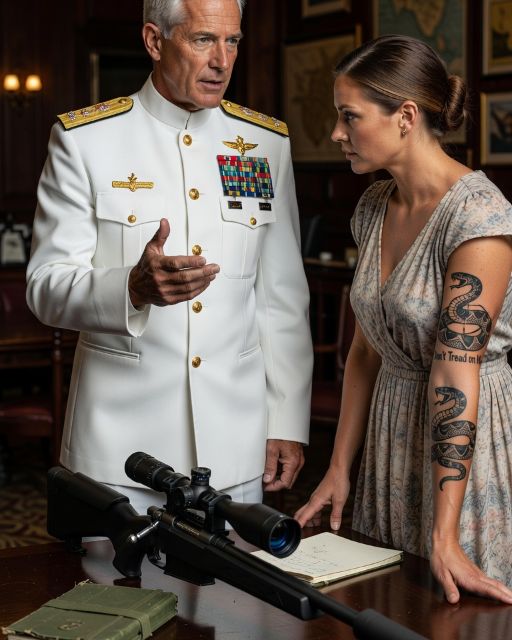

Chapter 1: The Sundress
The officers’ club at Fort Benning smelled like bourbon, old cigar smoke, and cologne that cost more than a private’s paycheck.
Saturday night. Full house.
Sarah Keller walked in wearing a yellow sundress and sandals, hair still damp from the shower. No makeup. No jewelry except a thin silver chain tucked under her collar.
She looked twenty-six, maybe twenty-seven. Small. The kind of woman people at the grocery store ask to reach things on low shelves, not high ones.
The bar went quiet for about half a second. Then it didn’t.
“Well, well.” The voice came from a corner booth. Three men in polos and pressed khakis, drinks sweating on the table. The one talking had a jaw like a shovel and a West Point ring he kept turning on his finger. “Look what the wind blew in.”
His buddies laughed. Not because it was funny. Because he was the kind of guy whose buddies always laughed.
Sarah kept walking toward the bar.
“Hey. Sweetheart.”
She stopped.
He leaned back in the booth, arm draped over the top, grinning like he owned the floor. “So tell me, sweetheart. What’s your rank? Or are you just here to polish our rifles?”
The table behind him busted up laughing. A captain at the next booth snorted into his beer. Somebody at the pool table said “Jesus Christ, Bradley” under his breath but didn’t look up.
Nobody said anything else.
The bartender, a retired master sergeant named Wayne, put down the glass he was drying. Real slow.
Sarah turned around.
She didn’t say anything at first. Just looked at Bradley. Head tilted a little. The way you’d look at a kid who just broke a window.
“You drinking bourbon?” she asked.
Bradley blinked. “What?”
“Your drink. That bourbon?”
“Yeah. So?”
“Good choice.” She nodded once. Walked over. Real casual. “Mind if I sit?”
He looked at his buddies. They looked at him. He pulled out a grin that was supposed to be charming. “Sweetheart, I don’t think you understand how this works.”
“I understand fine.” She sat down across from him. Folded her hands on the table. The two buddies scooted a little, giving her space without meaning to. “You asked me a question. I’m gonna answer it.”
“Oh yeah?” Bradley leaned forward, elbows on the table, trying to get the room back. “Go ahead then, darlin’. Tell us your rank.”
Behind the bar, Wayne reached under the counter and pressed something. Didn’t pick up a phone. Didn’t make a call. Just pressed a button and went back to wiping glasses.
Sarah pulled the silver chain out from under her collar.
Two tags slid out. Worn. Dented on one corner like they’d been hit with something hard.
She laid them flat on the table between Bradley’s drink and her folded hands.
Bradley looked down.
His face did something interesting. Started at smug. Went through confused. Landed somewhere near white.
“That’s not.” He swallowed. “That’s not real.”
“Read it out loud,” Sarah said. Quiet. Not mean. Just quiet. “Go ahead. For your friends.”
He didn’t. His mouth was open but nothing came out.
The front door of the club opened.
Three men walked in. Two colonels and a one-star general. Not in dress uniform. Golf shirts, khakis, the look of men pulled away from a Saturday dinner they didn’t want to leave.
The general’s eyes swept the room once. Landed on the booth.
He didn’t raise his voice. He didn’t have to.
“On your feet.”
Bradley stood up so fast he knocked over his bourbon. It spread across the table, soaked into the edge of the sundress. Sarah didn’t move. Didn’t look at it.
She was still looking at Bradley.
“Captain,” the general said, walking toward them slow, “do you know who you’ve been talking to for the last ten minutes?”
Bradley’s mouth opened. Closed.
The whole club was standing now. Every man in the place. Chairs scraped back. Pool cues set down. A full-bird colonel at the bar turned around and went pale.
Sarah finally stood up. Picked up her dog tags. Slipped them back under her collar.
Then she said the sentence that made every officer in that room forget how to breathe.
“Dad, you’re late.”
Chapter 2: The Tags
The silence in the room was a physical thing. You could feel it in your teeth.
General Morrison didn’t look at his daughter. His eyes were locked on Captain Bradley, a man who seemed to be shrinking inside his polo shirt.
“Sarah,” the general said, his voice dangerously low. “What happened?”
“Nothing, Dad.” Sarah’s voice was calm, but there was a weariness in it now. “Captain Bradley and his friends were just asking about my rank.”
She glanced down at the dark, spreading stain on her yellow dress. “He spilled his drink.”
The general’s gaze followed hers. For a moment, the iron control on his face flickered. It wasn’t just a general looking at a subordinate; it was a father looking at something that had hurt his child.
He turned back to Bradley. “Captain.”
“Sir.” The word was a croak.
“My office. 0600. Monday. With your commanding officer. Bring a pen.”
That was it. No shouting. No public reprimand. Just a quiet, surgical execution of a career. Everyone in the room knew what it meant.
The general took off his own light jacket and draped it over Sarah’s shoulders. It dwarfed her.
“Let’s go, honey,” he said, his voice softening just for her. He put a hand on the small of her back and guided her toward the door.
The crowd of officers parted like the Red Sea. Nobody made eye contact. The shame in the room was thick enough to choke on.
As they passed the bar, Sarah paused. She looked at the old bartender.
“Wayne,” she said softly. “Thank you.”
The retired master sergeant just nodded, his face carved from granite. “Anytime, Ms. Sarah. Anytime.”
Then she and her father were gone, the club door swinging shut behind them.
The sound of it closing seemed to snap everyone out of their trance.
Bradley sank back into the booth, his face in his hands.
One of his buddies, a lieutenant, finally spoke into the quiet. “I didn’t know she was General Morrison’s daughter.”
Wayne, from behind the bar, spoke without looking up from the glass he was now polishing with furious energy.
“She’s not,” he said, his voice flat and cold. “Not his daughter.”
The lieutenant frowned. “But she called him Dad.”
Wayne finally stopped polishing. He looked across the room at the broken man in the corner booth.
“She’s a Keller. She married Michael Keller, the general’s son. Michael was killed outside of Kandahar three years ago.”
He let that sink in.
“The general and his wife, they treat her like their own. Because she is. She’s all they have left of their boy.”
Someone in the back of the room swore softly. The full weight of what had happened was finally landing.
The lieutenant looked at the two dog tags still faintly imprinted in the spilled bourbon on the table. One for her. One for her husband.
“The dog tags…” he whispered.
Wayne’s voice was barely a whisper but it carried across the entire room. “The one on top is hers. Sergeant Sarah Keller, combat medic. Retired. The one underneath belonged to her husband, Captain Michael Keller.”
He picked up Bradley’s empty bourbon glass.
“And that comment about polishing rifles? Captain Keller was an infantry officer. He died protecting his men during a firefight. He took two rounds to the chest saving a private who was a brand new father.”
Wayne looked directly at Bradley. “He died holding his rifle.”
The sound of the glass shattering as Wayne crushed it in his hand was the only sound in the club for a long, long time.
Chapter 3: Monday, 0600
The walk to General Morrison’s office was the longest walk of Captain Bradley’s life. He hadn’t slept. He hadn’t eaten. He had just replayed the scene in the club over and over, each time feeling a fresh wave of nausea.
He had spent his whole life trying to be the man he thought the army wanted. Tough. Confident. The guy in charge. In ten seconds, she had shown him he was just a boy playing dress-up.
He straightened his uniform for the tenth time before knocking on the heavy wooden door.
“Enter.”
The General was sitting behind his desk, which was as big as a car. Colonel Davis, Bradley’s C.O., was standing rigidly to the side, his face a mask of disappointment.
There was a third person in the room.
Sarah Keller was sitting in a chair opposite the desk. Not in a sundress, but in a simple blouse and slacks. She looked not at him, but at her hands folded in her lap.
“Captain Bradley reporting as ordered, sir,” he managed, his voice sounding thin and weak.
General Morrison just looked at him for a long moment. He didn’t invite him to sit.
“Do you have anything to say for yourself, Captain?”
Bradley’s prepared speech, full of military jargon and excuses, evaporated. He looked from the General’s cold eyes to Sarah’s quiet form.
“Sir,” he began, his voice cracking. “There is no excuse for my behavior. My words were reprehensible. My conduct was a disgrace to this uniform and to the Army.”
He took a breath. “And to you, Ma’am,” he said, finally looking at Sarah. “I am… I am deeply, truly sorry. What I said was cruel and ignorant, and I can’t imagine the pain it caused you.”
His eyes were watering. He didn’t care.
“I am prepared to accept the consequences, sir. Whatever they may be.”
He stood there, at attention, waiting for the axe to fall. For his career to end.
General Morrison leaned back in his chair, steepling his fingers. He looked at Sarah.
Sarah finally looked up, meeting Bradley’s gaze. There was no anger in her eyes. Just a profound sadness.
“Captain,” she said, her voice soft. “Do you know why I was at the club?”
“Ma’am?”
“I was there to pick up a box. The last box of my husband’s things from his old locker. Wayne was holding it for me. I wore the sundress because… because Michael loved it. It was the last thing I was wearing when I saw him off for his final deployment.”
She paused, taking a steadying breath. The room was silent except for the ticking of a clock on the wall.
“He was just like you once. Young, full of fire, maybe a little too much swagger.” A ghost of a smile touched her lips. “He probably would have laughed at a joke like that a few years ago. Before he understood.”
She stood up and walked toward him. Bradley flinched, but she just stopped a few feet away.
“The Army doesn’t need men who think strength is about being the loudest voice in the room,” she said. “It needs leaders. Leaders who understand that every person they meet, in or out of uniform, is carrying something. A burden. A memory. A loss.”
She turned to her father-in-law.
“I don’t want his career to be over, Dad,” she said.
Colonel Davis looked stunned. The General’s eyebrows shot up. Bradley just stared, uncomprehending.
“I want him to learn,” she continued. “I want him to be a better officer than Michael ever had the chance to become.”
General Morrison looked from Sarah to the young, broken captain in front of him. A plan began to form behind his eyes. A different kind of punishment. A harder one.
“Captain,” the General said, his voice like rocks grinding together. “You’re right. Your conduct was a disgrace.”
“But Ms. Keller has offered you something you don’t deserve. A chance.”
“Effective immediately, you are being reassigned. Your new duty station is right here at Fort Benning.”
Bradley felt a flicker of hope. Maybe it wouldn’t be so bad.
The General crushed it.
“You will be the new Officer-in-Charge of the Survivor Outreach Services. The Gold Star Families program. You will spend every day for the next year working with the husbands, wives, parents, and children of the fallen.”
The blood drained from Bradley’s face.
“You will plan the memorials,” the General continued, his voice relentless. “You will coordinate grief counseling. You will help widows with their benefits paperwork and you will sit with parents who have lost their only child. You will listen to their stories. You will learn their names.”
“You wanted to know about service, Captain? You’re about to learn what it truly costs. You will look into the faces of the people left behind, and you will see the consequences of the war we fight.”
He stood up, his full height seeming to fill the entire room.
“Your first duty,” he said, pointing a finger at Sarah, “will be to personally inventory the last effects of Captain Michael Keller and deliver them to his widow. And you will do it with the respect you failed to show her.”
“Dismissed.”
Chapter 4: The Path Forward
One year later, the lawn by the main chapel was covered in small American flags, one for every soldier from the base lost since the wars began.
It was Memorial Day.
Sarah stood near a large oak tree, watching the families move quietly among the flags, touching a name, sharing a memory.
She wasn’t wearing a yellow sundress. She wore a simple blue dress, a color of peace and calm. She no longer wore the dog tags around her neck. They were in a small, polished wooden box at home, next to a picture of a smiling young man in uniform.
She wasn’t there in sadness, not entirely. It was a day of remembrance. A day of honor.
Across the lawn, she saw a man in a crisp dress uniform kneeling by a flag. He was talking to a little girl who was holding a teddy bear. He was listening patiently as she told him stories about her daddy.
It was Captain Bradley.
He looked different. The arrogance in his posture was gone, replaced by a quiet strength. There were new lines around his eyes, lines of empathy and fatigue. He had lost the swagger, but he had found his dignity.
He looked up and saw her watching. He didn’t smile. He just gave a slow, formal nod. A sign of respect. Of understanding.
Sarah nodded back.
Her father-in-law, General Morrison, came and stood beside her. He was in his full-dress uniform.
“He’s done good work,” the General said quietly, following her gaze. “The families love him. He listens.”
“I know,” Sarah said. “He was the right man for the job. He just didn’t know it yet.”
They stood in comfortable silence for a moment, watching the man who had been a symbol of everything wrong become a quiet force for good.
“Are you ready?” the General asked her.
Sarah finally smiled, a real smile that reached her eyes. “Yes. I am.”
The General handed her a small, velvet box.
“Michael would have wanted you to have this,” he said.
Inside wasn’t a medal or a memento of war. It was a simple, elegant key.
“The Keller Foundation’s first scholarship has been awarded,” he said. “To a young medic looking to go to nursing school. The foundation you built, with the inheritance Michael left you.”
Sarah looked at the key. It wasn’t just a key; it was a door. A door to a new future, built from the love of the past. She had turned her grief into a legacy.
She looked out at the sea of flags, at the quiet captain comforting a child, at the general standing proudly by her side. Her life had been defined by loss, but it would now be defined by what she built in its wake.
The lesson wasn’t about punishment or revenge. It was about redemption. It was about the quiet, difficult, and beautiful work of building a better person, a better community, one act of understanding at a time. True strength wasn’t in the rank on your collar, but in the compassion in your heart.