
My Mom Crushed My Navy ID Under Her Heel. “Just A Secretary,” She Sneered. My Brother Got The Steak. I Got Burnt Scraps. She Stole My Seat And Shoved Me To The Back Wall, Alone. Then A 3-Star General Roared, “Attention!” 250 SEALs Turned Back At Once.
The first thing my mother did that morning was step on my Navy identification card.
It slipped from my hand when she grabbed my wrist outside the hotel, and before I could reach for it, the heel of her suede shoe came down hard.
She glanced at the photo, the official seal, then looked at me with open contempt before dragging the card across the dirty floorboard of her pickup. Plastic scraped against dried mud and coffee stains while she smiled as if she had just taught me an important lesson.
“A secretary?” she scoffed. “That’s all you are. Don’t make a fool of yourself today pretending you’re something important. This ceremony is about your brother.”
I stared at the damaged card for a moment without saying a word.
Years in uniform had taught me that losing control never solved anything. The people who carried real authority rarely needed to prove it. So instead of arguing, I bent down, picked up the card, wiped the dirt from my photograph with my sleeve, and slipped it into the inside pocket of my blazer.
My mother barely noticed.
She was already checking her lipstick in the visor mirror.
“Hurry up,” she snapped. “Cole shouldn’t have to wait because of you.”
The drive to Coronado passed in complete silence on my side of the truck.
On hers, it was an endless celebration of my younger brother.
She talked about his discipline, his courage, his future, and how proud everyone would be once he officially joined the ranks. Every few minutes she found another opportunity to remind me that “real military people” didn’t spend their careers behind desks.
She had repeated that line for decades.
According to her, I had never accomplished anything worth mentioning. I was too serious as a child, too stubborn as a teenager, too ambitious as an adult, and apparently too insignificant to deserve basic respect despite wearing the same country’s uniform for more than thirty years.
The irony was almost painful.
If she had taken ten seconds to actually read the identification card she had just crushed, she would have realized it wasn’t the badge of an administrative assistant.
It belonged to someone who had spent decades leading classified operations, briefing admirals, and making decisions that affected missions across multiple theaters.
But she never looked long enough.
She only saw what fit the version of me she had created years earlier.
As the truck rolled toward Naval Special Warfare Center Coronado, memories of my father drifted through my mind.
He had retired as a Master Chief and understood military life in a way my mother never had. When I left for the Naval Academy, he hugged me so tightly I thought my ribs would crack.
“They’ll underestimate you,” he whispered. “Let them. The truth has a way of introducing itself.”
Those words stayed with me every day afterward.
Even after he passed away eleven years earlier.
When we reached the base entrance, my mother practically jumped out before the truck had fully stopped.
“There he is!” she exclaimed.
Cole stood near the entrance in immaculate dress whites, smiling as relatives gathered around him. My mother rushed over and wrapped him in a dramatic embrace while cameras immediately appeared.
I locked the truck and followed at a slower pace.
Nobody noticed.
Nobody asked where I had been.
That wasn’t unusual.
Inside the reception hall, round tables covered in white linen filled the room beneath rows of American flags. Nearly three hundred guests mingled with officers, instructors, and graduating candidates while servers carried trays of appetizers through the crowd.
My mother immediately claimed a front-row table.
“These seats are for family,” she said when I reached them.
“I am family.”
She looked at me as though I had interrupted something important.
“Cole’s family.”
She slid my place card off the table, handed it to me without apology, and pointed toward a lonely chair against the back wall beside the catering entrance.
“You’ll be more comfortable over there.”
No one objected.
Not my aunt.
Not my cousins.
Not even Cole.
He simply avoided looking at me.
Dinner began shortly afterward.
Perfect steaks arrived at every place setting around my mother’s table.
When the catering staff finally reached me, only one plate remained.
Burnt scraps.
Overcooked meat.
Cold vegetables.
The server apologized quietly.
“I’m sorry, ma’am. That’s all they left.”
“It’s fine,” I answered with a small smile.
I had eaten far worse during deployments.
Food wasn’t what hurt.
The message did.
I finished my meal alone while laughter echoed across the ballroom.
My mother never once glanced toward the back wall.
To her, the seating arrangement simply reflected the value she believed each of her children deserved.
Then the room began to change.
Conversations faded.
Officers near the entrance suddenly straightened.
One after another, decorated SEALs stopped talking and turned toward the doorway.
A hush rolled across the ballroom.
Moments later, a three-star general entered surrounded by senior officers.
He took only a few steps before stopping completely.
His eyes swept across the room.
Past the head table.
Past the graduating class.
Past my brother.
Until they landed on me.
For one long second, no one understood why he had frozen.
Then his voice exploded through the ballroom.
“ATTENTION!”
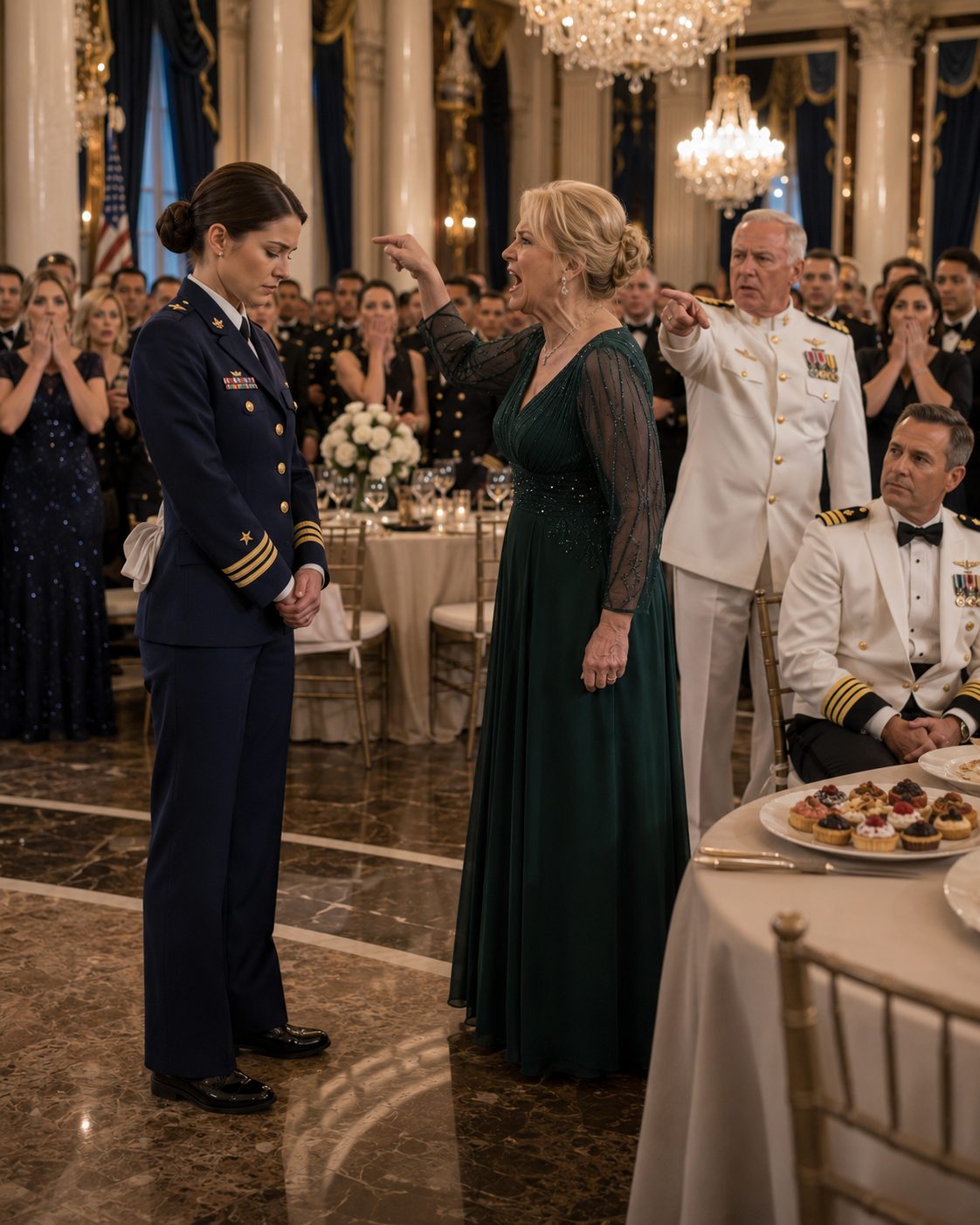
Nearly two hundred fifty Navy SEALs snapped around in perfect unison.
Every conversation died instantly.
Every chair stopped moving.
Every face turned toward the same place.
The back wall.
Toward the woman my own mother had pushed aside only minutes earlier.
What The Room Saw
I stood because that was the easiest thing to do.
Training takes over in moments like that. You don’t fidget. You don’t blink around like you’ve lost your car keys. You rise, shoulders back, chin level, and you let the room catch up.
The general’s face changed first.
Not softer. People always imagine that. It wasn’t softness. It was recognition, then annoyance, sharp and clean, like he’d just found a fire exit chained shut.
He crossed the ballroom straight toward me.
Not quickly. That would’ve made everyone else move too soon.
Just directly.
The chatter was gone now. All you could hear was silverware settling onto china and one idiot in the far corner dropping a glass. It didn’t break. I remember being vaguely irritated that it didn’t. A good shatter would’ve fit the mood.
When the general stopped in front of me, he saluted.
A full, crisp salute.
So I returned it.
Behind him, every eye in that room widened a fraction too late.
My mother made a small noise in her throat. Not a word. More like when somebody misses a step in the dark.
“Commander Bennett,” the general said.
He was loud enough for the room.
“Sir,” I answered.
He looked at the scorched plate on the little table beside me. Then at the folding chair tucked near the service door. Then back at me.
“Why,” he said, and now his voice had dropped, which was worse, “are you seated back here?”
I could feel my mother’s stare on the side of my face like heat off a bad engine.
“It’s my brother’s night, sir.”
That wasn’t an answer and he knew it.
His jaw did a little jump. He turned to one of the officers beside him, a captain named Hargrove, who I’d met three years earlier in Tampa during a very long week involving bad intel and no sleep.
“Who handled seating?”
Hargrove already looked sick.
“I’ll find out immediately, sir.”
“Do that.”
He stepped aside then, but not away from me. He was still making the whole room look at the ugly thing sitting in plain view.
My mother pushed back her chair so hard the legs shrieked over the floor.
“General,” she said, smiling too much, “I’m Cole’s mother. We didn’t realize there had been some confusion. My daughter works in an office, so we thought…”
He didn’t even turn his head all the way.
“I know exactly who your daughter is.”
That shut her up.
For a second.
Before Any Of This
People love to act shocked when a parent chooses a favorite.
Like it has to be subtle.
Like it has to hide itself in the wallpaper.
Mine didn’t.
She liked boys. That was the root of it. She liked easy stories, too, and my brother fit one better. Cole was handsome in the obvious way, broad smile, broad shoulders, football pictures in the hallway. I was the kid who corrected adults when they were wrong and read field manuals at twelve because my father brought one home and left it on the counter.
My mother called me difficult.
My father called me steady.
There’s your whole childhood in two sentences.
When Cole was ten, he forgot to feed our dog for two days and my mother laughed, said boys were scatterbrained. When I was ten, I got a B in algebra and she asked what was wrong with me.
When Cole dented my father’s truck, she blamed the rain.
When I won a statewide debate scholarship, she asked if there was prize money.
You can get used to anything if it starts early enough.
By seventeen I had a private rule: never bring good news home first. Let somebody else mention it. That way I got maybe three clean seconds before she found a way to bend it crooked.
Dad saw it. Of course he saw it.
One summer night, maybe two weeks before I left Annapolis, he found me in the garage wrapping plates in newspaper because my mother had announced that if I was going to “play sailor,” I could at least pack my own kitchen box for school.
He leaned against the freezer with a beer in his hand and watched me tape the box shut.
“You don’t owe anybody smallness,” he said.
I laughed because I was nineteen and thought I knew everything.
“That sounds like a bumper sticker.”
He took a drink. “Fine. Here’s a better one. If you spend your life asking your mother to see you plain, you’ll die tired.”
That one stayed.
Years later, after his heart gave out in a recliner during a Padres game, I found his old challenge coin tray in the garage. Dust on every last one of them. My mother had shoved it behind paint cans. She never liked reminders of him unless she was using him in a story about herself.
I took the tray home with me.
She noticed. Asked where it went.
I said, “Someplace it won’t be treated like junk.”
We didn’t speak for six months.
Best six months of that year.
The Part She Never Bothered Learning
My mother heard “executive officer” once and decided it meant filing calendars.
After that, nothing could move her.
She didn’t care that I’d graduated in the top slice of my Academy class. Didn’t care that I had surface warfare pins before some of the men she bragged about had learned how to lace boots. Didn’t care about deployments, command billets, task force planning, any of it.
To her, if I wasn’t kicking in doors on camera or giving a speech with a sword under an archway, I was a secretary.
Fine.
Let her think it.
But here’s what “desk work” looked like in my life.
It looked like eighteen-hour days in windowless rooms, tracking moving pieces across maps while twenty-year-olds with rifles trusted us not to get them killed by bad timing.
It looked like red folders hand-carried at 0400.
It looked like flights you couldn’t explain, names you couldn’t say at dinner, decisions that sat in your gut for years because the operation succeeded but one mother still got a folded flag.
It looked like answering to admirals who didn’t waste their time on decoration.
And yes, eventually, it looked like rank.
By the time of Cole’s ceremony, I was a commander with thirty-one years in, detailed to a joint assignment that required enough clearance to turn family conversations into comedy.
“What exactly do you do?” cousins would ask at Thanksgiving.
“I read emails,” I’d say.
It was easier.
Cole never asked much. That sounds cold but it isn’t. We weren’t close; we were parallel. Same house, same last name, two different weather systems.
He’d joined late, after drifting through jobs, a marriage that lasted thirteen months, and one disastrous landscaping company with his friend Brent who believed payroll taxes were a government suggestion.
When Cole finally found the Navy, my father was already gone.
My mother behaved like she’d personally invented service.
Every phone call became a campaign rally.
“Your brother’s doing real work now.”
Meaning mine wasn’t.
I let it slide because the truth was ugly in a way people don’t like. Cole had needed the Navy. I had built mine brick by brick. Those are different stories, and one of them gets more applause at family cookouts.
A Room Full Of Men Who Knew Better
The general, whose name was Merrick, had known me for twelve years.
Not socially. This wasn’t golf and Christmas cards.
We met in Bahrain when he was a one-star running a job that had gone sideways in three countries at once. I was the operations lead in a borrowed office with a broken air conditioner and a coffee maker that should’ve been put down humanely. We worked thirty-six hours almost straight. At some point, while everybody else kept throwing theories like darts, I laid out a sequence nobody wanted to hear because it meant admitting a source had been burned.
I was right.
A rescue team launched on the revised timeline.
Two men came home because of it.
Merrick never forgot that.
Men at that level remember the names attached to disaster, and they remember the names attached to the thing that kept disaster from getting bigger.
So when he looked at me in that ballroom, he wasn’t being theatrical. He was seeing an officer he’d pulled into rooms that mattered because she did not scare easy and did not bullshit him when the answer was bad.
He turned now and addressed the room.
“Some of you may not know Commander Nora Bennett,” he said.
Now my mother definitely made a sound.
Merrick kept going.
“That’s a failure of introduction, not of record.”
You could’ve snapped pool cues over the tension at the family table.
He spoke plainly. Mercifully plain.
He mentioned joint task forces. Theater planning. Commendations I hadn’t told anyone about, because why would I. He mentioned that I’d advised commands represented in that room. He mentioned two operations by year only, enough for people who knew to know.
That was the thing that changed the air.
The SEALs knew.
Not all the guests. Most civilians just heard military words and tried to assemble a ladder out of them.
But the operators. The instructors. The senior enlisted men. Their faces tightened because they understood the years he was talking around.
My mother looked from him to me and back again like she’d been dropped into a movie halfway through.
Cole finally turned fully in his seat.
He looked pale.
I don’t think he’d known either. Not really. Maybe pieces. Maybe rumors. But not the whole size of it.
Good.
The Second Turn
Hargrove came back with the banquet coordinator and one of the young lieutenant commanders assigned to the event.
They both looked ready to burst into flame.
“Sir,” Hargrove said, “Commander Bennett was originally assigned to the head table.”
Of course I was.
There had been a card there with my name on it. I’d seen it before my mother palmed it off the linen like a magician doing a cheap trick.
The coordinator cleared her throat. “Her seating was changed after a family member insisted there’d been an error.”
Merrick’s eyes slid to my mother.
Nobody helped her.
Not one person at that table.
It struck me then, weirdly, that my aunt had gone very still with her wineglass halfway up. She knew. Maybe she always knew. People in families know more than they admit because silence is cheaper.
My mother recovered enough to try indignation.
“There must be some misunderstanding,” she said. “I was protecting my son’s moment. She has a habit of making things about herself.”
That one almost made me laugh.
Merrick didn’t.
“Ma’am, if Commander Bennett wanted to make this about herself, none of us would be discussing your son at all.”
A few heads dropped. Real quick. Hiding smiles.
Then came the part I didn’t expect.
Cole stood up.
Chair scraping. Hands flat on the table.
“Mom,” he said.
I’ve heard him say that word a thousand times. Never like that.
He wasn’t loud. He didn’t need to be.
“Stop.”
She blinked at him.
He looked at me then, really looked, maybe for the first time in years without her voice sitting in his ear.
“You should’ve been up here,” he said.
I didn’t answer.
He swallowed. “Did Dad know?”
“Yes.”
That landed hard on him. You could see it.
Because if our father knew and respected what I’d become, then the story Cole had been fed his whole life wasn’t just unfair. It was fake. Cheap. Convenient. Built out of one woman’s need to keep one child above the other.
He sat down slowly and put his napkin beside his plate.
Not on it. Beside it.
Small thing. I remember small things.
Then he turned to the room’s senior master chief and said, “Permission to speak, Master Chief?”
The man gave one stiff nod.
Cole faced the room.
“My sister served longer than I’ve been alive as an adult,” he said, stumbling a little on the wording. “I didn’t know all of that. I should have. But I know enough now to say she belongs wherever the command intended her to sit.”
Not poetry.
Not polished.
Real enough.
My mother reached for his sleeve. He moved his arm away.
That did more damage to her than the general’s voice ever could.
My Father’s Coin
Merrick asked if I would join the head table.
I almost said no.
Not because I was humble. Let’s not dress it up. I said no in my head because I was tired, and because once people see the thing they’ve been blind to, they get embarrassing.
They overcorrect.
They want to clap.
Still, protocol is protocol, and refusing would’ve made a larger scene.
So I picked up my water glass, because leaving it there felt stupidly sad, and crossed the ballroom with every eye on me. One of the young candidates actually snapped to attention again as I passed him. Poor kid. Nearly knocked his own chair over.
At the head table, the lieutenant commander pulled out my chair with the panicked speed of a man trying to rewrite history in ten seconds.
My place card was still there.
“Commander Nora Bennett.”
Black script. Center seat, three down from the podium.
My mother had moved me from there to a folding chair by a service door and fed me scraps. The fact sat between my ribs with a cold little edge. Not new pain. Just old pain in a bright room.
Before I sat, I reached into my blazer pocket.
The crushed Navy ID was there, bent at one corner.
And behind it, because I carry odd things when I have a bad feeling, was one of my father’s challenge coins. Brass, worn smooth on one side. His old command crest almost rubbed away.
I set the coin on the table beside my plate.
Merrick glanced at it and said nothing. Which is why I liked him.
Across from me, Cole saw it.
He looked down fast. Then away. Then back.
After the speeches, after the certificates and handshakes and all the proud family camera business, he came over while guests were drifting toward dessert.
My mother was nowhere near us. Last I’d seen, she was near the exit talking too quickly to Aunt Janice, who had that pinched look people get when they’re being handed somebody else’s mess.
Cole stopped at my chair.
“I found Dad’s old sea bag when we cleaned out the garage,” he said.
“Okay.”
“He had clippings. About you. Promotions. One from Stars and Stripes. He kept them in a freezer bag.”
That hit harder than the general’s salute.
I stared at him.
Cole rubbed his thumb over the edge of his water glass. “Mom said he saved everything.”
“She lies a lot.”
A humorless little smile crossed his face.
“Yeah,” he said. “I think I’m getting up to speed on that.”
He took a breath.
“I let her do this. For years.”
I could’ve made him beg a little. I could’ve enjoyed that. Ugly thought. True one.
Instead I said, “You were her son. It was easier not to look.”
He nodded once like I’d sentenced him fairly.
Then he reached into his pocket and put something beside my father’s coin.
It was my original place card, the one my mother had handed me like trash.
He’d picked it up from the back table.
“I thought you should have this,” he said.
What She Did On The Way Out
You’d think that would’ve been the end of it.
Quiet humiliation. Lesson learned. Everybody goes home and pretends the weather changed.
No.
My mother came back.
Of course she did.
She caught me near the foyer while I was signing a program for one of the younger officers’ wives. I still don’t know why she wanted my signature. Maybe because she’d seen the room turn. That’s how people are. They smell gravity and want a souvenir.
My mother waited until the woman walked off.
Then she hissed, “You planned that.”
I almost admired it. The stamina.
“Planned what?”
“That man making a spectacle. Embarrassing your brother.”
I looked through the glass doors toward the dark parking lot. Wind bent the palms outside. Somewhere near the curb a shuttle bus was beeping in reverse.
“Your brother did fine tonight.”
She folded her arms. “You’ve always been jealous of him.”
There are moments when a person’s script becomes so absurd it stops reaching you. It just falls on the floor between your shoes.
I took out the damaged ID and held it up between two fingers.
She stared at it.
The scrape mark from her heel ran right across my photograph.
“You stepped on this this morning,” I said. “Do you remember?”
She didn’t answer.
“You saw what you wanted to see. Same as always.”
Her mouth tightened.
And because thirty-one years in uniform teaches you timing, and because my father was dead and done being polite for the both of us, I placed the ruined card in her hand.
“Keep it,” I said. “It’s the closest you’ve ever come to understanding who I am.”
Then I walked past her and out into the night.
Outside
The air off the water was cold enough to wake me up.
Guests were still spilling onto the curb in little clumps, laughing too loud, checking phones, arguing over where to eat after. Dress shoes clicked on concrete. A junior officer was trying to fold a stroller with one hand and salute with the other because Merrick had come outside. I spared him by stepping in the opposite direction.
Cole jogged after me before I reached the parking lot.
“Nora.”
I stopped.
He came up a little winded, which made me want to say, SEAL training, huh? I didn’t. Growth. Very mature of me.
He held out a set of keys. My mother’s pickup.
“Take it,” he said.
“What about her?”
“She can get a ride with Janice.”
I looked back toward the doors. My mother was still inside, rigid and furious, the damaged ID clutched in her hand like it might explain itself if she squeezed hard enough.
“You sure?” I asked.
Cole shoved the keys a little closer. “Yeah.”
I took them.
He stood there with his hands on his hips, staring at the asphalt. Then he said, “Was he proud of me too?”
Not what I expected.
Not apology. Not defense.
That.
I thought about lying. Quick comfort. But he’d had enough lies for one family.
“He wanted you to finish something,” I said. “He wanted you to stand on your own feet. He was worried she never let you.”
Cole looked at the ground for a long second.
Then he nodded.
“Fair.”
A shuttle hissed at the curb. Somebody in the distance yelled for Brent, which told me at least one disastrous landscaping friendship had survived.
Cole looked up.
“I don’t know how to fix…” He gestured vaguely between us, the building, maybe our whole last name.
“You don’t fix thirty years in a parking lot.”
“Yeah.”
Another nod.
Then, awkward and real, he tapped the coin still visible in my hand.
“Keep telling me about Dad sometime?”
“Maybe.”
That was enough for him. Enough for me too.
I got in the pickup, adjusted the seat back from my mother’s impossible position, and set my father’s coin in the cup holder. When I pulled away, Cole was still standing under the floodlights in his dress whites, not waving, just watching the truck go.
In the rearview mirror, the hall doors opened.
My mother stepped out.
And for once in her life, nobody was waiting for her.
If this stayed with you, send it to somebody who’d get it. Some stories don’t leave easy.
For more stories about family drama and unexpected twists, you might appreciate reading about when a daughter-in-law’s peculiar habit raised alarms or the shock of a flash drive revealing a secret. And if you’re curious about another tale of familial betrayal, check out what happened the day a father threw his child out.