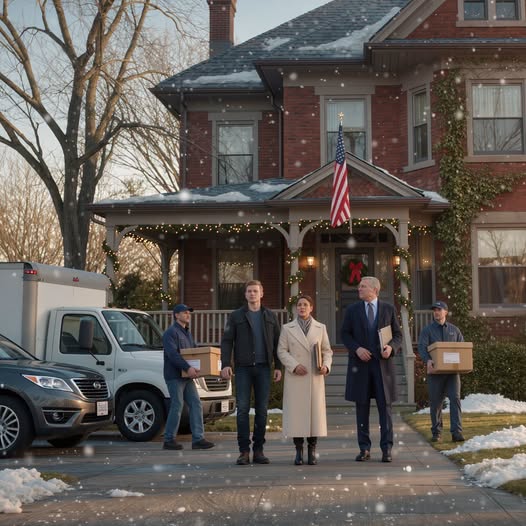

When I Inherited My Grandparents’ $920k Estate, I Quietly Moved It Into A Trust – Just In Case. Last Week, My Brother Showed Up With Mом, Grinning, ‘We Had The House Signed Into My Name – You’re Out By Friday.’ I Just Smiled And Said, ‘You Really Think I’d Let That Happen?’ Two Days Later, They Returned With Movers… And Froze When
They Saw Who Was Standing On The Porch, Holding The Folder.
I used to be the quiet one. The peacekeeper. The daughter who cleaned up messes and kept the family group chat from exploding. Then my grandparents’ will put a $920,000 estate—and a red-brick Victorian that had outlived three generations—entirely in my name. I didn’t move in. I moved smart. I appraised everything, hired counsel, and placed the deed, savings, and shares inside an irrevocable trust I control. Utilities shifted to an entity. Public records turned into a dead end. On the outside, nothing changed. On the inside, everything did.
My brother, Tyler—the charming hurricane—started posting “big changes coming.” My mother began dropping comments about “fairness” and “family obligations.” I said nothing. I listened. I waited.
Weeks later, the driveway filled with a rental truck and my mother’s SUV. Tyler hopped out in sunglasses, grinning like he’d just won a prize, waving a folded document. Two movers trailed behind him up the walk as if this were a delivery instead of a takeover. My mother smiled too widely, a clipboard pressed to her chest. “Good news,” she said, syrupy-sweet. “A lawyer explained the will wasn’t properly updated, so the title’s already been transferred. Don’t take it personally. You’ll be out by Friday.”
I didn’t argue. I didn’t cry. I just stepped onto the porch beside a man in a navy suit who carried a thick folder and looked like he’d seen this exact performance a hundred times. The movers froze. Tyler’s grin twitched. Somewhere in the ivy, a late afternoon breeze rattled the old oak door.
The man in the suit cleared his throat. “Are you Tyler Green?”
For the first time all afternoon, nobody spoke. My mother’s fingers tightened on her clipboard. One of the movers took a step back. Tyler’s smirk faltered, the way a wave collapses when it hits rock.
What came next didn’t involve raised voices. It involved facts. Dates. Signatures. And a sentence that turned the entire scene on its head.
“This property cannot be transferred to you,” the man said, opening the folder. “Because it does not belong to your sister personally anymore. It belongs to the Whitmore Family Preservation Trust.”
Tyler blinked once.
My mother’s smile fell away completely.
“What trust?” she asked.
The man looked at her with polite patience. “The trust your daughter created three days after probate closed. The trust recorded the deed, secured the assets, and gave my office authority to prevent unauthorized occupation, fraudulent transfer attempts, and asset interference.”
Tyler let out a laugh that sounded too loud. “That’s cute. A trust. Fine. Then she can sign it over.”
“She cannot,” the man replied. “That is what irrevocable means.”
The movers looked at each other. One of them slowly lowered the dolly.
My mother turned toward me. “Lena, what did you do?”
I looked at her clipboard. Then at Tyler’s folded document. Then at the house behind me—the porch swing Grandpa had fixed with his own hands, the stained-glass transom Grandma cleaned every Friday, the red-brick walls that still held the smell of lemon oil and old books.
“I protected what they left me.”
Tyler’s mouth tightened. “They left it to the family.”
“No,” I said. “They left it to me.”
Mom inhaled sharply, as if the words were disrespectful simply because they were true. “Your grandparents loved all of us.”
“They did,” I said. “And they knew all of us.”
The man in the suit—Mr. Nolan Pierce, trust attorney and co-trustee—removed a page from the folder and held it up. “For clarity, this is the recorded trust deed. This is the certificate of trust. And this is the county’s confirmation that no valid transfer to Tyler Green has occurred.”
Tyler shoved his document toward him. “Then explain this.”
Mr. Pierce did not take it immediately. He put on his glasses first, the slow way people do when they already know they are about to read nonsense dressed as law. Then he accepted the paper.
Mom watched him like she was waiting for a miracle.
I watched Tyler.
He was still trying to perform confidence, but his thumb rubbed the edge of his sunglasses over and over. That was his tell. When we were kids, he did the same thing with baseball cards after breaking something and blaming me.
Mr. Pierce’s expression did not change as he read.
Then he said, “Who prepared this?”
Tyler lifted his chin. “A lawyer.”
“What is the lawyer’s name?”
Tyler hesitated.
Mom stepped in quickly. “A property specialist. He said the estate had been mishandled. He said Lena used grief to isolate the assets.”
Mr. Pierce looked at her. “That is not a name.”
The movers shifted again. One of them, a broad man with a tattoo on his forearm, said, “Sir, we were told this was a legal move-in.”
“It isn’t,” Mr. Pierce said. “And if you remove anything from the house, you may become part of an investigation.”
That did it.
The mover took another step back from the porch. “We’re not touching anything until this is sorted.”
Tyler spun toward him. “I paid you.”
“You paid for a move,” the man said. “Not a charge.”
Tyler’s face darkened.
I almost felt sorry for him.
Almost.
Then I saw the rental truck doors open behind him, and inside were empty boxes labeled in black marker: Dining Room China, Master Bedroom, Estate Office, Silverware.
He hadn’t come to move in.
He had come to empty the house.
My stomach tightened so hard I had to press one hand against the porch rail.
Mom followed my gaze and went still for half a second. Half a second was enough.
“You knew,” I said.
She looked back at me too quickly. “Knew what?”
“You knew he wasn’t just moving in.”
Her face went smooth. Too smooth.
“Don’t start inventing things.”
Mr. Pierce turned to the truck. “Ms. Green, did you authorize removal of estate contents?”
“No.”
He looked at the labeled boxes. Then at Tyler. “Mr. Green, I strongly suggest you close that truck.”
Tyler took a step toward me instead. “You’re really going to do this? Hide behind some trust and some lawyer while Mom is standing right here?”
I laughed quietly.
It surprised both of us.
For thirty-four years, Mom had been his shield. If Tyler crashed a car, Mom reminded us he was stressed. If Tyler borrowed money and didn’t repay it, Mom said he was rebuilding. If Tyler screamed, Mom said he felt things deeply. If I said no, Mom said I was cold.
Now he had brought her to a porch like a legal document with a pulse.
“I’m not hiding behind anyone,” I said. “I’m standing in front of the house with the deed behind me.”
His eyes narrowed. “Grandpa would be ashamed of you.”
That one almost landed.
Almost.
Then Mr. Pierce opened another envelope.
“Actually,” he said, “your grandfather anticipated that exact sentence.”
The porch went silent.
Mom’s face changed first.
Not confusion.
Fear.
Mr. Pierce removed a folded letter from the envelope. The paper was thick, cream-colored, with Grandpa’s steady handwriting across the front.
For Lena, if they come for the house.
My throat closed.
Tyler looked at Mom.
Mom looked away.
“You’ve seen this?” I asked.
She didn’t answer.
Mr. Pierce glanced at me. “Your grandparents left conditional letters with my predecessor. This one was to be released only if a family member attempted to pressure, contest, or misappropriate the estate.”
Tyler scoffed. “That’s ridiculous.”
Mr. Pierce unfolded the letter.
He began reading.
Lena, if you are hearing this, then someone has decided that your quietness means weakness. I am sorry we left you a gift that also became a burden. Your grandmother and I knew there would be anger. We also knew why we chose you.
Mom’s lips trembled.
Tyler’s face flushed.
The letter continued.
This house is not a prize for the loudest person in the family. It is not compensation for Tyler’s mistakes. It is not your mother’s emotional bargaining chip. It is the home you protected when no one else noticed it needed protecting.
My eyes filled so fast the porch blurred.
I remembered Grandpa in his recliner, asking me to check the basement after heavy rains. Grandma calling me when the boiler made a sound she didn’t trust. Me driving over after work with groceries, medicine, clean sheets, and no expectation that anyone would ever call it inheritance.
I had thought they didn’t see.
They had seen everything.
Mr. Pierce read the next line, and that was when my mother truly paled.
Marianne, if you are present, do not tell Lena that fairness means surrender. You asked us twice to “balance things out” for Tyler before we died. We refused then. We refuse now.
Mom whispered, “No.”
Tyler turned to her. “What does that mean?”
She shook her head. “They misunderstood.”
Mr. Pierce looked at her over the page. “Mrs. Green, would you like me to continue?”
She said nothing.
He continued anyway.
Tyler has been helped many times. Quietly. Extensively. More than he knows and more than he deserved at moments when he confused love with rescue. Lena has never asked for rescue. She has asked for instructions, grocery lists, medical forms, and whether the porch light still works.
My brother’s mouth opened, but no sound came out.
The first revelation was not that my grandparents had left me the estate. I knew that.
The revelation was that they had left a record of why.
And that record did not flatter anyone but the truth.
Tyler snatched the letter from Mr. Pierce’s hand.
Deputy Harris, who had been standing near the walkway so quietly I almost forgot he was there, stepped forward.
“Sir.”
Tyler froze with the paper in his fist.
Mr. Pierce held out his hand. “That is not yours.”
Tyler’s breathing was hard now. He looked like a boy caught with stolen Halloween candy and a man deciding whether to double down at the same time.
Finally, he threw the letter back at Mr. Pierce.
“This is manipulation,” he snapped. “Dead people can’t know what’s fair now.”
“No,” I said. “But living people can know what theft looks like.”
His head turned toward me.
There it was.
The rage under the charm.
“Careful, Lena.”
I stepped down one porch step.
“No. I was careful when I put everything in trust. I was careful when I changed the utilities. I was careful when you started posting about big changes. I was careful when Mom asked if the upstairs bedrooms still had original locks. I was careful when I installed cameras after the back gate was opened twice.”
Mom’s eyes widened.
Tyler looked at the ivy.
He hadn’t known about the cameras either.
I pulled out my phone and opened a still image.
Tyler at the side gate, two nights earlier, testing the lock with one hand while holding his phone flashlight in the other.
Then another.
Mom standing at the front window, peering through the lace curtains after I had already told her I wasn’t home.
Then another.
Tyler lifting a rock near the potting shed, checking beneath it for the spare key Grandma had kept there fifteen years ago.
I turned the screen toward them.
“Did you find what you were looking for?”
Mom took a step back.
Tyler’s jaw worked.
Deputy Harris asked, “Were either of you on the property without permission?”
Mom’s voice shook. “It’s my parents’ house.”
“Was,” Mr. Pierce said.
That single word landed harder than any lecture could have.
Was.
Mom looked toward the house then, not like a daughter grieving, but like someone realizing a door she had always assumed would open was now locked from the inside.
Tyler tried one more angle.
“Fine. You want legal? Let’s do legal. We have a claim. Mom has a claim. You influenced them when they were old. Everyone knows you were always over there, whispering in their ears.”
That one hurt because it was the lie I had feared from the beginning.
I had been there because they needed help.
He was about to turn that into evidence against me.
Mr. Pierce slipped another document from the folder.
“Your grandparents also anticipated that accusation.”
Tyler’s face faltered.
Mr. Pierce handed copies to Deputy Harris and then to me. “Two independent capacity evaluations. One from their primary physician, one from a court-approved geriatric specialist. Both completed within ninety days of the trust update. Both confirm sound mind, no undue influence, and clear understanding of the estate plan.”
Mom stared at the papers.
“They did this without telling me?”
I looked at her.
“They probably knew what would happen if they did.”
Her eyes filled with tears. “I was their daughter.”
“And I was their granddaughter,” I said. “The one you wanted them to use as a backup plan for Tyler.”
She flinched.
For once, she did not deny it.
That was the small silence that confirmed years of family math.
Tyler cursed and turned toward the movers. “We’re leaving.”
“No,” Mr. Pierce said.
Tyler spun back. “Excuse me?”
“You arrived with forged or fraudulent documents, attempted to initiate an unauthorized move into trust property, and brought movers for removal of labeled estate contents. You are not leaving until Deputy Harris has the information he needs.”
The movers immediately raised their hands like they wanted their innocence visible from space.
“We didn’t know,” the lead mover said. “We were given an address and told Mr. Green owned it.”
Deputy Harris nodded. “You’ll provide your invoice and communications.”
Tyler laughed in disbelief. “You’re treating me like a criminal?”
Deputy Harris looked at the truck. “I’m treating this like something that needs a report.”
The second revelation came from the clipboard in Mom’s hands.
Maybe she loosened her grip because her fingers were shaking. Maybe the wind helped. Either way, the top page flipped over, and I saw my own name printed beside a line that said Voluntary Occupancy Release.
I moved before she could hide it.
“What is that?”
Mom pulled the clipboard to her chest. “Nothing.”
I reached for it.
She stepped back.
Deputy Harris’s voice sharpened. “Mrs. Green.”
Mom looked trapped.
Slowly, she handed the clipboard to him.
He read the first page, then the second, then looked at Mr. Pierce.
“Mr. Green, did you expect your sister to sign this today?”
Tyler said nothing.
Mr. Pierce accepted the document and his face hardened. “This states that Lena voluntarily authorizes Tyler Green to occupy the residence as managing family member and waives objections to removal of furnishings for ‘inventory protection.’”
My stomach went cold.
They hadn’t just planned to push me out.
They had planned to make me sign proof that I had agreed.
Mom whispered, “We were going to explain it gently.”
I looked at her.
“Gently?”
Her tears spilled over. “You get overwhelmed. Tyler thought if everything was already in motion, you’d understand that fighting would only make it harder.”
The old version of me would have gone numb.
The old version would have heard Mom’s trembling voice and wondered if maybe I was being cruel. Maybe family was complicated. Maybe I could let them stay in the guesthouse. Maybe I could give Tyler cash instead. Maybe peace was worth more than a house.
But the porch beneath me belonged to a trust built from my first clear no.
And behind me was Grandpa’s letter.
I looked at Mom and finally said what I had never been allowed to say at Christmas dinners, hospital rooms, birthdays, emergency loans, or every quiet moment after Tyler made a mess.
“You don’t protect me from being overwhelmed. You create the crisis and then offer obedience as the cure.”
Mom’s face collapsed.
Tyler snapped, “Oh, spare us.”
I turned to him. “No. I spared you for years.”
He stopped.
“I spared you when you borrowed from Grandma and called it investing. I spared you when Grandpa paid your credit cards after you cried in the garage. I spared you when Mom asked me not to mention the missing silver because you were ‘in a dark place.’ I spared you when you sold Grandma’s antique lamp online and told everyone it had cracked in storage.”
Mom gasped.
Tyler’s eyes widened with real panic now.
Mr. Pierce looked at me. “You have documentation?”
I smiled sadly.
“Yes.”
Because I used to be the quiet one.
And quiet people hear everything.
I went inside and returned with a binder I had kept in the estate office, not because I planned revenge, but because something in me had known peace without proof was just another trap.
Receipts. Screenshots. Texts. Photos. Bank transfers. The online listing for Grandma’s lamp. Messages from Tyler saying, Don’t tell Mom, I’ll replace it before she notices.
Mom stared at the binder like it had crawled out of the floor.
“You kept all this?”
“Yes.”
“Why?”
“Because every time I told the truth without proof, you called it an attitude.”
The lead mover whispered, “Damn,” under his breath.
Tyler pointed at me. “You’re sick.”
“No,” I said. “I’m done being unbelievable.”
Deputy Harris took the documents related to the current incident. Mr. Pierce took copies of the rest. The movers closed the truck without loading a single thing. Tyler spent twenty minutes answering questions badly, contradicting himself twice and blaming Mom once.
That was the moment something in her finally cracked.
“Tyler,” she said, stunned. “You told me the lawyer said this was valid.”
He glared at her. “You wanted the house handled too.”
“I wanted fairness.”
“No,” I said quietly. “You wanted not to say no to him.”
Mom turned toward me, wounded.
But she knew.
So did I.
Deputy Harris issued formal trespass notices for Tyler and documented Mom’s role separately. Mr. Pierce served them both with written notice that any further interference with trust property would trigger immediate civil action.
Tyler tore his copy in half.
Deputy Harris simply took a photo of the torn notice and said, “Acknowledgment received.”
For some reason, that almost made me laugh.
Mom stood near the driveway while Tyler climbed into the rental truck, slamming the door hard enough to shake the side mirror. She did not get into her SUV right away.
She looked at the house.
Then at me.
“I thought your grandparents would have wanted us to stay connected.”
I held Grandpa’s letter against my chest.
“They did. But they didn’t want me looted to make it happen.”
She closed her eyes.
“I don’t know how to fix this.”
For the first time, she sounded like someone telling the truth.
I wanted to soften.
I wanted to say something kind enough to make the porch less brutal.
But kindness had been used against me too many times to be automatic.
“You can start,” I said, “by not asking me to fix Tyler.”
She nodded slowly.
Then she left.
The house was quiet after the vehicles disappeared.
Not peaceful exactly.
Quiet in the way a battlefield is quiet after the noise stops, when the damage is still everywhere and the air has not yet decided what to become.
Mr. Pierce stayed while I locked the side gate, checked the windows, and walked through every room. The red-brick Victorian smelled like old wood, dust, and lemon oil. Sunlight moved across the staircase where Grandma once sat with a crossword puzzle. In the dining room, the china cabinet stood untouched, full of plates Tyler’s boxes had already labeled in his mind.
I pressed my palm against the cabinet glass.
“I almost let them,” I whispered.
Mr. Pierce stood behind me, respectful and silent.
“I know,” I said, though he had not asked anything. “I did the trust. I did the paperwork. I changed the records. But part of me still thought maybe I was overreacting.”
He said, “People raised to doubt their boundaries often need paperwork before they trust their own discomfort.”
That sentence stayed with me.
Over the next weeks, the attempted transfer unraveled fully.
The “lawyer” Tyler mentioned was not a lawyer at all, but a disgraced title agent who had once helped him refinance a truck. The document he waved around in the driveway was a fake quitclaim draft, never validly recorded, built from an old scanned signature of mine taken from a family medical form.
A medical form Mom had forwarded to Tyler.
When Mr. Pierce told me that, I sat in the estate office and stared at the wallpaper for a long time.
The betrayal was not only in the act.
It was in the supply chain.
Mom had handed him the paper without asking what he needed it for because, deep down, Tyler needing something had always been reason enough.
The trust filed a civil complaint. Tyler’s attempt to use forged transfer documents triggered a criminal investigation. The movers cooperated. The title office flagged the names. The county recorder added an alert to the property.
Tyler stopped posting “big changes coming.”
Then he started posting quotes about greed.
I blocked him.
Mom called once a day for a week. I did not answer. Then she started leaving voicemails. Some were defensive. Some were tearful. Some were old performances in new costumes.
Finally, one was different.
“I gave him your medical form,” she said. Her voice sounded raw. “He said he needed to compare signatures because you were making things confusing with the trust. I didn’t ask enough. No. That’s not true. I didn’t want to ask. Asking would have meant saying no if the answer was bad.”
I sat at the kitchen table while the voicemail played.
Grandma’s yellow curtains moved slightly in the window.
Mom continued, “I am not asking you to forgive me. I am telling you because I have lied to myself long enough. Your grandparents trusted you because you knew how to care for things without consuming them. I confused need with entitlement. I did that to you. I’m sorry.”
The message ended.
I did not call back.
But I saved it.
Not as evidence.
As the first apology that did not arrive with an invoice.
The strongest moment came three months later, at the final civil hearing.
Tyler looked smaller in court. Not humble. Just less cinematic without sunglasses, a rental truck, and Mom beside him. He had a public defender for the criminal matter and a separate attorney for the civil complaint, a tired man who seemed to regret every minute of the case.
Mom came alone and sat behind me.
Not beside Tyler.
Behind me.
I felt her there before I saw her.
Mr. Pierce presented the trust documents, the video from the driveway, the forged release, the attempted signature match, the movers’ statements, and Grandpa’s letter only where relevant. The judge, a woman with silver hair and a face that gave nothing away, listened without interruption.
Tyler’s attorney argued confusion. Family misunderstanding. Grief. Poor communication.
The judge looked at Tyler.
“Mr. Green, did you believe you owned the property?”
Tyler hesitated.
His attorney whispered something.
Tyler’s face tightened.
“No.”
The word was quiet.
But it filled the room.
“Did you present yourself to movers as the owner?”
“Yes.”
“Did you intend to move into the property?”
“Yes.”
“Did you intend to remove contents?”
He looked at me.
For one second, I saw the brother who once taught me to ride a bike by pushing too hard and laughing when I fell. The brother who stole Halloween candy from my pillowcase, then gave me one piece back and expected gratitude. The brother who had been forgiven so many times he believed forgiveness was part of his inheritance.
“Yes,” he said.
Mom began crying behind me.
The judge ordered damages, legal fees, a permanent injunction, and referred the forgery issues to continue through the appropriate criminal process. Tyler was barred from the property, the trust assets, and any attempt to represent himself as connected to estate management.
Then the judge looked at me.
“Ms. Green, anything you want to add?”
I stood.
My knees shook, but my voice did not.
“My grandparents left me a house. My family treated that as a problem to solve. I want the record to reflect that I did not steal from them by accepting what was given to me. I did not betray them by protecting it. And I am not responsible for making an unfair story feel fair to the people who benefited from it.”
The judge nodded.
“So reflected.”
That was all.
No dramatic music.
No collapse.
Just a sentence entering the record where gaslighting used to live.
Outside the courthouse, Mom approached me.
Mr. Pierce stayed close but did not interfere.
“I’m proud of you,” she said.
The words hit a place I wished they no longer could.
I looked at her.
“Don’t use pride to skip accountability.”
She nodded immediately.
“I know.”
Maybe she did.
Maybe she was learning.
“I’ve started therapy,” she said.
I almost smiled. “Good.”
“And I told Tyler he can’t stay with me unless he follows the court orders.”
That was new.
“What did he say?”
“That you turned me against him.”
“Did you believe him?”
She looked tired.
“No.”
That one word did not fix us.
But it mattered.
I said, “I’m not ready to have you in the house.”
Her eyes filled, but she nodded again. “I understand.”
I believed that maybe, for the first time, she actually did.
The red-brick Victorian became mine slowly after that. Not legally—that had already been true. Emotionally. Room by room.
I cleaned the attic and found Grandma’s wedding gloves wrapped in tissue. I repaired the porch swing. I turned Grandpa’s study into my office but kept his old lamp on the desk. I hired a gardener to save the roses Mom had assumed would be dug up when Tyler “modernized” the yard.
One afternoon, I found a small note tucked behind a drawer in the kitchen.
Grandma’s handwriting.
Lena likes the house quiet. She listens before she speaks. People like that should inherit old walls. They know what walls remember.
I sat on the kitchen floor and cried.
Not because I was sad.
Because I was finally believed by people who were no longer alive to say it out loud.
A year after the driveway scene, I hosted dinner in the Victorian for the first time. Not for the whole family. Not for Tyler. Not yet, maybe not ever. I invited Mr. Pierce and his wife, my friend Anika, two neighbors, and Mom.
I almost didn’t invite her.
Then I did, with rules.
No Tyler.
No comments about fairness.
No rearranging the kitchen.
She arrived with flowers and stood on the porch waiting to be let in.
That mattered too.
During dinner, she asked before opening a cabinet. She complimented Grandma’s curtains without saying what she would have done differently. When Anika asked about the trust, Mom looked at me and said, “Lena was smart to protect the estate.”
The room went quiet for just a moment.
I looked at her.
She looked back.
No performance.
No tears.
Just the truth, arriving late but dressed correctly.
After everyone left, I stood on the porch with a cup of tea. The old oak door was locked behind me. The ivy moved softly against the brick. No rental truck in the driveway. No boxes labeled for theft. No one telling me I had until Friday to leave what was mine.
My phone buzzed.
A message from Tyler.
You got what you wanted. Hope it was worth losing your brother.
I looked at it for a long time.
Then I typed back:
I did not lose you when I protected the house. I lost you every time you thought taking from me still counted as family.
I blocked the number before he could answer.
Then I sat on the porch swing Grandpa had fixed and let the quiet settle around me.
For years, I thought peace meant preventing explosions. Answering softly. Paying quietly. Letting Tyler have one more chance because Mom’s face crumpled when I said no.
Now I understood peace differently.
Peace was a recorded deed.
A locked door.
A trust that did not bend under guilt.
A mother waiting to be invited.
A brother learning that blood does not grant access to what love was supposed to protect.
My grandparents had not left me the estate because I was the quiet one.
They left it because, in a family that mistook noise for need, I had learned how to hear what was worth saving.
And this time, when someone came for my home with movers, forged papers, and my mother’s approval, the house did not become a battlefield.
It became a witness.
And the witness had my name on the deed.