
My name is Hannah. I’m 26.
I enlisted when I was 21, right after a screaming fight with my mother about my “wasted potential.”
I served four years overseas. Two deployments. A commendation I never got to show anyone.
My younger sister, Lila, was the only one I wrote to. She was 15 when I left, and her letters were the only mail I got.
Then, about a year in, her letters stopped.
I told myself she was busy. A teenager. Life moves on.
Something felt off, but I couldn’t place it from across the world.
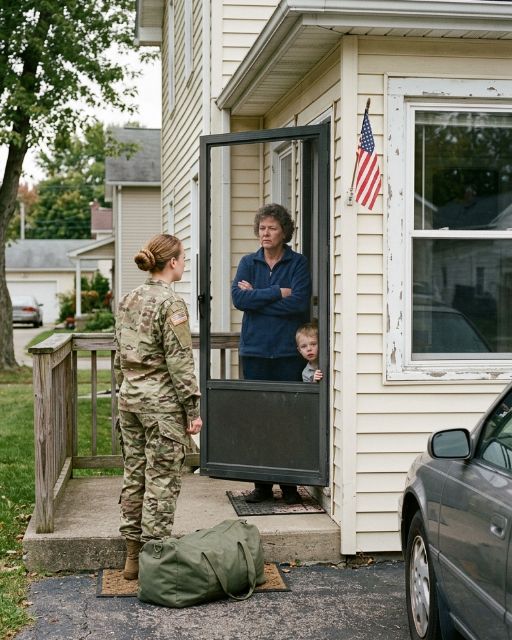
When my service ended, I flew home in uniform, duffel bag on my shoulder, and walked up the driveway of the house I grew up in.
My mother opened the door, looked me dead in the face, and slammed it shut.
I knocked again. I heard her on the phone inside.
“There’s a woman in army clothes trying to break in,” she said. “I don’t know her.”
I froze.
Then I heard footsteps behind me – a neighbor, Mr. Hollis, walking his dog. He stared at me like he’d seen a ghost.
“Hannah?” he whispered. “But your mother said you were locked up in Marysville.”
That’s when it hit me.
For four years, she had told this entire town I was a CRIMINAL.
The police arrived. I showed them my ID, my discharge papers, my service record.
The officer looked at my mother through the screen door and asked, “Ma’am, why did you say you didn’t know her?”
She wouldn’t answer.
But behind her, in the dim hallway, I saw a small figure peek out.
A little boy. Maybe three years old.
He had my eyes. My exact eyes.
And then I noticed the framed photo on the wall behind him – a photo of Lila, holding him as a newborn, with a date stamped in the corner.
A date from when she was 16.
My duffel bag hit the porch.
“Mom,” I said slowly, “WHOSE BABY IS THAT?”
She finally looked at me.
And what she whispered next made my blood run cold –
“She left him. Just like you left us.”
The words hung in the humid Ohio air, colder than any winter I’d ever known.
It was a classic move. A tactical strike designed to wound and disable. My mother was a master of it.
The police officer, a young guy with a confused look on his face, cleared his throat. “Ma’am, is this your daughter?”
My mother just stared at me, her eyes daring me to contradict her, to make a scene, to prove I was the unstable person she’d painted me to be.
The little boy toddled forward and pressed his face against the screen door, his tiny fingers curling in the mesh. He looked right at me, a silent, questioning gaze. He had Lila’s soft brown hair.
My heart didn’t just break; it detonated.
“I think you should go, Hannah,” my mother said, her voice regaining its icy composure. “There’s nothing for you here.”
She closed the inner door, leaving me on the porch with two confused cops and the ghost of my family. Mr. Hollis was still standing on his lawn, pretending to fiddle with his dog’s leash but watching the whole disaster unfold.
“Miss, do you have somewhere to go?” the older officer asked, his tone shifting from suspicion to pity.
I just shook my head, my throat too tight to speak. Four years of discipline, of holding it together under fire, and a single sentence from my mother had completely disarmed me.
My duffel bag felt like it weighed a thousand pounds. It held everything I owned, everything I’d earned. And none of it mattered.
Mr. Hollis finally shuffled over, his old dog trailing beside him. “She can stay with us,” he said, his voice surprisingly firm. “Martha will make up the guest room. Come on, child.”
I looked from my childhood home, now a fortress I couldn’t breach, to the kind, wrinkled face of my neighbor. The man who thought I was a convict minutes ago was offering me a bed.
I let him lead me away, the image of that little boy’s face burned into my mind. I didn’t even know his name.
Martha Hollis fussed over me like I was her own, offering me sweet tea and a plate of cookies I couldn’t touch. I sat on their floral sofa, still in my uniform, feeling like an alien.
“Your mother… she has her own way of seeing things, Hannah,” Mr. Hollis said gently, sitting in his worn armchair.
“She told you I was in prison,” I stated, the words tasting like ash.
“She said there was an incident,” he corrected softly. “That you got in with a bad crowd. We all felt terrible for her and your father.”
My father. I hadn’t even thought to ask about him. “Where is my dad?”
“Still at the plant. Works the late shift now. He… he doesn’t talk much these days,” Martha added, her hands twisting a dish towel.
The whole town had a story, a neat and tidy narrative to explain my absence. Meanwhile, the real story, the one involving a teenage mother and a secret baby, was hidden behind my parents’ front door.
That night, I lay awake in a stranger’s guest room, the scent of lavender and mothballs filling the air. My mission, the one I hadn’t asked for, was clear. Find Lila. Find the truth.
The next morning, I traded my uniform for jeans and a t-shirt. I felt exposed without it, just another person in a town that thought they knew me. My first stop was the house. I had to try again.
I walked up the driveway, my stomach in knots. My father’s truck was there. He was home.
I knocked. This time, he answered.
He looked older. The laugh lines around his eyes had deepened into grooves of worry. He saw me and his face crumpled.
“Hannah,” he breathed, stepping outside and pulling the door shut behind him. He didn’t hug me.
“Dad, what is going on? Where is Lila?”
He wouldn’t meet my eyes, focusing instead on a crack in the driveway. “Your mother thinks it’s for the best.”
“Best for who?” I demanded, my voice rising. “Lying to an entire town? Hiding my own nephew from me? Where is my sister?”
“She’s… away,” he mumbled. “She needed a fresh start.”
“Away where? Give me a phone number. An address. Anything.”
“I can’t, Hannah. Please don’t ask me to.” He looked trapped, a man caught between two impossible choices. His loyalty had been chosen for him.
“And the little boy?” I pressed. “His name. What is his name?”
He finally looked at me, his eyes filled with a profound sadness. “His name is Theo. And he thinks they’re his parents.”
The final piece of the cruelty slotted into place. They weren’t just hiding him; they were stealing him. Stealing his story, his mother, his whole identity.
I knew then that I couldn’t get through to my father. My mother’s influence was a fortress wall he was unwilling, or unable, to breach.
I backed away, shaking my head. “You both have to live with this,” I whispered, and turned my back on him. I had to find a different way in.
My new plan was to find Lila’s friends. Someone had to know something. I remembered a name from her letters: a girl named Rachel, her best friend since kindergarten.
I found the address in an old phone book at the Hollis’s house. Rachel’s family lived on the other side of town. When I knocked on the door, a woman with kind eyes and familiar brown hair answered. It was Rachel.
She stared at me for a long moment, her jaw slack. “Hannah? Oh my god. We all thought…”
“I was in prison. I know,” I finished for her. “Can I come in? I need to ask you about Lila.”
Her expression clouded over immediately. She ushered me inside, away from the prying eyes of neighbors.
“My mom hasn’t let me talk to her in years,” Rachel said, her voice low and tense. “Not since… you know.”
“Since she got pregnant?”
Rachel nodded, chewing on her lip. “Your mom told everyone Lila was going to live with an aunt in California to finish school. She told my mom I was a bad influence and that I wasn’t allowed to contact her. She said Lila needed to focus.”
The web of lies was more intricate than I had imagined. A different lie for every audience, all designed to isolate and control.
“Did you ever hear from her, Rachel? After she left?”
She hesitated, glancing toward her own mother who was watching from the kitchen. She shook her head no, but her eyes told a different story.
I took a gamble. I pulled out a pen and a napkin from my pocket. “If you happen to ‘remember’ anything, this is my number. I’m staying with the Hollises. I just want to know if she’s okay.”
I left without pushing further. An hour later, my phone buzzed. A text from an unknown number.
It was an address. One town over, in a town called Westerville. Underneath the address were three words: “She works here.”
The place was a small, dusty bookstore called ‘The Turning Page.’ My heart was pounding so hard I could feel it in my ears. I pushed the door open, a tiny bell announcing my arrival.
And there she was.
She was behind the counter, a little older, her face a little thinner, but it was her. It was Lila.
She looked up, a polite customer service smile on her face that froze when she saw me. Tears welled in her eyes instantly.
“Hannah?” she whispered, her voice cracking.
I couldn’t speak. I just walked toward her, and we met at the end of the counter, holding onto each other like we were drowning.
“I thought I’d never see you again,” she sobbed into my shoulder. “Mom said you’d disowned us.”
Another lie. Another wound.
We sat in the bookstore’s back room for hours, surrounded by the smell of old paper and ink. And she told me everything.
She hadn’t just gotten pregnant. The father was a boy from a wealthy family in the next county, named Daniel. They had been in love. When they found out she was pregnant, they were scared, but Daniel wanted to do the right thing. He told his parents. He wanted to support Lila and the baby.
That’s when my mother intervened.
“She told me Daniel and his family wanted nothing to do with me,” Lila said, wiping her eyes. “She said they thought I was trash and that they would pay for an abortion. When I refused, she said I had shamed the family.”
My mother had orchestrated a meeting with Daniel’s parents. She told them Lila was emotionally unstable and had decided to give the baby up. She presented herself as the grieving, responsible grandmother, willing to raise the child herself to save him from the foster system. All she needed was a little “financial support” to make it happen.
“They gave her so much money, Hannah,” Lila whispered, looking ashamed. “A monthly payment. A huge one. For Theo’s ‘care and upbringing’.”
My mother wasn’t just hiding a scandal. She was running a business. Theo was her golden goose.
She had convinced a terrified, pregnant sixteen-year-old that her boyfriend had abandoned her. Then she convinced the boyfriend’s family that Lila had abandoned her son. She’d told me Lila had abandoned her son. And she’d told the town I was a felon to ensure that if I ever came back, my word would mean nothing against hers.
It was diabolical. And it was brilliant in its cruelty.
“She sent me here,” Lila continued. “Found me this job, this tiny apartment. She pays the rent from the money Daniel’s family gives her. She said if I ever tried to contact Daniel or come home to see Theo, she would call the police and tell them I was unstable and trying to kidnap my own son. And she said you were in so much trouble that you’d be in prison for a decade.”
We just sat there in silence for a while, the sheer weight of our mother’s deception pressing down on us.
She had built a prison for each of us. Mine was a lie told to a town. Lila’s was a small apartment one town over. Our father’s was a prison of silent guilt. And Theo’s was the loving home of his kidnappers.
But I wasn’t the broken kid who had left four years ago. The army had taken me apart and put me back together, stronger and more focused. I was a strategist now.
“Okay,” I said, my voice steady. “Here’s what we’re going to do.”
The next day, Lila and I drove to meet Daniel’s family. I made her call them first. The tearful, shocked voice on the other end of the phone was all the confirmation I needed. Daniel was there, too. He’d been told Lila had moved on and didn’t want to be a mother. He’d been looking for her for three years.
We met them at a lawyer’s office. Lila walked in, and Daniel, now a 22-year-old man, saw her and broke down. They fell into each other’s arms, three years of lies melting away in an instant. His parents, the Parkers, looked on, their faces a mixture of joy and absolute fury.
They had the bank statements. Every single transfer made to my mother’s account. It was extortion. It was fraud.
The final confrontation wasn’t dramatic. There was no screaming match.
We just showed up at the house. All of us. Me, Lila, Daniel, his parents, and their lawyer.
My father opened the door. When he saw the crowd on his porch, he just sagged against the doorframe and started to cry.
My mother came to the doorway, a look of confusion on her face that quickly turned to stone when she saw Lila holding Daniel’s hand.
“What is the meaning of this?” she demanded, trying to hold onto her authority.
Mr. Parker’s lawyer stepped forward. “Mrs. Miller, we are here on behalf of our clients. We have evidence of three years of wire fraud and extortion. We also have a testimony from your daughter, Lila, about the custodial interference and emotional distress you have caused.”
My mother looked at me, her eyes blazing with a hatred so pure it was terrifying. “You did this,” she hissed. “You ruined this family.”
“No, Mom,” I said, my voice quiet but clear. “You did. You built this house of cards. I just came home and kicked the door in.”
From inside, we heard a small voice. “Nana?” Theo came toddling into the hallway, his blanket clutched in his hand.
Lila knelt down, her face wet with fresh tears. “Hi, Theo,” she whispered. “I’m Lila. I’m your mommy.”
Theo looked from Lila to my mother, confused.
It took months. There were lawyers, and therapists, and a quiet investigation that kept the town buzzing with new, more accurate rumors.
My mother, faced with prison time for fraud, gave up everything. She signed away her rights. My father, finally free from her grasp, cooperated fully. He moved into a small apartment and started trying to rebuild a relationship with his daughters.
The house was sold. The money from the Parkers was put into a trust for Theo.
The conclusion wasn’t a single moment, but a series of small, quiet victories. It was Lila and Daniel, co-parenting and rediscovering their love. It was Theo, slowly learning to call Lila “Mommy.” It was my father, showing up to one of Theo’s t-ball games, looking shy but happy.
And it was me, sitting on the porch of the new apartment I shared with Lila, watching her play with her son in the yard. My commendation from the army was finally framed, hanging on our living room wall.
My mother had accused me of having “wasted potential.” But she was wrong. My potential wasn’t something she could define. It wasn’t about a college degree or a respectable job in our small town.
My potential was about strength. The strength to leave, the strength to serve, and the strength to come home and fight a different kind of war. A war for my family.
Lies, no matter how carefully constructed, are built on foundations of sand. They can’t withstand the tide of truth, especially when that truth is powered by love. And that’s a lesson worth fighting for.