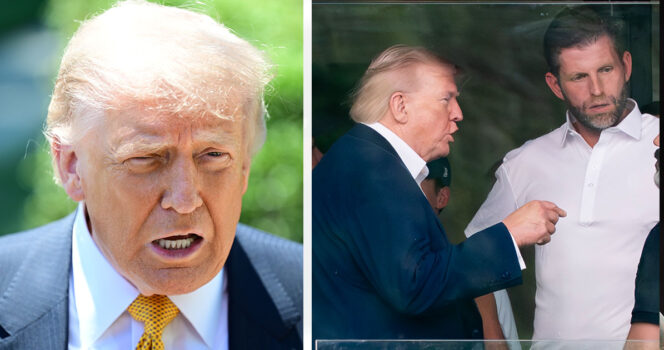

Questions about President Donald Trump’s age and mental sharpness have followed him for years. As he approaches his 80th birthday, those conversations have only grown louder. Now, a professional lipreader says a quiet moment between Trump and his son Eric at a recent golf event offers a rare, personal glimpse into how the president himself is thinking about growing older.
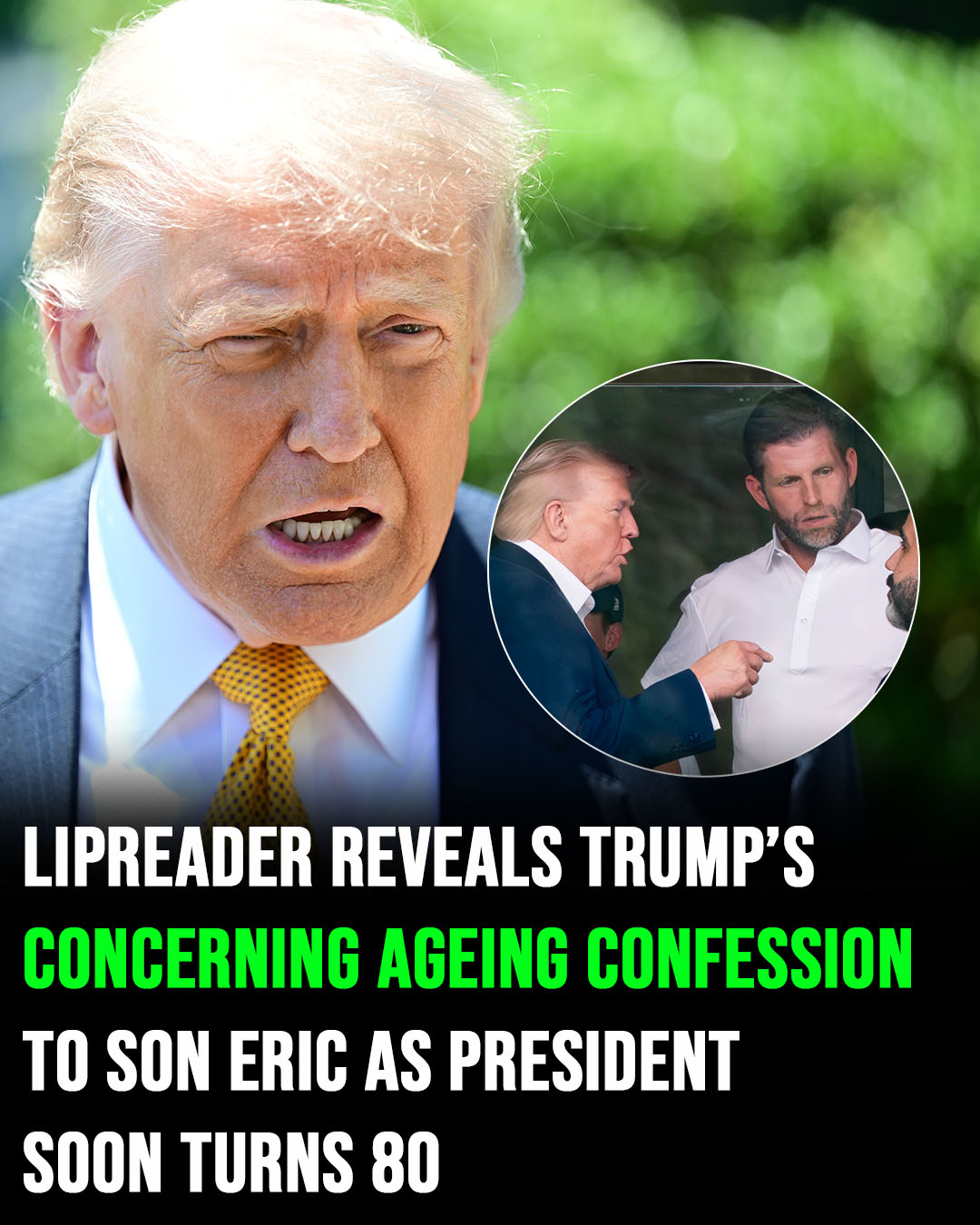
According to the lipreader, Trump acknowledged his upcoming milestone birthday and confided that a simple comment about turning 80 briefly made him feel old—before quickly adding that age is as much about attitude as it is about the calendar. For many Americans in their late 40s through mid-60s, that sentiment will sound familiar: age brings challenges, but how we approach it matters a great deal.
The long-running debate over age and fitness for office
Public debate over Trump’s fitness, both physical and cognitive, has spanned multiple years and dominated countless headlines. Supporters point to his energy on the campaign trail and his stated success on cognitive screening tests. Critics, meanwhile, question his judgment and consistency, and argue that age can magnify existing traits in ways that may affect leadership.
Amid the back-and-forth, Trump has repeatedly said he has performed strongly on cognitive assessments. He has specifically mentioned taking the Montreal Cognitive Assessment, commonly known as the MoCA, more than once and described “acing” it each time. The MoCA is a screening tool that doctors often use to look for signs of cognitive impairment. It is not a complete neurological work-up, but it can help flag areas such as memory, attention, language, and problem-solving that may need further evaluation.
As with many health-related topics in public life, reactions to these claims have been split. Some people accept the idea that a sitting president taking and passing a cognitive screen is reassuring. Others say that a short screening cannot fully settle deeper questions about judgment and decision-making under pressure.
A former insider’s stark warning and what it means
Adding to the strain, last week former Trump legal adviser Tyler Cobb, who served on the president’s legal team from July 2017 to May 2018, offered a blunt public assessment of Trump’s current state. In remarks reported by INews, Cobb alleged that the president is experiencing a meaningful decline, describing it as a combination of possible frontal lobe issues and potential dementia. These were his words and interpretations, not medical diagnoses, but they were strong statements from a onetime insider.
He characterized Trump’s behavior as increasingly driven by impulses that, in Cobb’s view, the brain’s frontal lobe typically helps regulate. He tied that to what he described as revenge-mindedness, grandiosity, and alleged abuses of power. Speaking to INews, he said there had never been a president who publicized potential war crimes in the early hours or celebrated the misfortunes of decorated public servants. These are extraordinary claims, and their seriousness ensured that they received immediate attention.
It is important to remember that such descriptions are opinions, however forceful, and not clinical determinations. Yet in the realm of public perception, they carry weight—especially when they come from someone who previously worked in Trump’s orbit. Whether one agrees or not, these statements have become part of the wider conversation about leadership and aging at the very top of government.
Talk of the 25th Amendment resurfaces
Concerns like these have periodically sparked calls to consider the 25th Amendment, which outlines a process for transferring presidential power if a president is deemed unable to discharge the powers and duties of the office. Over the past year, some lawmakers have argued for creating a formal commission that could evaluate presidential fitness should the need arise.
Democratic Representative Jamie Raskin has called for a body that would work with the vice president—currently JD Vance—to assess presidential capacity if questions become too urgent to ignore. Raskin has said that public trust in Trump’s ability to meet the demands of the office has hit new lows. He has cited foreign policy volatility, controversial public statements, and inflammatory online posts as causes for deep concern, framing the matter as a national security issue that Congress cannot simply set aside.
Supporters of the president have dismissed these pushes as political theater, pointing to the closeness of elections, the charged partisan climate, and Trump’s own insistence that he is fully capable of carrying out his duties. As with so much in today’s politics, the same set of facts is often read very differently depending on where one stands.
A quiet golf-course moment, caught on camera
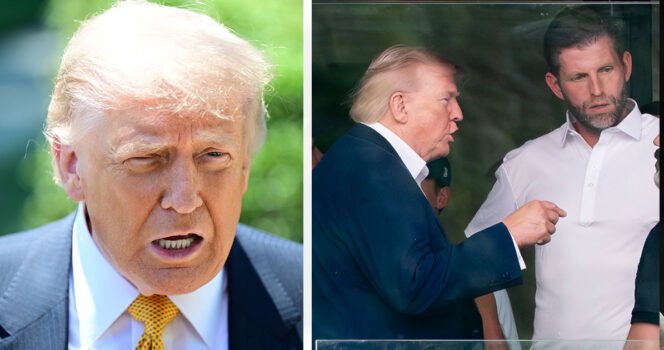
Against this fraught backdrop, a weekend at Trump National Golf Club in Virginia has nudged the age conversation in a more personal direction. While watching the LIV Golf tournament from behind bulletproof glass, Trump spoke briefly with his son Eric. That short exchange, according to professional lipreader Nicola Hickling, touched on the president’s upcoming 80th birthday.
Hickling told The Mirror that as they stood together, Eric mentioned the milestone directly. She recounted Trump saying that his son had told him, “Dad, you know you’re going to be 80 years old.” Hickling reported that Trump went on to admit, “After he said this, I felt old,” before adding a note of reassurance, “You’re only as old as you feel, right?”
For many families, that kind of exchange will ring true. A milestone birthday can catch us off guard, not because the calendar changes who we are overnight, but because it prompts reflection on what has been and what lies ahead. In private, many parents and grandparents have likely had a similar moment with an adult child—sharing a laugh, acknowledging the passage of time, and reaffirming that spirit matters.
How much weight should lipreading carry?
It is worth pausing to consider the nature of lipreading. Professionals can be remarkably skilled, especially with clear video and favorable angles. Yet lipreading is not perfect. Without audio, context can sometimes be lost, and mistakes can be made. People speak quickly, turn away, or use phrases that look similar on the lips. Even trained experts caution that their work is best viewed as informed interpretation rather than ironclad transcription.
In this case, the reported exchange is straightforward and in keeping with what one might expect when discussing a big birthday. Whether or not every word is exact, the tone of the moment—equal parts honesty and humor—feels familiar. If anything, it humanizes a figure who is often seen only through the lens of headlines and official statements.
Trump’s own framing of age and sharpness
Trump has not shied away from addressing concerns about age. He often contrasts his stamina with that of his rivals, highlights his nonstop travel and rally schedule, and returns to those cognitive assessments as shorthand proof of sharpness. He frequently presents himself as someone who thrives on high-pressure decision-making and late nights with little sleep.
For supporters, that image of relentless energy is reassuring. For skeptics, any single test or anecdote cannot answer the larger question of how age may affect leadership over time. Both sides will find examples to bolster their view, whether from official briefings, off-the-cuff remarks, or the daily demands of the job.
Understanding the MoCA and what it does—and does not—show
Because Trump has mentioned the MoCA repeatedly, it helps to understand what the assessment measures. The Montreal Cognitive Assessment is a screening tool used by many physicians to flag potential signs of mild cognitive impairment. It includes tasks such as drawing a clock face, remembering a short list of words after a delay, identifying animals, and performing simple attention and language exercises. Scores can help a clinician decide if more thorough testing is needed.
What the MoCA cannot do is capture the full complexity of a person’s executive functioning in the real world. Leading a nation involves not only memory and attention but also judgment, emotional regulation, ethical reasoning, and the stamina to manage crises. These are not traits any single screening tool can fully measure. Still, a strong MoCA result can be a data point in a broader picture, particularly when interpreted by medical professionals in the context of a patient’s history and daily functioning.
Leadership, longevity, and what age really means
America has a long history of older leaders. Experience can bring perspective and steadiness that are difficult to teach. At the same time, age can bring changes in processing speed, sleep patterns, and recovery time after long days. Many readers in their 50s and 60s will know these truths firsthand. They have likely learned to pace themselves differently, to safeguard their energy, and to prioritize what matters most.
When it comes to the presidency, the stakes of that balance are uniquely high. Supporters look for signs that an older leader remains vigorous and focused. Critics look for lapses that might hint at broader decline. What cannot be denied is that the conversation itself is not going away. As Trump nears 80, voters are weighing not only policies but also temperament, resilience, and the capacity to carry the burden of the office day after day.
The 25th Amendment in context
In heated times, it can be tempting to treat the 25th Amendment as a routine political tool. In reality, it is a grave constitutional mechanism designed for extraordinary circumstances. Historically, its use has been limited, and any serious move to invoke it would require clear evidence, consensus among senior officials, and a willingness to bear the political and civic consequences.
Calls to create a commission to evaluate presidential fitness reflect the anxieties of the moment as well as the modern reality that leaders are serving later into life than ever before. Whether one sees such a commission as a prudent safeguard or a partisan cudgel, its reappearance in public debate tells us something about how unsettled the country feels regarding leadership and aging.
A family moment that resonates beyond politics
The brief exchange between Trump and his son Eric, as described by a lipreader, stands out because it feels ordinary. Most families, at one time or another, have teased or reflected about age. A child reminds a parent of a big birthday; the parent laughs, maybe winces, then shrugs and says, it is all about how you feel. In that way, the moment reaches beyond politics to something more universal. It reminds us that behind every title is a person who is still a parent, still a spouse, still someone measuring time the way we all do.
For older readers who have marked their own landmark birthdays, the president’s reaction may seem not only understandable but also healthy. To feel a twinge when the number lands is natural. To answer it with a bit of humor and resolve—“You’re only as old as you feel”—is the sort of attitude that can carry someone through a demanding season of life.
What the coming months could reveal
As the calendar advances toward Trump’s 80th birthday, the practical questions will remain the same. Can he maintain a rigorous schedule without visible strain? Do public remarks and decisions reflect steadiness and clarity? Does the team around him function smoothly, with clear lines of responsibility and accountability? These are the kinds of signals that tend to reassure or alarm the public over time.
It is also likely that family will continue to play a role, even when the cameras are not around. For many leaders, a son, daughter, or spouse may be the one person who can speak frankly when others might hesitate. That brief golf-course chat, filtered though it was by a lipreader’s interpretation, hints at that private world where milestones are acknowledged and perspective is offered with love.
Final thoughts
The debate over Trump’s age and cognitive health is not new, and it is not simple. Strong opinions on both sides have been hardened by years of political battles. Yet in the midst of that noise, a simple human moment has drawn attention: a father hearing from his son that 80 is around the corner, feeling the weight of it for a beat, and then choosing to frame it with determination and a touch of humor.
As with any report based on lipreading, caution is wise. Still, the sentiment rings true for many people entering their later years. Age does not arrive overnight, and it does not define us entirely. What matters most is how we meet it—how we care for our minds and bodies, how we rely on our families, and how we continue to show up for the responsibilities we have taken on.
In the end, voters will make their judgments not from a single moment on a golf course, but from the full measure of what they see and hear over time. Between now and Trump’s 80th birthday, and beyond it, the nation will be watching for clarity, steadiness, and a sense that the person in the Oval Office understands both the weight of the job and the passage of years. The conversation may be contentious, but it is also deeply human—because it is, at heart, a conversation about how all of us age, and how we carry on.