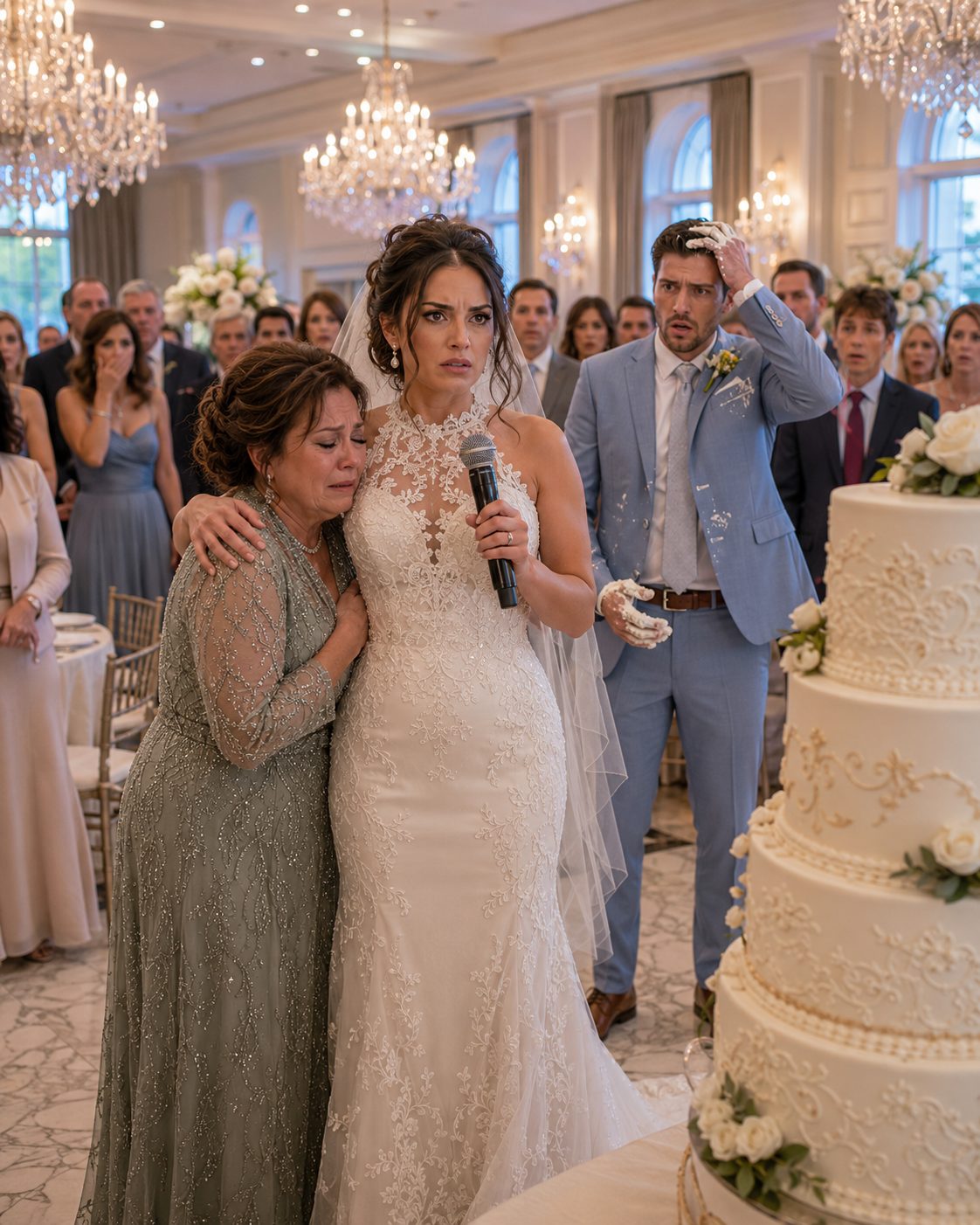

At our lavish wedding reception, my wealthy fiancé humiliated my mother in front of five hundred guests by tossing a hundred-dollar bill onto the floor and telling her to pick it up.
His family laughed, convinced they were rescuing a poor woman and her desperate daughter.
They never noticed the three men standing quietly near the ballroom doors weren’t security guards. They were waiting for a signal from me.
The first thing Preston threw at my mother wasn’t an insult.
It was money.
A brand-new one-hundred-dollar bill floated onto the carpet and landed beside the dessert fork she’d accidentally dropped while trying to steady her shaking hands.
The entire ballroom saw it.
Nobody moved.
Preston leaned back in his chair as though he’d just delivered the cleverest joke of the evening.
“Leave it there.”
He smiled.
“Think of it as a tip.”
“You won’t have to clean floors anymore.”
For a heartbeat…
Silence settled over the reception.
Then laughter spread across the head table.
My future mother-in-law didn’t even pretend to be embarrassed.
Holding her champagne glass, she addressed the room through the microphone.
“We’ve all worked so hard helping Sophie fit into our family.”
She smiled toward me.
“We even had to teach her which fork belongs with each course.”
More laughter.
Crystal glasses clinked together.
Several guests politely hid their smiles behind wine glasses.
Others didn’t bother.
My mother stared at the banknote lying on the carpet.
Then at the fork beside it.
Finally…
She looked at me.
Her eyes held only one question.
Should I pick it up?
That look hurt far more than anything Preston had said.
She’d spent her entire life sacrificing for me.
Working double shifts.
Skipping vacations.
Building a successful cleaning company from absolutely nothing after my father died.
Every opportunity I’d ever received existed because she’d quietly earned it.
Now…
She was apologizing with her eyes for dropping a fork.
I reached across the table and gently covered her hand.
“You don’t have to touch it.”
Preston’s fingers immediately tightened around my wrist beneath the tablecloth.
His smile never disappeared.
“Don’t embarrass yourself.”
“You’re marrying into this family.”
“Act like it.”
Across the room, his mother calmly raised her glass.
“Preston has already been incredibly generous tonight.”
“Let’s not spoil such a beautiful celebration.”
Generous.
Interesting choice of word.
Six months earlier, I’d accepted a position as a forensic accountant specializing in complex financial investigations.
One lesson became clear almost immediately.
People willing to humiliate others in public usually assume nobody will ever examine what happens in private.
Especially their finances.
This wedding wasn’t simply a celebration.
It was part of a carefully designed business strategy.
Preston constantly spoke about the legendary Vale family fortune.
The investments.
The trusts.
The legacy.
Every conversation somehow returned to their wealth.
What almost nobody knew…
Was that the empire behind those stories had begun quietly collapsing months earlier.
They desperately needed outside assets.
And hidden among the stack of elegant “wedding paperwork” Preston proudly handed me earlier that afternoon…
Sat a legal agreement that would’ve transferred far more than sentimental keepsakes.
Buried beneath polished language…
Were financial obligations capable of draining nearly everything my mother had spent decades building.
He assumed I’d sign without reading.
He assumed love made people careless.
He underestimated the profession I’d chosen.
My mother whispered beside me.
“I’m sorry about the fork.”
I turned toward her.
“You’ve done absolutely nothing wrong.”
She lowered her eyes.
That was enough.
I slowly stood.
The silk of my wedding gown whispered across the polished floor.
Conversations stopped.
Musicians lowered their instruments.
Five hundred guests watched, expecting tears.
Or an apology.
Instead…
I glanced toward the ballroom entrance.
Three men wearing tailored black suits remained exactly where they’d stood all evening.
To everyone else…
They looked like discreet event security.
Only I knew they were federal agents.
Only I knew what operation had brought them there.
One subtle signal.
That was all they needed.
I walked calmly toward the stage.
Past towering floral arrangements.
Past the wedding cake.
Past guests who shifted uneasily in their chairs.
Then I lifted the microphone from its stand.
Its cool metal steadied my hands.
“I’d like to say a few words…”
Every eye turned toward me.
Preston smiled confidently.
He expected gratitude.
Maybe forgiveness.
Perhaps even an emotional speech thanking his family for accepting someone beneath their social status.
He loosened his designer cufflinks and settled comfortably into his chair.
Completely unaware…
That the slideshow projector behind him was about to display something very different from wedding photographs.
And he certainly didn’t know…
What document my mother had quietly carried into the ballroom inside her worn leather handbag.
I looked directly at him.
Smiled.
Then reached into my pocket for the small device the agents had been waiting for all evening.
Six Months Earlier
I clicked the remote once.
The giant screen behind Preston blinked from a sepia engagement photo to a spreadsheet.
Not the kind people put in wedding slideshows.
Rows. Dates. account numbers. Wire transfers.
At first nobody understood what they were looking at, which bought me maybe four seconds.
Then the room changed.
It’s strange how quickly rich people can recognize danger when it has columns.
Preston turned halfway in his chair. His smile held on too long and then slipped, like a plate tipping off a wet counter.
“What is this?” he said.
I kept my eyes on the guests, not him.
“This,” I said into the microphone, “is the real reason for tonight.”
A stir went through the ballroom. Linen rustled. Somebody at table eleven laughed once, short and stupid, because he thought it was some private joke he hadn’t been let in on yet.
It wasn’t.
Six months earlier, my office had been handed a file from a regional bank in Hartford. Routine review, they called it. A cluster of transfers moving through shell companies with forgettable names. Alder Holdings. Finch Advisory. Marsten Domestic. The kind of names built to sound expensive and boring.
My supervisor, Carl Benton, dropped the folder onto my desk on a Tuesday at 8:15 a.m.
“Probably insurance padding,” he said. “Or tax games. Take first pass.”
I’d taken first pass.
Then second.
Then I’d sat up until two in the morning with stale coffee and a legal pad, tracing lines between companies that existed on paper and nowhere else. Every trail bent back toward one surname.
Vale.
At first I thought it had to be coincidence.
Connecticut is full of old money families who move cash around like cups on a table. But the farther I dug, the uglier it got. Loans secured against assets that had already been pledged somewhere else. Vendor payments to companies owned by cousins. Employee retention funds diverted into a trust whose listed beneficiary had been dead since 2019.
And then I’d seen Preston’s name.
Not as an owner.
As an authorized signer.
The First Lie He Told Me
I met Preston Vale at a charity dinner where he spent twenty minutes pretending not to notice people noticing him.
He had that polished thing down cold. Navy tux. Nice watch. Soft voice. A hand at the small of my back exactly when a photographer drifted by. He asked what I did, and when I told him I worked in forensic accounting, he laughed and said, “So you ruin parties for a living.”
I should’ve heard it.
Instead I smiled.
He sent orchids to my office two days later. Not roses. Orchids. Because rich men love making sure you know they know the difference.
Our first three dates were theater-level expensive. Private room at Cordeo. A weekend at the Berkshires property his family called “the lodge” even though it had fourteen bathrooms and a wine cellar bigger than my first apartment. Tickets to the gala opening of some museum wing with his last name on a bronze plaque by the entrance.
He talked about legacy all the time.
That’s the word he liked.
Legacy.
He said it the way some men say love.
My mother, Ruth, didn’t trust him from the start.
Not dramatically. She never did anything dramatically. She’d just ask little questions while stirring sauce on the stove.
“What does he do all day, exactly?”
“Does he ever laugh at himself?”
“Why’s his mother look at you like she’s pricing drapes?”
I told her she was being unfair.
I hated that memory most of all.
Because she was right.
What My Mother Carried
Back in the ballroom, Preston stood so fast his chair legs scraped hard enough to make half the room jump.
“Turn that off,” he said.
I clicked again.
The next slide showed a scanned signature page from the packet he’d handed me in the bridal suite.
There was a heading in twelve-point Garamond, all very tasteful and oily.
Spousal Asset Integration Schedule.
A few guests actually leaned forward to read.
I spoke clearly, because my hands had started to shake and I knew if I let myself speed up I’d lose the room.
“This document was included with my marriage license packet, seating revisions, and vendor receipts this afternoon. It was not disclosed by counsel representing the Vale family. If signed, it would’ve made me jointly liable for debts attached to three distressed entities and one pending civil action.”
My mother-in-law, Lenora, rose slowly.
Even then she looked elegant. Bone-white dress. Diamonds at the throat. A face stretched by money and practice into permanent calm.
“This is not the time,” she said.
“No,” I said. “You wanted the time to be after.”
That landed.
A little murmur. Sharper now.
My mother was still seated at the head table, one hand over her mouth. Not crying. Just watching.
She knew some of it. Not all. I’d told her enough to keep her from signing anything, enough to make her bring the papers I’d asked for, enough to get her company lawyer on standby in case the night went bad.
I hadn’t told her about the agents until noon.
She’d gone very still at her kitchen table when I said it.
“Federal?” she’d asked.
“Yes.”
“At your wedding.”
“If we let them fold these assets into a spouse transfer, they’ll bury the trail for another year.”
She’d stared at the sugar jar. Then she said, “Your father would’ve kicked that boy’s front teeth in.”
I almost laughed.
Instead I said, “I know.”
The Men By the Door
The three men at the ballroom entrance moved when I gave the signal.
Not running. They didn’t need to.
Just direct.
One to Preston. One to Lenora. One toward Preston’s uncle Gene, who had been trying very hard all evening to look decorative and uninvolved.
He failed.
Guests began turning in their chairs. A woman near the dance floor whispered, “Oh my God,” at full volume, which is how people always whisper those words.
Preston saw the badges and did the thing guilty men do first.
He smiled again.
Like maybe if he looked confused enough it would all become a misunderstanding.
“There has to be some mistake,” he said.
Agent Mercer, the tallest of the three, didn’t bother with polite face.
“Mr. Vale, don’t leave the room.”
That got everybody’s attention.
Lenora took one step toward the stage. “This is absurd. On whose authority?”
Mercer said, “A federal warrant and about eight months of paper your family should’ve burned sooner.”
Not poetry, but good enough.
My boss had warned me agents don’t talk like television. Mostly they sound tired.
These men sounded tired.
And pissed.
The projector changed again.
This time it showed a property ledger from a Delaware holding company tied to the Vale estate, then a payment schedule from a municipal redevelopment fund, then a chain of transfers that ended in a Cayman account with Preston’s initials attached in internal notes some idiot had forgotten to scrub.
That idiot, as it turned out, was Preston’s cousin Darren.
Darren was at table four and had gone the color of library paste.
Turn one.
I hadn’t expected Darren to be there.
I definitely hadn’t expected him to bolt.
He pushed back from the table so fast his wife yelped, clipped a server carrying coffee, and made it three steps before the shortest agent caught him near the coat check.
There were gasps then. Actual gasps. Old people still gasp correctly. Everybody else just stares into their phone.
Coffee spread across the marble.
Somewhere a violinist said, “Jesus Christ,” without meaning to do it into a live microphone, except he did.
How They Planned To Take It
Preston’s attorney, Martin Keefe, had drafted the asset transfer language.
He was supposed to meet me in the bridal suite at three-thirty to “walk me through some routine family office protections.” That’s what the email said.
Routine.
Family office.
Protections.
Three clean little lies in a row.
He’d laid the packet on the vanity beside my lipstick bag and smiled at me in the mirror.
“Nothing urgent,” he said. “Just signatures where tabbed.”
I hadn’t touched the pen.
Instead I asked if I could have ten minutes alone.
He gave me seven. I counted.
In those seven minutes I photographed every page and sent them to my office, to my mother’s lawyer, and to Agent Mercer, who had already been working the Vale case under a separate inquiry. We’d started speaking three weeks earlier after I flagged overlap between my file and an active fraud investigation.
That was the part nobody in the ballroom knew.
I hadn’t stumbled into this at random.
I had called.
I had asked hard questions.
I had kept copies.
By 4:12 p.m., while a makeup artist was trying to powder the side of my nose, two assistant U.S. attorneys were on speakerphone explaining exactly how close the Vales were to insolvency and how badly they’d need a clean spouse to absorb liability.
Not just me.
My mother.
Her company.
Her equipment leases. Her commercial property. Even the condo she’d finally paid off last winter, the one with the ugly beige carpet she kept saying she’d replace “once business slows down.”
Business never slowed down.
Ruth Cleaning Services started with her, a borrowed vacuum, and a station wagon with one door that only opened from the inside. By the time I graduated college she’d built contracts with three hospitals, two school districts, and a biotech campus that insisted on using the phrase environmental hygiene like they were too dignified to say mop.
The Vales had looked at all that and seen a life raft.
And because they were the kind of people who only recognized labor when they could buy it, they assumed my mother would be too flattered, or too scared, to notice.
Lenora Picks Up the Bill
This part I didn’t plan.
It’s still my favorite.
In the middle of the commotion, while Agent Mercer was speaking into his shoulder mic and Preston was sputtering about attorneys and defamation and “optics,” my mother stood.
No microphone.
No dramatic speech.
She walked around the head table in her navy dress, the one she’d bought off the clearance rack at Talbots and then paid more than she should have to get altered because she wanted to “look proper around these people.”
She stopped where the hundred-dollar bill still lay beside the fork.
The room quieted in that ugly, hungry way crowds quiet when they think they’re about to get one more humiliation.
My mother bent down.
Picked up the fork first.
Then the bill.
She smoothed it between both hands. Once. Nice and careful.
Then she walked straight to Lenora Vale.
Lenora actually held out her hand.
She thought my mother was giving it back.
Instead my mother tucked the bill into the top of Lenora’s champagne glass.
Right into the bubbles.
The whole room made this weird little noise.
Half choke. Half laugh.
My mother said, “There’s your tip. Buy yourself a little class.”
Then she turned and handed the fork to a stunned waiter like this was all a scheduling issue and he was behind.
I don’t think I’ll ever stop loving her for that.
Lenora’s face did the thing.
The thing expensive women think they’ve trained out of their faces.
Raw hate. Fast and naked.
She yanked the bill from the glass, wet and curling at the edges.
My mother had already walked away.
Preston Tries One More Trick
If Preston had shut up, he might have made it to court with a little dignity.
He didn’t.
He pointed at me like I was some intern who’d spilled toner.
“You were never supposed to read those documents.”
He said it into a hot microphone.
Because in all the mess, he’d grabbed the spare one from the head table and forgotten it was live.
There are moments in life so stupid they come gift-wrapped.
That was one.
A laugh broke from somewhere near the back. Real this time. Then another.
Preston realized what he’d done a second too late.
“I mean reviewed by yourself without counsel,” he snapped. “That’s not what I meant.”
Agent Mercer looked almost bored.
“It was what you meant.”
Preston turned to the guests as if he could still work the room.
“This is a personal dispute being twisted into theater.”
That from the man who’d thrown money at my mother under chandeliers the size of compact cars.
Then came turn two.
Old Mr. Hollis Bancroft, one of the Vale family’s golf-club fossils and a donor whose name was on half the hospital wing where my mother had once scrubbed blood off tile at 2 a.m., rose from table two and said, very loudly, “Personal dispute my ass.”
Everybody looked at him.
Hollis was eighty if he was a day. Red face. Hearing aid. Tremor in one hand. He jabbed that same hand toward the projector.
“I asked your father about those redevelopment funds in March. He told me the delays were permitting. You stole from the city.”
Nobody had expected the old man to join in.
Lenora sure hadn’t.
“Hollis,” she said, doing that smile again, “please sit down.”
He didn’t.
“I vouched for your family,” he said. “You used my name.”
Then he sat, very suddenly, like his knees had filed a complaint.
And just like that, the social part of the evening died. You could feel people recalculating. Who they knew. What they’d signed. Which photos tonight needed deleting before morning.
The Dress, The Exit, The End of It
Agents separated Preston from his uncle. Darren was crying by then, which I admit I enjoyed more than was probably decent.
Martin Keefe, the attorney, never showed. Smartest thing he did all day.
The band packed up in silence except for the drummer, who kept absentmindedly tapping a rim with one stick until the singer hissed at him to stop.
My phone started buzzing in the folds of my skirt. My boss. Then our legal department. Then a reporter whose number I didn’t know. Then another.
I set the microphone back in its cradle.
My hands were steady now.
Preston stared at me like I had become a different species in front of him.
“You set me up,” he said.
I looked at him for a long second.
“No,” I said. “I read what you handed me.”
That hurt him more.
You could tell.
Because a setup is unfair. A trap is bad luck. But being understood, clearly and all the way through, by someone you thought was smaller than you? That kind of thing strips a man.
He took a step toward the stage.
Mercer stopped him with two fingers to the chest.
It wasn’t rough. It didn’t need to be.
My mother came up beside me and touched the beadwork at my sleeve with that distracted little habit she has when she’s making sure something expensive hasn’t been damaged.
“You want to leave?” she asked.
I looked around the ballroom.
The cake still perfect.
My seating chart still glowing by the entrance.
Five hundred guests pretending not to stare while absolutely staring.
And on the giant screen behind the head table, frozen under the chandelier light, a wire transfer dated April 14 for $2,480,000.
“Yeah,” I said. “I think I’m done here.”
We walked off the stage together.
Not fast.
Just done.
At the doors, I passed the welcome mirror with our names painted across it in gold script.
PRESTON & SOPHIE
Forever begins tonight
I took one of the pearl hairpins from my updo and drew a hard line through both words.
The pin snapped in my hand.
Outside, the night air hit cold and wet. It had rained while we were inside. The limo idled under the porte cochere, useless now. Beyond it, my mother’s old silver Buick sat crooked near the curb because valet had tried to tuck it away and she’d insisted on keeping her keys.
“Take my car,” she said.
“In this dress?”
“You’ve driven in worse clothes.”
Fair point.
I kicked off my shoes, gathered up the skirt, and slid into the driver’s seat. Beads bit into the back of my legs. My mother got in on the passenger side, set her handbag on her lap, and then, after a moment, opened it.
Inside were the extra copies of the agreement, a pack of wintergreen gum, two business cards from federal agents, and half a chicken salad sandwich wrapped in wax paper.
I started laughing.
Really laughing.
So hard my forehead hit the steering wheel once.
My mother looked at me, then at the sandwich, then she started too. Small at first. Then gone.
“What?” she said.
“You brought a sandwich to my wedding.”
“I didn’t know how long this federal thing was gonna take.”
That made it worse.
I laughed until mascara got into my mouth.
Then she unwrapped the sandwich and held half out to me across six pounds of white silk and said, “Eat something before you pass out.”
So I did.
Chicken salad. Too much celery.
In my wedding dress.
In my mother’s Buick.
While inside the Grand Marlowe Ballroom, the Vale family finally got audited by people who didn’t care about centerpieces.
If this one stayed with you, send it to somebody. Sometimes a person needs the reminder to read every damn page.
If you’re looking for more dramatic tales, you might enjoy reading about how the judge opened my envelope before he finished smiling or when I let my stepmother announce my exile at my own graduation party.