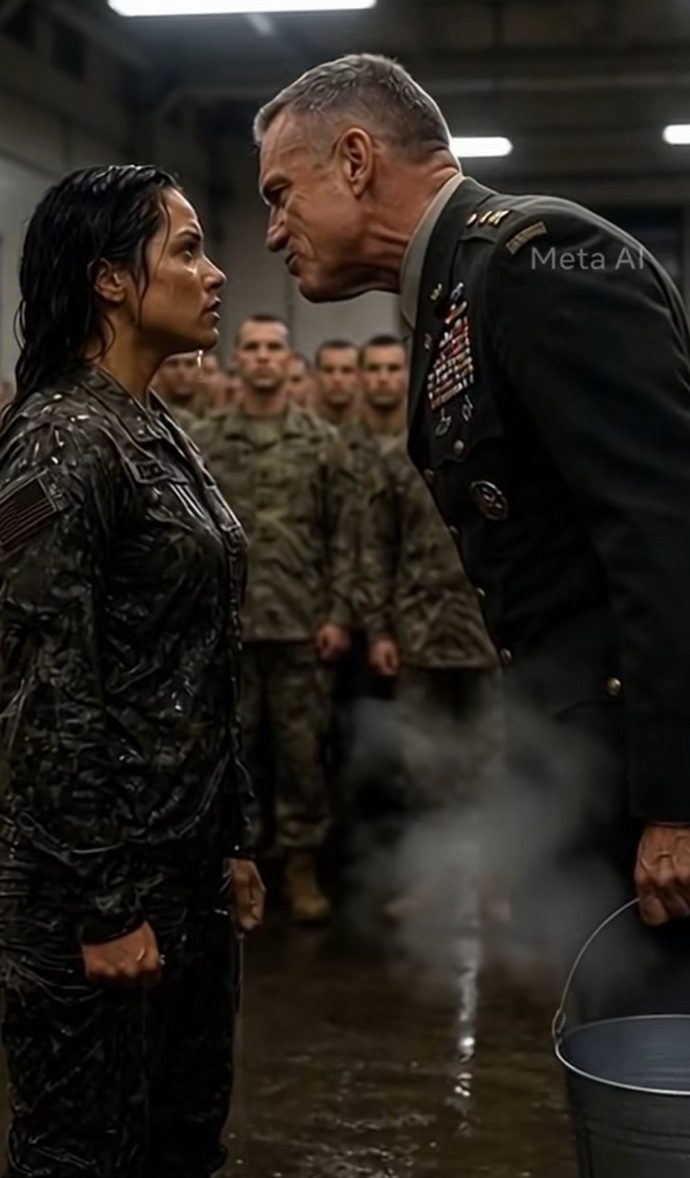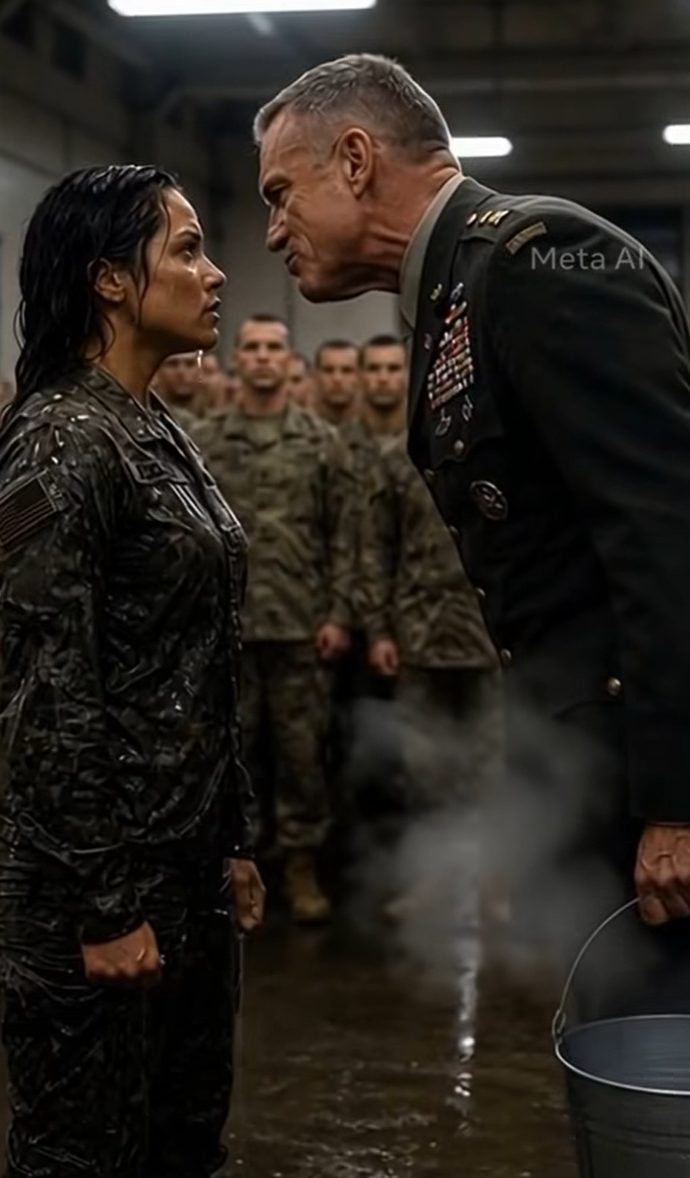

The water was still dripping from Ava’s collar when the first sound reached the hall.
Boots.
Not one pair. Not two. A rhythm. Heavy, synchronized, military-grade boots moving in formation down a corridor that wasn’t supposed to have visitors today.
General Thorne didn’t hear it yet. He was still pacing, still performing, still telling a junior officer near the door to “fetch a mop before the Specialist drowns in her own failure.” A few soldiers laughed because they had to. The rest stared at the floor.
Sergeant Grant heard the boots first. His head snapped toward the double doors at the far end of the training hall.
Then he went pale.
“Sir,” Grant said quietly.
Thorne ignored him.
“Sir,” Grant repeated, louder.
“What, Sergeant?”
Grant didn’t answer. He just took one slow step backward, the way a man steps away from a live wire.
The doors opened.
Three men in dress uniform walked in first. Not soldiers. Aides. The kind of aides who only walked ahead of one specific category of human being. Their shoulders were squared, their faces blank, their eyes already scanning the room and locking onto General Thorne like targets being painted.
Behind them came a fourth man.
He didn’t rush. He didn’t shout. He walked into that training hall the way weather walks into a valley – slow, inevitable, and impossible to argue with.
He was tall. Older. His uniform was darker than Thorne’s, and the stars on his shoulders caught the fluorescent light in a way that made the closest row of privates instinctively straighten their spines.
Four stars.
Thorne turned around, irritated at the interruption, and the color drained out of his face so fast that the medals on his chest suddenly looked too heavy for him to carry.
“General… Cordero,” he whispered.
The room stopped breathing.
Ava didn’t move. Water still ran down her jaw. She just watched her father cross the training hall, his eyes passing over the puddle at her boots, the empty metal bucket, the red burn blooming across her collarbone, the fifty soldiers frozen in place.
He stopped two feet from Thorne.
He didn’t look at Thorne.
He looked at Ava.
“Specialist Cordero,” he said, his voice quiet enough that the back of the room had to lean in. “Are you injured?”
“Minor burns, sir.”
“Did you receive medical attention?”
“No, sir.”
“Were you given the opportunity?”
“No, sir.”
A muscle moved in General Cordero’s jaw. That was the only thing on his face that moved.
Then, slowly, he turned to Thorne.
And what he said next made a four-star general’s aide actually pull out a notepad – because every word was about to become evidence.
“Harris,” General Cordero said softly, “do you remember what I told you in Kandahar in 2011?”
Thorne’s mouth opened. Nothing came out.
“I told you,” Cordero continued, “that one day your mouth was going to walk you into a room you couldn’t walk out of.”
He took one step closer.
“Today is that day.”
Then he turned to the aide on his left and said six words that made every soldier in that training hall realize they were about to witness something that would never appear in any official report – but would be whispered across every base in the country by morning.
Six Words
“Get the Inspector General on the phone.”
That was it. Six words. No yelling. No theatrics.
The aide had his phone out before Cordero finished the sentence.
Thorne’s aide, a young corporal named Petersen who had been with him fourteen months and had spent most of that time looking the other way, took two small steps to the side. Quiet, almost imperceptible. Like a man relocating himself out of a blast radius.
Smart kid.
Ava stood exactly where she was. She hadn’t been dismissed. She hadn’t been told to sit, or to go to medical, or to do anything except stand there with her collar soaked and her collarbone burning and her father six feet away doing what four-star generals do when someone has made a serious, irreversible mistake.
She’d grown up watching him work. She knew what this looked like.
This was the quiet version. The version that was worse.
What Thorne Thought He Knew
Here’s what Harris Thorne had known about Specialist Ava Cordero before this morning: she was twenty-three, she’d come through Fort Benning, she kept her head down, she didn’t complain, and she had a last name that didn’t ring any bells.
Cordero. Common enough.
He hadn’t bothered to look further. Men like Thorne rarely did. They operated on a kind of institutional arrogance that mistook silence for weakness and compliance for stupidity. Ava had been quiet in his training hall for six weeks. She’d done her work. She hadn’t pushed back when he singled her out, hadn’t filed anything, hadn’t made noise.
He’d taken that as confirmation of his own theory about her.
He was wrong about almost everything.
What Thorne hadn’t known: Ava had been in his training hall for six weeks because her father had specifically requested she receive no special treatment, no reassignment, no buffer. General Raymond Cordero had three daughters. Two of them had gone into medicine. Ava had gone into the Army, and she’d told him, very clearly, at a kitchen table in Bethesda three years ago, that she didn’t want his name to mean anything when she got there.
He’d agreed. He was proud of her for asking.
He was less proud of himself right now for honoring that request so completely that she’d spent forty minutes this morning standing in a puddle with scalded skin while a subordinate officer used her as a prop.
The muscle in his jaw moved again.
The Notepad
Corporal Diane Reyes was the aide with the notepad. She was twenty-six, sharp, and had been with General Cordero’s staff for eleven months. She’d seen him in a lot of rooms. She’d never seen him look like this.
She wrote down the time: 0917.
She wrote down Thorne’s full name, rank, and billet.
She wrote down a physical description of the scene as she’d found it: one Specialist, female, standing in approximately two liters of water, visible redness on neck and upper chest consistent with thermal contact, no first aid administered, no medical personnel present.
She wrote down the names of every officer in the room who had not intervened.
She got those names from Sergeant Grant, who gave them to her without being asked, quietly, standing next to her while he watched his commanding officer try to figure out which direction to stand in.
Grant had served under Thorne for two years. He’d filed three informal complaints that went nowhere. He gave Reyes every name she needed and then he gave her two more she hadn’t asked for, from an incident four months ago that had also gone nowhere.
He’d been waiting for a notepad.
What Ava Did
She stood at attention the whole time.
Her collarbone hurt. Not dramatically, not in a way that made her eyes water, but a persistent radiating sting that she kept filing away in the back of her mind to deal with later. She’d had worse. She’d had a stress fracture in her left foot during the third week of training and she’d walked on it for five days before anyone noticed, because she wasn’t going to be the one who stopped.
She watched her father work.
She didn’t smile. She didn’t let anything cross her face. This was her training hall, her unit, her problem, and the fact that her father had appeared in it was not a rescue. She hadn’t called him. She hadn’t called anyone.
He was here because he’d been scheduled to conduct a regional readiness review at this installation for two weeks. The timing was coincidence. The room number was coincidence.
Or it wasn’t. She genuinely didn’t know. With her father, sometimes the coincidences were real and sometimes they were just things he’d arranged so carefully that they looked like coincidences. She’d never been able to tell the difference and she’d stopped trying around age fifteen.
Thorne had told her to call her father.
She hadn’t. She’d stood there.
Her father had walked in anyway.
What Cordero Said to Thorne
The Inspector General’s office picked up on the second ring. Reyes handed the phone to General Cordero. He spoke for four minutes. He used precise language, no color, no editorializing. He described what he’d observed. He gave times. He gave names. He requested that a formal inquiry be opened before end of business.
Then he handed the phone back.
Then he turned to Thorne.
“You have a problem, Harris,” he said, “that has nothing to do with me or my daughter.”
Thorne’s jaw tightened. “Sir, if I could explain – “
“You could explain it to the IG.” Cordero’s voice hadn’t changed register once. “I’m not interested.”
“Sir, the Specialist failed three consecutive – “
“I didn’t ask.”
Silence.
“You poured hot water on a soldier under your command,” Cordero said. “In front of her unit. And then you told her to call her father, because you thought that was humiliation.” He paused. “You were performing for an audience.”
Thorne said nothing.
“That’s not a training method,” Cordero said. “That’s a man who’s afraid of something. I don’t know what. The IG will figure it out.”
He turned away from Thorne then. Completely. Like a door closing.
He walked to Ava.
He stopped in front of her. Up close. She could see the lines in his face that hadn’t been there five years ago, the gray that had moved further into his temples. He looked at the burn on her collarbone the way a doctor looks at something, clinical and exact, cataloguing the damage.
“Medical,” he said.
“Yes, sir.”
“Now.”
“Yes, sir.”
She turned and walked toward the door. She didn’t look back at Thorne. She didn’t look back at the room. She heard, behind her, the sound of Grant quietly directing the rest of the unit to stand down, and the sound of Reyes still writing, and the sound of Thorne breathing too loud in a room that had gone completely still.
She pushed through the door into the corridor.
The fluorescent lights out there were the same as in the training hall. Same floors. Same smell of rubber matting and industrial cleaner. But it was quieter, and she was alone, and she stopped for a second and put her hand flat against the wall.
Her collarbone burned.
Her hand was steady.
She kept walking.
What Got Whispered by Morning
By 1400 that afternoon, Thorne had been relieved of his training command pending the IG inquiry. The order came through so fast that Petersen, his aide, was still in the parking lot when it arrived. He heard about it from Grant, who texted him one sentence: it’s done.
By 1800, the story had moved the way stories move in the military. Not through official channels. Through phones, through mess halls, through the particular network of enlisted soldiers who always know more than officers think they do.
The version that spread wasn’t entirely accurate. Stories never are. In some versions, Cordero had dressed Thorne down in front of the whole unit, loud enough to rattle the windows. In some versions, Ava had said something sharp and devastating right before her father walked in, a line that landed perfectly.
Neither of those things happened.
What actually happened was quieter and, because of that, somehow worse for Thorne. No one could accuse Cordero of a scene. No one could say he’d been unprofessional. He’d been so controlled, so exact, so completely without drama, that Thorne had no angle. No grievance. No counter-narrative.
Just a notepad, a phone call, and six words.
Ava spent two hours in the base medical clinic. First-degree burn, treated, documented. The medic who saw her didn’t ask questions. She answered them anyway, because the documentation mattered, because Reyes had told her it would matter, because her father had raised her to understand that paperwork is a form of memory and memory is a form of power.
She was back in her bunk by 2000.
She lay on top of the covers with the lights off and stared at the ceiling.
Her phone had twelve messages. She read two of them, both from her sister Carol, who had apparently heard something from someone and wanted to know if Ava was okay.
Ava typed back: Fine. Burns are minor. Don’t make it a thing.
Carol sent back a single word: Dad.
Ava put the phone face-down on the mattress.
Outside, somewhere across the base, a group of privates were talking about what they’d seen. She could hear the low murmur of voices through the barracks wall, too far away to make out words, just the tone of people chewing over something that surprised them.
She closed her eyes.
The burn still ached, a little. She filed it away.
She was asleep by 2030.
—
If this one got to you, pass it on to someone who’d get it too.
If you’re looking for more stories about unexpected twists and turns, you might enjoy this tale about what happened when someone was told to empty their bag in front of everyone.