
My sister booked our mother’s funeral flights and handed me my boarding pass with a smirk – “economy suits you better, Karen, you’ve always been the SIMPLE one.”
I’m Karen, 52, and I’ve spent the last thirty years in a job my family never asked about.
My sister, Diane, 49, runs a boutique in Connecticut and married a cardiologist named Phillip.
Every Christmas, she introduces me as “my sister who works for the government, isn’t that cute.”
I stopped correcting her in 2003.
Our mother’s funeral was in San Diego, and Diane handled the arrangements because she “had the bandwidth” and I “obviously didn’t.”
She booked herself and Phillip in first class.
She booked me in 34B.
I didn’t argue. I never argue with Diane – it only makes her louder.
At the gate, she air-kissed me and said loud enough for the family behind us to hear, “Try not to spill anything on yourself, sweetie.”
Phillip chuckled.
I boarded last, found my middle seat, and folded my hands in my lap.
That’s when I noticed the flight attendant staring at my carry-on tag.
She walked up the aisle, then came back with the purser.
The purser leaned down and whispered, “Ma’am, would you please come with me?”
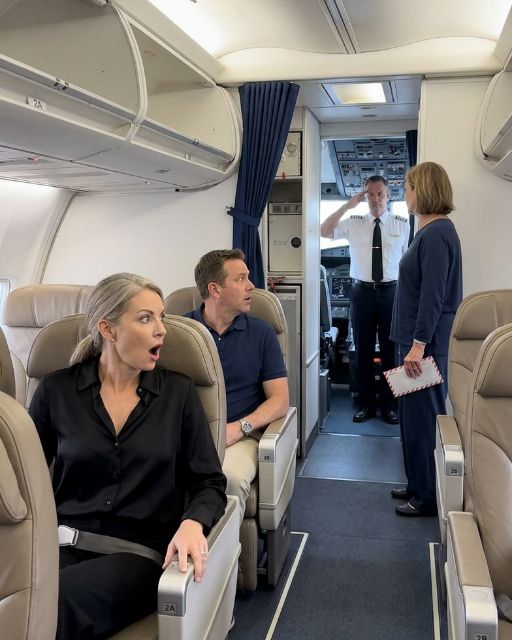
I followed her past Diane, who twisted around in 2A with her mouth open.
“Where are you taking her?” Diane hissed.
The purser ignored her.
She walked me through the galley curtain and knocked twice on the cockpit door.
It opened.
The captain stood up from his seat, turned fully toward me, and saluted.
“GENERAL, MA’AM. IT’S AN HONOR. WE WERE NOTIFIED THIRTY MINUTES AGO.”
My stomach dropped.
Notified by whom.
I hadn’t told anyone at the Pentagon I was flying commercial today.
Behind me, I heard Diane’s voice climbing into a register I hadn’t heard since we were children – “WHAT did he just call her?”
The captain held out an envelope sealed with a red stripe I recognized immediately.
“Ma’am, this came through Andrews. They said you’d understand once you opened it.”
My hands didn’t shake. They hadn’t shaken in thirty years.
But when I read the first line, I forgot Diane existed.
The paper was thick, official, and cold to the touch.
The message was brief, coded in a way only a handful of people would understand.
It translated to a single, chilling directive: “Sparrow is compromised. Proceed to designated alternate. Your flight is cancelled.”
Sparrow wasn’t a person or a mission.
Sparrow was our mother.
It was the code name she had been assigned forty years ago, one I thought had been retired when she did.
The world tilted on its axis, but my face remained a mask of calm.
“Captain, I need to de-plane,” I said, my voice steady. “And I need a secure room at this airport immediately.”
He nodded crisply. “Of course, General. We’ll arrange it now. We’ll announce a minor mechanical issue to clear a path for you.”
As I turned, I saw Diane standing in the aisle, her face a mess of confusion and fury. Phillip was behind her, looking pale.
“Karen, what is going on?” she demanded, her voice no longer a hiss but a sharp cry that turned heads.
“Diane, I have to go,” I said, keeping my voice low. “I’ll call you when I can.”
“Call me? Our mother is dead! We’re going to her funeral! What could possibly be more important than that?”
I looked at her, really looked at her, for the first time in years. I saw the little girl who used to follow me around, before life had carved a canyon between us.
“This is about Mom,” I said softly, and the honesty in my own voice surprised me. “Just… trust me.”
Her face hardened. “Trust you? The ‘simple’ one? The one who works a ‘cute’ government job? What is this, some kind of prank?”
The purser stepped between us. “Ma’am, you need to return to your seat.”
I walked past Diane without another word, my carry-on in hand. I could feel every eye in the first-class cabin on my back.
A ground crew member met me at the jet bridge, his face grim. He led me through a series of sterile corridors, away from the public eye.
The secure room was a small, windowless box with a single table and a video-conferencing unit.
As soon as the door closed, the screen lit up. The face of Secretary of Defense Miller appeared, looking tired.
“General,” he said, skipping the pleasantries. “I’m sorry about your mother. Truly.”
“What happened to Sparrow, sir?” I asked, cutting to the chase.
“Her passing wasn’t natural, Karen. We just got the coroner’s preliminary report from a trusted source in San Diego. It was a targeted potassium chloride injection. Made to look like a heart attack in an elderly woman.”
The air left my lungs in a silent rush. My mother hadn’t just died. She’d been murdered.
“Why?” I finally managed.
“We don’t know,” Miller said. “But her house was tossed. Not in a way a common burglar would. This was professional. They were looking for something specific.”
My mother’s house. A quiet little bungalow filled with pictures of her grandchildren, half-finished knitting projects, and the scent of lavender.
Or so I thought.
“What did she have?” I asked.
“That’s what you need to find out. Thirty years ago, your mother and father were lead researchers on Project Nightingale,” the Secretary explained.
I knew the name. It was a defunct Cold War energy project, officially shelved for being too unstable. My father, a brilliant physicist, had died in a lab accident related to it when I was twenty-two. That accident was what had pushed me to join the military. I wanted to create order in a world that had stolen my father.
“Nightingale was a cover, Karen,” Miller continued. “The real project was something else. Something your father created. Your mother was his failsafe. She safeguarded his work. We believe she had the only remaining data.”
My mind raced. My quiet, gentle mother who taught me how to bake bread. Who always told me and Diane that the most important thing was to be kind.
She had been a guardian. A sentinel.
“Someone knows she had it,” I said. “And they killed her for it.”
“Exactly. We think whoever it is believes the data is still in the house. You’re the only one who can go in. You’re her daughter. No one would question you being there before a funeral. Find it, Karen. Before they do.”
The line went dead. I sat there in the silent, gray room, the two halves of my life crashing together. The daughter and the General.
I was escorted to a black sedan on the tarmac. As we drove away, I saw my plane, Flight 237, finally pulling back from the gate, on its way to San Diego. On its way to a funeral that suddenly felt like a lie.
Diane would be furious. She would be hurt. I pictured her in her first-class seat, sipping champagne, thinking I had abandoned her out of spite.
The pain of that thought was a sharp, physical ache.
My phone rang an hour later. It was a new, encrypted device one of the agents had given me. It was Diane. They must have patched her through.
“Where are you?” she screamed into the phone. “I can’t believe you. I cannot believe you would do this, Karen! Mom is gone, and you just walk off a plane?”
“Diane, I can’t explain right now.”
“Of course you can’t! You never explain anything! You drift through life in your drab little suits, doing your secret little government work, too important for your own family! You know what I think? I think you couldn’t handle it. You couldn’t handle saying goodbye to Mom.”
Her words were meant to be cruel, but they landed on a truth. I couldn’t handle saying goodbye to the mother I thought I knew, because she didn’t exist.
“Her house,” I said, changing the subject. “Is anyone there?”
“The police released it this morning. Phillip arranged for a cleaning service for tomorrow. Why?”
“Cancel it,” I said firmly. “Don’t let anyone in the house. Not you, not Phillip, no one. Do you understand me?”
“I don’t understand any of this!” she sobbed. “I’m in San Diego alone, I have to plan our mother’s memorial, and my own sister has apparently lost her mind!” She hung up.
I arrived at my mother’s small house in La Jolla just after dusk. From the outside, it was exactly as I remembered. The rose bushes she loved were in full bloom. A wind chime tinkled softly from the porch.
Inside was a different story.
To the untrained eye, it might have looked like a messy house. But I saw the precision. The books pulled from shelves and replaced in the wrong order. The single baseboard screw that was slightly scraped. The faint indentation in the carpet where something heavy had been moved and moved back.
They had been thorough. But my mother had been more thorough.
For the next two days, I lived a strange double life. By day, I spoke with Diane on the phone, helping her choose readings for the memorial, listening to her cry and rage. I let her believe I was holed up in a hotel, consumed by grief.
By night, I became the General. I searched my childhood home not for memories, but for data. I recalled my mother’s odd habits, the little quirks that were now clues.
She always said, “A place for everything, and everything in its place.” But she had one exception. A chipped porcelain bird that she moved around the house every single week. Sometimes it was on the mantel, sometimes the kitchen windowsill, sometimes her nightstand.
It wasn’t on any of them.
I found it in the one place that was truly hers: her greenhouse. It was a tiny, humid space filled with orchids. My mother called them her fussy babies.
The porcelain bird was sitting on a shelf behind a Queen of the Night cactus.
I picked it up. It was heavier than it should have been. With a twist, the base came off. Inside was not a microchip or a key, as I expected.
It was a small, rolled-up piece of paper. A recipe.
It was for my mother’s lemon meringue pie, written in her familiar, looping script. I remembered that pie. It was my father’s favorite.
For a moment, I felt a crushing wave of despair. Was this a wild goose chase? Had my mother’s mind been failing?
But then I saw it. In the ingredients list, she had written “3 large eggs, separated.” And next to it, a tiny note: “(See page 33).”
Page 33 of what?
I thought about my mother. She wasn’t a spy or a soldier. She was a librarian before she married my father. She loved books more than anything.
I went to her favorite cookbook, the one with the broken spine she’d had for fifty years. “The Joy of Cooking.”
I flipped to page 33. The recipe was for a simple vinaigrette. But there, in the margin, my mother had written a sequence of numbers in faint pencil.
It wasn’t a code I recognized from any military briefing. It was a library code. The Dewey Decimal System.
The numbers led me to a book in her own collection. A book of poetry by Emily Dickinson. Tucked inside was a photograph of my father and mother on their wedding day.
Behind the photograph, glued to the book’s back cover, was a tiny, wafer-thin drive.
I had it.
Just as I pulled it free, I heard a floorboard creak in the hallway.
I didn’t move. My training took over. I pocketed the drive and slowed my breathing, listening.
The back door opened and closed softly. Footsteps crunched on the gravel path outside.
I slipped out the front door and circled around the house, staying in the shadows. I saw a man in a dark suit getting into a generic sedan. I memorized the license plate.
My encrypted phone buzzed. It was a text from an unknown number.
“So sad about your mother. Phillip and I are at the house. We let ourselves in with the spare key. Where are you? – Diane.”
My blood ran cold.
The man in the suit wasn’t the threat. He was surveillance. My surveillance. Miller’s men, watching me.
But Diane was in the house.
I called her. “Diane, get out of the house right now.”
“Karen? What is wrong with you? I was just… tidying up. Phillip is here.”
“Get out,” I repeated, my voice low and urgent. “Take Phillip and walk out the front door. Do not hang up.”
“This is insane,” she said, but I heard fear in her voice. “Okay, we’re walking.”
Through the phone, I heard Phillip grumble, “What’s her problem now?”
And then I heard another voice. A man’s voice. Calm and polite.
“I’m afraid you can’t leave just yet.”
The line went dead.
I ran. Not like a General, but like a big sister.
I burst through the back door. Diane and Phillip were in the living room. Phillip was white as a sheet. Diane was standing protectively in front of him.
A man stood opposite them. He was unassuming, in his late sixties, with a kind face that didn’t match the small, silenced pistol in his hand.
“Karen,” he said, a sad smile on his face. “I was hoping I’d only have to deal with your mother. I’m truly sorry for your loss.”
I knew him. Dr. Alistair Finch. He had been my father’s partner. A man I’d called “Uncle Alistair” as a child.
“You killed her,” I said. It wasn’t a question.
“She wouldn’t listen to reason,” Alistair said calmly. “Your father’s work… it could solve the world’s energy crisis. But she kept it hidden, gathering dust, because of some misplaced promise to him. It’s a crime against humanity.”
“He shelved it for a reason,” I shot back. “It was unstable.”
“He fixed it,” Alistair said, his eyes gleaming. “In the last few months before he died. He perfected it. Your mother hid the final key. I’ve spent thirty years looking for it.”
Diane let out a small sob. “Uncle Alistair? What are you doing?”
“Securing our future, my dear,” he said, his eyes flicking to her. “Now, Karen. The drive. I know you found it. Your mother always did love her little games.”
I slowly held up the small drive. “It’s over, Alistair. Let them go.”
“Hand it to me, and they can walk out that door.”
I looked at Diane. Her face, tear-streaked and terrified, finally held a glimmer of understanding. She was looking at me not as “simple Karen,” but as someone she didn’t know at all. Someone who was standing between her and a man with a gun.
“Fine,” I said. I took a step forward, holding out the drive.
As he reached for it, I did something my mother taught me. Not the librarian, but the woman who grew up on a farm and knew how to be practical.
I threw the entire pot of orchids from the side table directly at his face.
Dirt and ceramic shards flew everywhere. He stumbled back, momentarily blinded. In that split second, I moved. I disarmed him with a move I had practiced a thousand times. The gun clattered to the floor. Phillip scrambled for it.
I slammed Alistair against the wall, my forearm pressed against his neck.
“It really is unstable, isn’t it?” I asked, my voice barely a whisper. “The perfected formula. That’s why Dad shelved it. It works, but it’s volatile. It can be weaponized.”
His eyes widened. He knew I understood.
“He didn’t want it in anyone’s hands,” I said. “Not ours, not theirs, not yours.”
Sirens wailed in the distance. Miller’s men, finally making their move now that the asset was secure.
The memorial service was two days later. It wasn’t a funeral. We had our mother cremated, as she’d wished.
It was a small gathering in her garden. I read the Emily Dickinson poem from the book.
Afterward, Diane found me by the rose bushes. She was holding two glasses of iced tea.
She handed one to me. “I don’t think I ever knew you,” she said quietly.
“In a way, you didn’t,” I admitted. “It was safer that way.”
“For me, you mean,” she said. “Mom… was she protecting me?”
“I think so,” I said. “She wanted one of her daughters to have a simple life. A normal one.”
Diane looked down at her hands. “My ‘successful’ life… running a shop, going to galas… it all seems so ridiculous now. You were carrying this. All of it. All this time.”
“It’s just a different kind of life, Diane. Not better or worse.”
She shook her head, and for the first time, a genuine, sad smile touched her lips. “No. It’s better. You save people. I sell them overpriced scarves.”
She took a breath. “The man from the plane, the captain… he called you General. What does that mean?”
“It means I have a lot of meetings,” I said, a small smile playing on my lips.
She laughed, a real laugh that sounded like it had been trapped inside her for years. “Right. A lot of meetings.”
She grew serious again. “I’m sorry, Karen. For everything. For 34B. For calling you simple.”
“It’s okay,” I said, and I meant it. “You could only see the part of me I showed you.”
That evening, we sat in our mother’s kitchen, the two of us. I made her lemon meringue pie, the real one. As we ate, I told her about our mother, the librarian who became a guardian. I told her about our father, the brilliant man who made a choice to protect the world from his own creation.
I didn’t tell her everything. I didn’t tell her that Alistair Finch was now in a very dark, very quiet room, or that the drive was being permanently destroyed at a secure facility.
I just told her the story of our parents.
As I spoke, Diane’s eyes filled with a new kind of respect, not just for me, but for the quiet, simple woman who had raised us.
We are not defined by the noise we make, but by the quiet burdens we choose to carry. Strength isn’t about being the loudest person in the room; it’s about the resolve you hold in your heart when the room is empty. My mother taught me that, not with words, but by the life she lived, hidden in plain sight.
And in that quiet kitchen, sharing a pie, my sister finally understood it, too. We weren’t the “simple” one and the “successful” one. We were just two daughters, finally getting to know our mother, and each other.