
I was picking up my rental car at Gate B7 in Atlanta when I heard the scream.
“DADDY! DADDY!”
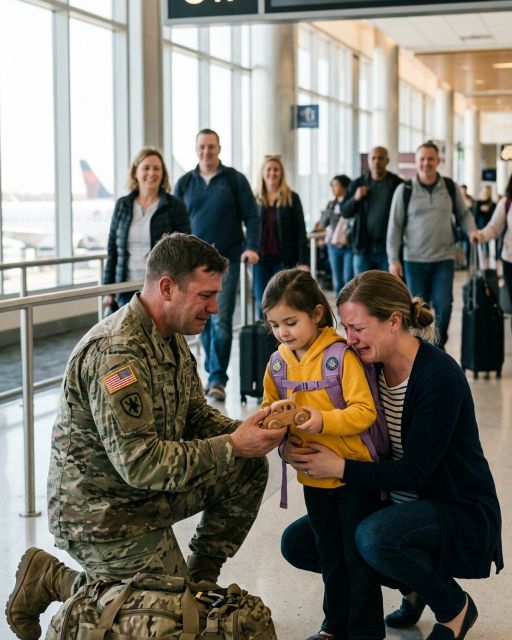
A little girl, maybe six, broke free from her mother’s hand and sprinted through the crowd. Pink backpack bouncing. Light-up sneakers slapping the tile. She was running full speed toward a soldier standing near baggage claim.
Everyone stopped. You know how airports get during homecomings – people pull out their phones, strangers start clapping. A woman next to me was already crying.
The soldier dropped his duffel bag. Got down on one knee. Opened his arms wide.
The little girl slammed into him. Wrapped her arms around his neck.
Then she went still.
She pulled back. Looked at his face. Her little hands touched his cheeks, his jaw, like she was reading him.
“You’re not my dad,” she whispered.
The clapping died.
Her mother – a woman in a grey cardigan, mid-thirties, already halfway across the terminal – froze mid-step. Her face went white. Not embarrassed-white. Terrified-white.
The soldier didn’t let go.
He looked at the little girl, calm as anything, and said her name. Not a guess. Not a nickname. Her full name.
“Margot Elaine Purcell.”
The girl’s eyes went wide.
He reached into his breast pocket and pulled out something small. A hair clip. Purple, with a tiny butterfly on it. The enamel was chipped. One wing was almost completely worn off, like someone had rubbed it ten thousand times.
Margot’s hands started shaking.
“Your daddy asked me to bring this home to you,” the soldier said. His voice cracked on the word “home.”
The mother was close now. Close enough to hear. She grabbed Margot’s shoulder and yanked her back. Hard.
“Who are you?” she said. But it wasn’t a question. It was a warning.
The soldier stood up. He was younger than I first thought – maybe twenty-five, twenty-six. His name tape read KESSLER. His eyes were red, but he wasn’t crying. He looked like a man who had already finished crying a long time ago.
“Ma’am, my name is Corporal Wade Kessler. I served with your husband in Logar Province.”
The mother — I later learned her name was Denise — didn’t move.
“Troy gave me this clip the night before the convoy,” Kessler continued. “He told me if anything happened, I had to put it in Margot’s hand myself. Not mail it. Not send it with a chaplain. In her hand.”
Denise shook her head. Slow. Like if she shook it hard enough, the words wouldn’t land.
“Troy is at Walter Reed,” she said. “He’s recovering. He called me last Tuesday.”
Kessler looked at her for a long time.
Then he reached into his jacket and pulled out a folded piece of paper. Worn soft at the creases. He didn’t hand it to Denise. He held it against his chest.
“Ma’am. I need to tell you something about that phone call.”
Denise’s knees buckled. A stranger caught her elbow.
Margot was holding the purple clip in both hands, staring at it, whispering something to it like it was alive.
The entire terminal had gone dead silent. No announcements. No rolling luggage. Just the sound of a little girl talking to a butterfly hair clip and a young soldier trying to find the words for something he had carried across an ocean.
He unfolded the paper.
“Troy wrote this eight months ago,” Kessler said. “He made me promise two things. Give Margot the clip. And read this letter. But only to you. And only in person.”
He looked down at the first line.
His jaw tightened.
“It says: Denise, the man who’s been calling you from Walter Reed is not—”
He stopped. Looked at Margot. Looked back at Denise.
“Ma’am, is there somewhere private we can go?”
Denise grabbed his arm. “Finish the sentence.”
Kessler’s hands were shaking now. The paper rattled.
He leaned in close — close enough that I almost couldn’t hear — and whispered the rest.
Denise’s scream hit the terminal like a shockwave.
Margot dropped the hair clip.
And Kessler — this twenty-five-year-old kid in dusty boots — caught them both before they hit the ground.
I don’t know what the letter said. I don’t know who had been calling Denise from that hospital.
But I know this: when security arrived, Kessler handed them a second document from his bag. An official one. With a seal.
The officer read it, looked at Denise, and said four words that made every person within earshot reach for their phone:
“Ma’am, your husband’s identity…”
He paused and looked around at the growing crowd, then lowered his voice. But the damage was done. Everyone had heard enough to understand that something deeply wrong had been happening, and that this young corporal had just blown it wide open.
They moved Denise and Margot to a private lounge behind the Delta service desk. Kessler followed. Two airport security officers flanked them. I should have walked away. I should have gone and gotten my rental car and driven to my hotel and forgotten the whole thing.
But I couldn’t move.
I sat down on a bench near the baggage carousel and waited. I don’t know why. Maybe because I had seen the look on that little girl’s face when she touched the soldier’s cheeks and realized he wasn’t her father. That look stays with you. It carves itself into a place you can’t reach.
About forty minutes later, Kessler came out alone. He sat down two seats away from me. He put his elbows on his knees and stared at the floor between his boots.
I didn’t say anything for a while. Then I said, “You okay, son?”
He looked at me like he had forgotten other people existed. Then he shook his head. Not dramatically. Just a small, honest no.
“Her husband’s been dead for eight months,” he said quietly. “IED hit the third vehicle in the convoy. Troy was driving.”
My stomach dropped. I asked the only question I could think of. “Then who’s been calling her?”
Kessler rubbed his face with both hands. He looked ten years older than he probably was.
“Troy’s half-brother,” he said. “A guy named Garrett Purcell. He wasn’t military. Never served a day. But he had access to Troy’s personal information because Troy had listed him as secondary emergency contact years ago, back before he and Denise were even married. They’d been estranged for a while, Troy and Garrett. Troy told me Garrett had money problems. Bad ones. Gambling, mostly.”
I felt something cold settle in my chest. “He was pretending to be Troy?”
Kessler nodded. “After Troy was killed, the notification process got delayed because of a records mix-up. Two soldiers from the same unit had similar service numbers. The wrong family got the initial casualty call. By the time the Army corrected the error internally, Garrett had already contacted Denise claiming to be Troy, saying he was injured and recovering at Walter Reed. He told her not to visit yet because he was in a special rehab ward and they were restricting visitors. He said he’d be home soon.”
“But why?” I asked, even though I already knew.
“Troy had a life insurance policy,” Kessler said. “SGLI. Four hundred thousand dollars. Plus there was back pay, death benefits, survivor benefits for Denise and Margot. Garrett had somehow gotten hold of enough of Troy’s documents to start positioning himself to intercept the money. He’d been coaching Denise over the phone, telling her to update bank information, to set up a new joint account for when he got home. He’d been building the whole thing for months.”
I felt sick. Genuinely, physically sick.
“Troy suspected something like this might happen,” Kessler went on. “Not specifically this, but he knew Garrett was dangerous. That’s why he wrote the letter. He told me, ‘If I don’t come back, Garrett’s going to try something. He’s going to go after Denise and the money. You have to warn her before he gets his hooks in.’ Troy didn’t trust the system to catch it in time. He trusted me.”
I asked him why he hadn’t just called Denise himself. Why he had to come all the way to Atlanta to do it in person.
“I tried calling,” he said. “Three times. The number Troy had for Denise was disconnected. Garrett had convinced her to change it. New phone, new number, new account. All part of the setup. The only address I had was the old one in Marietta, and when I sent a letter there, it came back undeliverable. So I pulled her flight records through a buddy who works at the VA. I know that sounds crazy. It probably was crazy. But Troy made me swear, and I wasn’t going to break that promise to a dead man.”
He found out Denise was flying into Atlanta that afternoon with Margot. She was coming to meet a lawyer Garrett had recommended to help process what she thought was Troy’s medical discharge paperwork. Kessler got himself on a flight that landed thirty minutes earlier and waited at baggage claim.
He hadn’t expected Margot to run at him. He hadn’t expected any of that. He told me when the little girl hit his chest, he almost broke apart right there because Troy had shown him a hundred photos of her over there in the dust, and holding her felt like holding a ghost’s most precious thing.
I asked about the hair clip.
“Troy found it in his cargo pocket the morning after Margot was born,” Kessler said with a faint, painful smile. “Denise had been wearing it in the hospital and it fell off. He kept it with him on every single deployment. He said it was the first thing his daughter ever touched. He used to rub the butterfly wing while he was on watch. That’s why it’s worn down like that.”
We sat in silence for a long time after that. People walked past us with their rolling suitcases and their coffee cups, completely unaware of what had just shattered and reassembled in that terminal.
Then the lounge door opened and Denise came out. Her eyes were swollen, but her jaw was set. She was holding Margot on her hip, and Margot was holding that purple hair clip like it was the most important object in the universe.
Denise walked straight up to Kessler. He stood.
She looked at him for a long, hard moment. Then she said, “The lawyer I was going to meet today. Garrett set that up. Didn’t he.”
Kessler nodded.
“I almost signed everything over,” she whispered. “He had me convinced. He sounded just like Troy on the phone. They had similar voices. I thought he sounded different because of the injuries. I thought that was why he didn’t want me to visit.”
Kessler didn’t say I told you so. He didn’t say anything at all. He just stood there, steady, like a wall she could lean against if she needed to.
And she did. She leaned her forehead against his shoulder and cried. Not the screaming kind from before. The quiet kind. The kind that means you are finally letting yourself understand something you were afraid to know.
Margot reached out from her mother’s arms and put the butterfly clip in Kessler’s front pocket. He looked at her, confused.
“Hold it for a little while,” Margot said. “It makes you feel better. Daddy said so.”
Kessler’s face crumbled. He pressed his lips together so hard they went white, and he nodded.
I found out later what happened after that day. A friend of mine works at the Fulton County courthouse and I asked him to look into it, because I couldn’t stop thinking about Margot and the butterfly clip.
Garrett Purcell was arrested eleven days later in Knoxville. He had already opened three fraudulent accounts using Troy’s service records and social security number. He had forged power of attorney documents. He had impersonated a fallen soldier to steal from that soldier’s widow and child. The FBI got involved because it crossed state lines, and Garrett was charged with wire fraud, identity theft, and military benefits fraud.
He pleaded not guilty at first. Then the prosecution played a recording of one of his phone calls to Denise where he pretended to be Troy, describing memories of Margot’s birth that he had clearly pulled from Troy’s personal letters. Letters that Garrett had stolen from the family home during a visit the year before Troy deployed.
The jury took less than two hours. Garrett got fourteen years.
Denise and Margot received every cent they were owed. The full SGLI payout, the survivor benefits, all of it. The Army also issued a formal apology for the notification delay that had created the window Garrett exploited.
And Kessler? He stayed in Atlanta for three days to help Denise sort through the legal mess. Then he flew home to Oregon. But he didn’t disappear.
He kept in touch. Birthday cards for Margot. A phone call to Denise every couple of weeks to check in. Nothing romantic. Just a man honoring the bond he had with the friend he lost.
About two years later, Denise posted a photo online that one of her friends shared with me because she knew I had been there that day at the airport. The photo showed Margot at her school’s father-daughter dance. She was wearing a purple dress, and in her hair was a brand-new butterfly clip, shiny and perfect.
Standing next to her, in a suit that didn’t quite fit because he clearly never wore one, was Wade Kessler.
The caption read: “He promised Troy he’d bring us home. He’s been keeping that promise ever since.”
I’m an old man now. I’ve seen a lot of airports and a lot of goodbyes and a lot of strangers passing each other without a second glance. But I have never in my life witnessed anything like what I saw that day at baggage claim in Atlanta.
A little girl ran toward a stranger because her heart recognized something her eyes couldn’t. A soldier carried a butterfly clip and a letter across the world because a dying friend asked him to. And a man who had never met a woman and her daughter chose to stand in the gap that grief had torn open, not because anyone made him, but because he believed a promise doesn’t end when the person you made it to is gone.
The people who try to take advantage of others in their darkest moments will always exist. But so will the people like Wade Kessler, who carry crumpled letters in their chest pockets and keep their word even when no one is watching.
The world breaks your heart sometimes. But every once in a while, it sends someone to help you pick up the pieces.
If this story moved you, share it with someone who needs to hear it today. Sometimes a single act of loyalty can change everything. Drop a like if you believe that promises should outlast the people who make them.