
WHEN I FAINTED AT MY GRADUATION, THE HOSPITAL CALLED MY PARENTS – BUT ONLY GRANDPA CAME
I hit the floor mid-sentence. Right there on the stage, in front of six hundred people, microphone still hot in my hand.
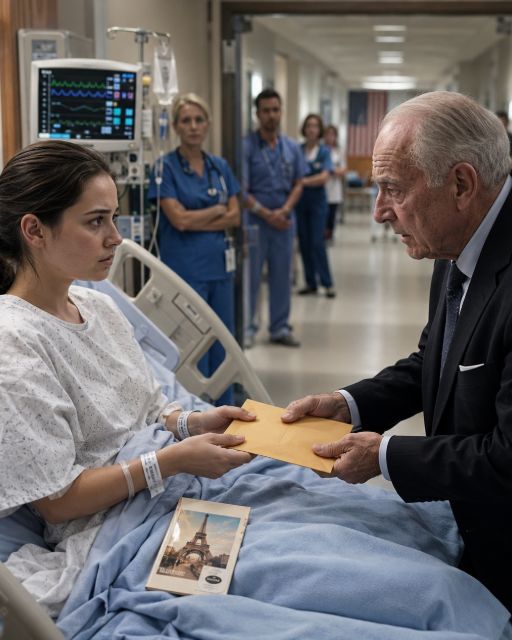
When I opened my eyes, it was all fluorescent lights and beeping machines. No balloons. No family crowding the doorway. Just one chair pulled close to my bed, and Grandpa Howard sitting in it – still wearing his good suit, still holding that manila envelope he’d been clutching in the front row.
“Where are Mom and Dad?” I croaked.
He squeezed my hand. Didn’t answer.
The nurse did. “We’ve called your parents four times. No answer.”
My phone was on the tray table, plugged in by someone who cared enough to think of it. I tilted the screen toward me and saw the notification: my sister Darlene had tagged me in a photo. The Eiffel Tower. My whole family grinning in matching scarves. The caption read: “Finally – Paris family trip. No stress, no drama. 💕”
No stress.
No drama.
No me.
I set the phone face-down and stared at the ceiling tiles until they blurred.
—
Four weeks before graduation, I was still the girl who said yes to everything. Napkin samples for Darlene’s engagement party. Airport runs for Aunt Carol. Double shifts at the coffee shop so I wouldn’t have to ask anyone for gas money.
“Grace handles it,” my mom would tell people. “She’s our easy one.”
Easy. Like I was a setting on a washing machine.
The headaches started during finals week—sharp, blinding things that made my vision swim. I told myself it was stress. I drank more water. I kept going. I always kept going.
The night before commencement, I called Grandpa because he was the only person who ever asked me a question and actually waited for the answer.
“Gracie. You eat dinner?”
“I had a granola bar.”
“That’s not dinner. That’s a snack for a bird.” He paused. “I’ll be in the front row tomorrow. Wouldn’t miss it for anything on this earth.”
Nobody else confirmed they were coming. Mom sent a blurry airport selfie that morning: “Have a great graduation sweetie!! So proud of you!!”
Two exclamation points. Zero plane tickets home.
—
I put my cap on anyway. I walked the processional line. I spotted Grandpa in the front row—early, centered, saving two empty seats on either side of him like he still believed someone might show.
Nobody did.
My name echoed through the auditorium speakers. I stepped to the podium. I gripped the edges and looked out at six hundred faces, searching for the ones that were supposed to matter most.
“I stand here today because of the people who—”
The room tilted. The lights went white. I heard my best friend Rachel scream my name from somewhere far away, and then Grandpa’s hand was around mine, warm and rough and steady.
“I’m here, sweetheart. I’m right here.”
—
The doctors said it wasn’t just exhaustion. They needed to run more tests. They needed parental consent for part of the treatment. They called my parents six more times.
Six more times, nobody picked up.
Grandpa signed everything. Grandpa slept in that visitor chair for three nights straight in the same wrinkled suit. Grandpa was the one holding a cup of water to my lips when I finally woke up with my throat on fire and tubes in my arm.
Rachel was curled up in the corner chair, red-eyed. “You scared me half to death, Grace.”
I reached for my phone. The Paris photos had multiplied. Darlene at a café. Mom holding a macaron. Dad raising a wine glass on a river cruise.
I didn’t comment. I didn’t text. I didn’t do what I always did, which was make it easy for them to forget me.
I just set the phone down and breathed.
—
Then, on day four, my screen lit up like a switchboard.
65 missed calls.
One text from Dad: “We need you. Answer immediately.”
Not “are you okay.” Not “we heard you collapsed.” Not “we’re sorry we weren’t there.”
We need you.
I stared at those three words for a long time. The monitor beeped beside me. Rachel was asleep. Grandpa was in the hallway talking to my doctor in a low, serious voice.
His manila envelope was still sitting on my blanket. He’d brought it to graduation. He’d been waiting to give it to me on the stage, before everything went sideways.
I picked it up. It wasn’t sealed—just tucked closed, like he trusted me to open it when I was ready.
I slid the paper out.
It was a deed. And a letter. And a name I had never seen before.
I read the first line, and my hands started shaking—not from weakness this time, but from the weight of what Grandpa had been carrying alone for twenty-two years.
I picked up the phone. I called Dad back. He answered on the first ring, panicked, breathless.
“Grace, thank God—listen, we need you to—”
“I opened Grandpa’s envelope,” I said quietly.
Dead silence.
Then my father’s voice, stripped of every ounce of authority: “He promised he would never show you that.”
I looked at Grandpa standing in the doorway, watching me with steady, unblinking eyes. He gave me one slow nod.
I turned back to the phone and said the words that changed everything: “Then you shouldn’t have left me alone long enough to find out. Now let me tell you exactly what happens next—”
But what I said next… and what that envelope actually proved about who I really was in that family…
That part made my father hang up the phone and book the first flight home—not to Paris, not for Darlene’s trip.
To me. For the first time in twenty-two years, to me.
My father walked into the hospital room and stopped cold when he saw the documents spread across my bed.
He didn’t yell.
He didn’t argue.
He just looked at my mother.
And for the first time in my life…he looked afraid.
“She knows,” he said quietly.
My mother’s face drained of color.
“No,” she whispered. “He promised—”
“I didn’t promise anything,” Grandpa said from the doorway. His voice was calm, but it cut through the room like a blade.
Silence filled the room.
Heavy. Final.
I held the paper tighter in my hands. The elegant, swirling script belonged to my grandmother, Eleanor, who passed away when I was just a baby.
Because whatever they had been hiding for twenty-two years…was sitting right in front of me now.
And it wasn’t just about money. It wasn’t just about family.
It was about who I really was to them.
And why they were so afraid I’d find out.
My mother, Sarah, took a hesitant step forward, her hand outstretched. “Gracie, honey, let’s just talk about this. You’re not well.”
“I’m well enough to read,” I said, my voice steadier than I felt. I looked past her, at my father, Mark. “You’re not in Paris anymore.”
He flinched. “We came as soon as we got your message.”
“You came as soon as you heard I opened the envelope,” I corrected him. “Big difference.”
Grandpa moved to stand beside my bed, placing a protective hand on my shoulder. It was a simple gesture, but it felt like a fortress wall.
“What is all this?” my mother asked, her eyes darting between the papers and my face, full of a frantic energy I’d never seen before. “Howard, what did you do?”
“I did exactly what Eleanor asked me to do,” Grandpa said. “I watched. And I waited.”
He looked at me then. “It’s time, Gracie. Tell them what you know.”
I took a deep breath, the sterile hospital air filling my lungs. I picked up the first page, the deed to our family home. The big colonial on Elm Street that I grew up in.
“This house,” I said, my voice quiet but clear. “It’s not yours.”
My father started to speak, a protest forming on his lips, but I cut him off.
“It’s mine.”
I let that hang in the air. The beeping of the heart monitor seemed to get louder, marking time in the sudden, suffocating silence.
“That’s ridiculous,” my mother finally sputtered. “This is some kind of sick joke.”
“It’s no joke,” I said, picking up the second document. It was a summary of a trust account. The numbers were dizzying. “Neither is this.”
I read the official name at the top of the page. “The Grace Eleanor Thompson Trust.”
“Grandma Eleanor set this up just after I was born,” I explained, piecing it together from the letter I had read a dozen times in the last twenty-four hours.
“She worried you were too focused on Darlene, too concerned with appearances.” The words felt strange in my mouth, but they were true. They were Grandma Eleanor’s words.
“She saw that you were living beyond your means even then,” I continued.
“So she put everything—her entire estate—into a trust. The house, the stocks, the savings. And she made me the sole beneficiary.”
My mother sank into the visitor’s chair, the one Grandpa had occupied for three sleepless nights. She looked smaller, shrunken.
My father just stood there, his face a mask of stone.
“She made you the trustees,” I went on. “You were allowed to live in the house. You were allowed to use the income from the investments.”
I paused, letting them absorb the weight of my next words.
“But there was one condition.”
I looked them right in the eyes. Both of them.
“You had to take care of me. My needs, my health, my well-being had to be your absolute first priority.”
The Paris trip photos flashed in my mind. The matching scarves. The wine glasses.
“You failed,” I said simply. “You broke the contract.”
“And Grandpa,” I said, my voice softening as I looked at him, “was the enforcer. The failsafe.”
Grandpa nodded slowly. “Eleanor made me promise that if they ever truly neglected you, if they ever put their own desires so far above your needs that it put you in harm’s way… I was to step in.”
His eyes hardened as he looked at his son. “You leaving her to collapse alone at her own graduation while you were sipping champagne in Paris was the final straw, Mark. It was the proof.”
My father finally cracked. “We needed a break! The stress of Darlene’s wedding, the business…”
“The stress?” I asked, a bitter laugh escaping my lips. “I was working two jobs to pay my own way through college so I wouldn’t be a ‘burden.’ I was planning Darlene’s parties. I was having blinding headaches and you told me to drink more water!”
My voice was rising, filled with twenty-two years of being the “easy one.”
“You weren’t stressed. You were on vacation. A vacation paid for with my money, while I was lying in a hospital bed.”
My mother started to cry then, quiet, desperate sobs. “We love you, Grace. We do.”
“Your love feels an awful lot like being forgotten,” I replied, the anger draining away, leaving only a deep, hollow ache.
Just then, my phone, still on the bedside table, buzzed to life. It was a video call from Darlene. My mother’s head shot up, her eyes pleading with me not to answer.
I looked at my grandpa. He gave another small, almost imperceptible nod. Do what you need to do.
I pressed the green button.
Darlene’s face filled the screen, perfectly made up, a beautiful Parisian balcony behind her.
“Mom? Dad? What is going on?” she demanded, her voice high and irritated. “Our dinner reservations are in an hour! Why did you just leave? Did something happen to Grace?”
The last question felt like an afterthought.
“Something like that,” I said, angling the phone so she could see me in the hospital bed, IV tubes taped to my arm.
Her perfectly painted mouth fell open. “Oh my God. Grace. What happened?”
“I graduated,” I said. “And then I fainted. Turns out being the ‘easy one’ is exhausting.”
“What’s all that paper on your bed?” she asked, her eyes narrowing.
“That,” I said, holding up the deed, “is the title to your house. Or, I should say, my house.”
The color drained from Darlene’s face just as it had from our mother’s. The entitlement she wore like a second skin began to crumble.
“And this,” I added, holding up the trust summary, “is the reason you have a platinum credit card and a designer wedding dress.”
“It’s all mine, Darlene.”
For a moment, she was speechless. Then, the anger returned, tenfold. “You can’t do that! That’s our money! Dad, tell her!”
My father wouldn’t meet the phone’s camera. He just stared at the floor.
“It was never your money,” Grandpa’s voice boomed, startling even me. “It was a privilege you were afforded, and you abused it.”
I looked at my sister’s panicked face on the screen, at my mother’s tear-streaked cheeks, at my father’s defeated slump. I had all the power. I could have been cruel.
I could have told them to pack their bags. I could have cut them off without a cent. A part of me, the part that had felt invisible for so long, wanted to.
But looking at them, stripped bare of their pretense and their financial security, I didn’t see monsters. I saw weak, flawed, selfish people who had made a terrible series of choices.
I saw the parents I had always wanted, and the broken reality of who they actually were.
My anger was a roaring fire, but beneath it, a tiny, flickering flame of something else was trying to survive. It wasn’t forgiveness. Not yet. But it might have been the start of understanding.
I ended the call with Darlene. “She’ll be on the next flight,” I said to no one in particular.
My mother looked up, hope in her eyes. “Gracie, what are you going to do?”
I let the silence sit for a long moment. I thought about my grandmother Eleanor. She hadn’t done this to punish her son. She had done it to protect her granddaughter.
She had given me a life raft. It was up to me how I used it.
“First,” I said, my voice now firm with a resolve I had never felt before. “You are going to sell the tickets for your flight back to Paris.”
“Second, you are going to get jobs. Real jobs. I will no longer be funding your lifestyle.”
My father’s head snapped up. “Grace, I have a business—”
“A business propped up by my trust fund,” I countered. “We’ll have a forensic accountant look at it. From now on, it stands or falls on its own.”
I looked at my mother. “You will go to therapy. We all will. Together, and separately. That is not negotiable.”
“You will live in my house,” I continued, “but you will live there as tenants. You will contribute to the bills. You will help with the upkeep. You will treat it, and me, with respect.”
They were just staring at me, stunned.
“I’m not doing this to punish you,” I said, and to my own surprise, I realized it was true. “I’m doing this because it’s what Grandma Eleanor wanted. She wanted me to be safe and cared for. And for twenty-two years, I haven’t been.”
“This isn’t about revenge,” I told them. “This is about balance. You’ve had all the power. Now, we’re going to share it.”
I leaned back against the pillows, suddenly exhausted but also lighter than I had ever felt. The headaches were gone.
“Those are the terms,” I finished. “You can accept them, or you can find somewhere else to live. The choice is yours.”
It was a slow, painful process. Darlene came home spitting fire, threatening lawyers, but her fury fizzled when she realized every legal expert told her the same thing: the trust was ironclad.
My father, stripped of his easy money, had to actually learn how to run his business profitably. He failed a lot at first. But slowly, with Grandpa’s reluctant guidance, he started to figure it out. He started to show up.
My mother cried for a week. Then she got a part-time job at a local library. She started talking in therapy about the pressure she felt, her insecurities, the reasons she’d poured everything into Darlene, the daughter who was easy to show off, and ignored me, the daughter who was a constant, quiet reminder of their obligations.
It wasn’t a fairy tale. There were screaming matches. There were setbacks. Darlene moved in with her fiancé and barely spoke to me for six months.
But little things started to change.
My dad called me one afternoon, not to ask for anything, but to tell me he was proud of a deal he’d closed on his own.
My mom started leaving soup for me on the stove, remembering I was working late. It wasn’t a granola bar. It was dinner.
The day I was finally cleared by my doctors to go back to my life, I came home from the hospital not to an empty house, but to my father, awkwardly holding a single balloon that said “Welcome Home.” My mother was in the kitchen, making my favorite meal.
It wasn’t Paris. It wasn’t flashy. It was small, and hesitant, and real.
That night, Grandpa Howard and I sat on the porch swing, the same one he’d built with Grandma Eleanor years ago.
“You could have taken everything from them, you know,” he said softly.
“I know,” I answered, watching my mother and father through the window as they washed dishes together, a sight I had never witnessed before.
“Taking it all away felt like their way of doing things,” I said. “I wanted to try my way.”
He smiled, a real, deep smile that reached his eyes. “You have more of your grandmother in you than just her name.”
True strength, I was learning, wasn’t about winning a fight or holding a grudge. It was about seeing a broken thing and having the courage to try and fix it, even if it cut your hands in the process. It’s about setting boundaries not to push people away, but to teach them how to stay. My family had to lose me to finally find me. And in finding out who I was to them, I finally found myself.