
“No,” I said. “I’m doing this because my children deserve better than learning they’re welcome only when it’s convenient.”
No one spoke.
Even Melissa’s youngest stopped swinging his legs beneath the chair.
My mother folded her arms tightly across her chest.
“Jack, you’re making everyone uncomfortable.”
I almost smiled.
That sentence had followed me my entire life.
Not when someone lied.
Not when someone played favorites.
Not when someone treated my family like an inconvenience.
Only when I finally refused to accept it.
I looked at Tyler.
He hadn’t cried.
That somehow hurt even more.
Nine-year-olds should not already know how to hide disappointment from adults.
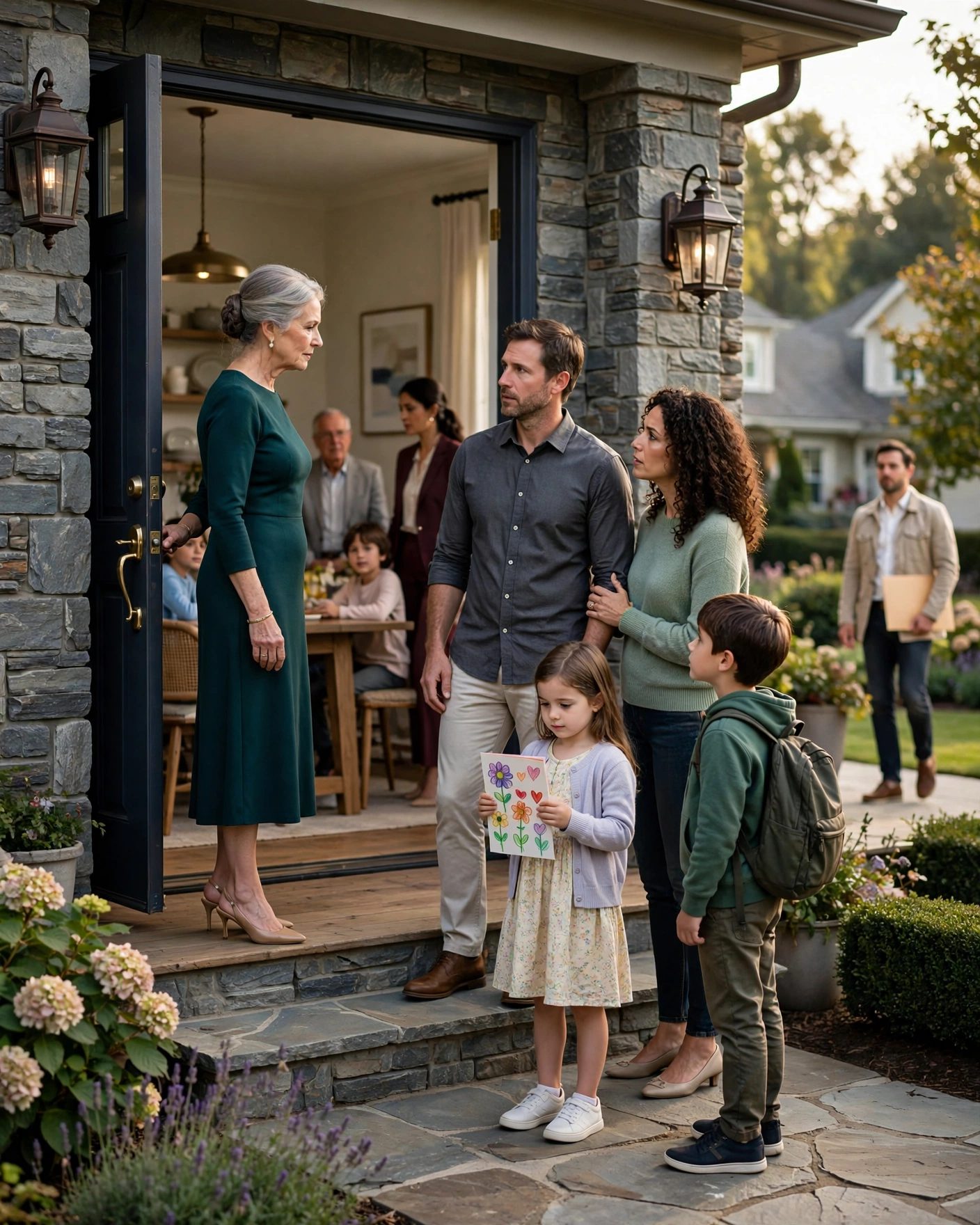
Emma quietly held the pink card against her chest, careful not to bend the foam hearts she had glued on one by one that morning.
My father finally stood.
“Son,” he said, trying to sound reasonable, “don’t turn this into something bigger than it is.”
“Bigger than what?”
“A misunderstanding.”
I slowly shook my head.
“A misunderstanding happens by accident.”
I pointed toward the dining room.
“Seven plates. Seven glasses. Seven chairs.”
Then I looked directly at my mother.
“You knew exactly who wasn’t supposed to be here.”
Melissa rolled her eyes.
“Oh, please. My kids got here first.”
“No,” I answered calmly.
“They were expected.”
Her expression hardened.
Laura quietly stepped beside me without saying a word.
She slipped one arm around Emma while still holding the bakery box.
My mother noticed it.
“At least leave the cheesecake,” she said automatically.
I actually laughed.
Not loudly.
Just once.
The sound surprised all of us.
“No.”
Her face flushed.
“I bought that for everyone.”
“You bought it for family.”
I rested my hand on Tyler’s shoulder.
“My children apparently don’t qualify.”
My father rubbed both temples.
“Jack…”
“No, Dad.”
I hadn’t interrupted him in years.
“I’m finished pretending this keeps happening by accident.”
The room stayed perfectly still.
I took one slow breath.
“For twelve years I’ve helped pay this mortgage.”
Nobody answered.
“I covered the property taxes twice.”
Silence.
“I paid for the new roof.”
Still nothing.
“I replaced the furnace.”
Melissa stared at the floor.
“I’ve transferred more than three hundred thousand dollars into this house since Mom called crying after your retirement.”
My mother’s eyes widened.
“Don’t exaggerate.”
“I don’t have to.”
I reached into my jacket pocket.
Laura already knew what I was doing.
She had asked me months ago why I kept carrying the folded document.
Because someday, I told her, I might need to remember I wasn’t imagining any of this.
I unfolded a single sheet of paper.
My father immediately recognized it.
His shoulders dropped.
“Jack…”
“This wasn’t supposed to come out today.”
I handed the document toward my mother.
She didn’t take it.
So I held it where everyone could see.
“The deed.”
Melissa frowned.
“What deed?”
I looked at her.
“The one you never bothered reading.”
She laughed nervously.
“What are you talking about?”
I met my father’s eyes.
“Tell her.”
He remained silent.
My mother finally whispered,
“Harold…”
He closed his eyes for a moment.
Then sighed.
“When we refinanced eight years ago…”
Melissa looked back and forth between them.
“…we couldn’t qualify.”
Nobody moved.
“We were going to lose the house.”
Her smile disappeared.
“So Jack…”
His voice grew quieter.
“…used his savings to pay off the remaining balance.”
Melissa frowned.
“So?”
I answered for him.
“So the attorney insisted my investment be protected.”
I tapped the bottom of the page.
“My name was added to the deed.”
Her face emptied.
“No…”
“Mom and Dad have lifetime occupancy.”
I nodded toward the hallway.
“They can live here as long as they choose.”
Then I looked directly at my mother.
“But ownership doesn’t work the way you’ve been pretending.”
Tyler squeezed my hand.
I squeezed back.
“This house doesn’t belong to the person deciding who gets invited.”
I paused.
“It belongs to the person who made sure there was still a house.”
No one spoke.
Not my father.
Not Melissa.
Not even my mother.
For the first time in years, everyone in that dining room remembered something they had worked very hard to forget.
The only reason that front door still opened every Sunday…
…was because my name had been quietly sitting on the deed all along.
The Part Before This Started
It hadn’t started with Easter.
Or birthdays.
Or even the Sunday dinners, though those had turned into their own little theater production over the years.
It started when I was ten and Melissa was eight and my mother decided, without ever saying it out loud, that one of us was easier to love in public.
Melissa was the cheerful one. The pretty one. The one who liked being looked at and knew how to keep adults entertained.
I was useful.
Useful kids get praised funny. Not warmly. Efficiently.
“Jack will do it.”
“Jack understands.”
“Jack doesn’t mind.”
By the time I was fourteen, “Jack doesn’t mind” had become family law.
I minded plenty.
I just learned early that in our house there was no prize for saying so.
My father worked at the paper mill until it cut half the crew in 2009. Before that he was a decent man who mostly came home tired and stayed out of whatever current weather system my mother had created in the kitchen. After that, he got smaller. Not physically. In every other way.
Mom took a receptionist job at Dr. Bern’s office three days a week and called me crying the first time the mortgage company sent a final notice.
I was twenty-nine then. Laura was pregnant with Tyler.
I remember the exact place I was standing when she called. Menards parking lot. November. Wind sharp enough to hurt your ears. I had a cart with drywall screws and a shop vac in it because I was running jobs on my own by then, taking anything I could get.
“Your father doesn’t know what to do,” she said.
That was the first lie.
He knew. Sell the house. Downsize. Rent something. Be embarrassed for six months and move on.
But my mother didn’t want smaller. She didn’t want the neighbors asking why. She didn’t want church people finding out they’d overextended themselves trying to keep a house they bought in 1987 and refinanced stupid in 2006 when everybody was being stupid.
So I went over that night.
The kitchen smelled like old coffee and wet newspaper. My father sat there with a stack of envelopes laid out in front of him like he’d been trying to solve a murder.
Melissa was there too, of course. Sitting with one leg tucked under her, saying all the right sad things while contributing exactly nothing except mascara and concern.
“I’d help if I could,” she said.
At the time she had a brand-new Tahoe and a husband named Brent who changed bass boat tires for fun.
I said nothing.
That was my specialty then.
The attorney, Mr. Doyle, was a square-headed guy with a yellow tie and a voice that made every sentence sound annoyed. He met us downtown in a second-floor office above a tax service place and laid it out plain: if I paid the balance, the only smart thing was to put my interest on paper.
My mother hated that.
Not because she didn’t understand it. Because she understood it immediately.
“He’s our son,” she told Mr. Doyle, like he was insulting her.
He didn’t blink. “That’s nice. I’m still putting his name on the deed.”
I should’ve listened harder to the part of me that felt relieved hearing someone else say no to her.
Instead I told myself this was temporary. A bridge. Family helping family.
I signed.
So did they.
Melissa, who had come along for reasons known only to God and her own appetite for information, stood in the parking lot afterward and said, “Well. Guess Jack’s the landlord now.”
She laughed after it.
Nobody else did.
Sunday Rules
The first few years after that, things stayed smooth on the surface.
I never brought up the deed.
They never thanked me in a way that sounded like they knew what it cost.
When the roof started leaking over the back bedroom, I paid for that too because my mother sounded frantic on the phone and because my nephew Caleb had been sleeping in that room every other weekend back then. When the furnace died the week before Christmas, I wrote the check and spent half a day there with a space heater, a wrench, and a guy named Rick from Bryant Heating who smelled like Marlboros and peppermint gum.
Every time, same pattern.
Mom cried.
Dad looked ashamed.
Melissa said, “Thank God Jack’s doing so well.”
As if money arrived at my house by mail.
I wasn’t doing “so well.” I was working sixty-hour weeks, skipping vacations, driving a truck with 211,000 miles on it, and taking side jobs on Saturdays. Laura cut coupons so hard she knew which stores doubled on Wednesdays and which cashiers would let a manufacturer coupon slide if the date was only one day off.
We didn’t suffer. But we felt every check.
Still, every Sunday we’d show up.
That was my stupid part.
Mom insisted on family dinner after church. Pot roast in winter, grilled chicken in summer, overcooked green beans all year, and a dessert she announced like she’d discovered fire. If we came late, she’d make a face. If we missed two weeks, she’d call and ask if we were “pulling away.”
But there were rules inside those dinners, and they weren’t written down.
Melissa’s kids got first pick of seats.
Melissa’s husband, after Brent left and there was a string of others, always got introduced like company.
Laura got treated politely, which was worse in some ways. Politeness can be a knife if you know how to hold it.
My kids got the side version of everything.
Not cruel enough that you could point to one thing and call it abuse. Just steady. A thousand little edits.
When Tyler was six, Mom forgot his birthday but posted fourteen photos from Caleb’s baseball tournament the same weekend.
When Emma brought a hand-painted ornament she made in preschool, Mom said, “How sweet,” and set it on the piano. Two months later I found it in a grocery bag with old catalogs in the mudroom.
When Melissa’s daughter Brook wanted violin lessons, there was suddenly money for that. When Tyler asked if Grandpa would come to his school science fair, Dad said he would try, then forgot.
Laura saw it before I let myself admit it.
“Your mother likes the version of family where your sister stays at the center and everyone else orbits around her,” she told me one night while folding towels.
I remember being irritated.
Not because she was wrong.
Because she said it clean.
People like me can live a long time inside fog if nobody names it.
The Pink Card
This whole thing finally broke over a card made from construction paper and Dollar Tree glitter glue.
Mother’s Day.
That’s all it was supposed to be.
Emma had been up at our kitchen table at 7:15 that morning, tongue peeking out the corner of her mouth, gluing foam hearts onto pink cardstock and writing “Grandma I love you” in giant crooked letters with a silver marker. Tyler, who thought cards were babyish now that he was nine, still asked if we should stop for flowers because “Grandma likes those yellow ones.”
Daffodils. He meant daffodils.
We picked up the cheesecake at Franklin Bakery at 10:40 after church. Laura carried it because the box was flimsy and the kid at the counter had taped one side badly. I drove. The children talked in the back about whether Grandpa would let them feed the koi in the pond even though those fish were basically indestructible and overfed.
Nothing felt dramatic.
Just Sunday.
Then we pulled into the driveway and saw Melissa’s minivan, Steve’s pickup, and my father’s Buick.
“Everybody’s here already,” Laura said.
Normal.
Until we walked inside and my mother looked straight at us the way people look when the wrong package gets delivered.
That one second.
That’s when I knew.
Not guessed. Knew.
The dining room table was set in full. Her good cream plates with the blue ring around them. Seven places. Seven water glasses. Cloth napkins. The roast already carved.
Melissa, her boyfriend Steve, and her three kids.
Mom and Dad.
Seven.
My family made eleven total if we’d been expected.
Which we hadn’t.
My mother recovered fast. She’s good at that.
“Oh,” she said. “Jack. We thought you were going to Laura’s mother this year.”
Laura’s mother had been dead for four years.
Not even a smart lie.
Tyler noticed first, because kids count before adults do. “There aren’t enough chairs.”
Emma stood there with the card.
My father looked like he’d rather swallow a screw.
Melissa made it worse by saying, “The kids can eat in the den. We do that sometimes.”
No they didn’t. Her kids had never once eaten in the den on a holiday in that house.
Laura went still beside me. She gets very still when she’s furious. It used to scare me because I thought quiet anger meant retreat.
It doesn’t.
It means she’s picking where to cut.
I said, “No.”
And then all the words after that started coming out.
The Thing They Forgot About Quiet People
People make a mistake with quiet men.
They think silence means agreement. Or weakness. Or that there isn’t a ledger being kept somewhere.
There is.
Mine wasn’t even secret.
I had every transfer saved. Every invoice. Every contractor receipt. The roof from Mays Roofing, twelve thousand four hundred. The furnace, eighty-six hundred. Tax payments. Emergency plumbing when the basement line backed up and Mom called me sobbing because there was sewage near the washer.
Laura knew all of it because she had sat beside me more than once at our old oak kitchen table while I asked, “Am I crazy?” and she answered, “No. You’re subsidizing people who think that’s the same as owning you.”
Three months before Mother’s Day, we’d had the real fight about it.
Not with them. With each other.
It was late. I’d come home from replacing deck boards at a lake house in the rain and there was a letter on our counter from the county assessor addressed to my parents’ house. My legal interest meant duplicates sometimes came to me. The envelope had been opened by mistake with the rest of the mail.
Inside was a notice about deferred maintenance and a tax adjustment.
Laura held it up and said, “Tell me why this is your problem.”
I didn’t have a decent answer.
“They’re old.”
“So are plenty of people.”
“It’s my parents.”
She set the paper down very carefully. “And those are your children.”
That one stuck.
Not because it was clever. Because Emma was in the living room then, asleep on the couch with one sock off, and Tyler had a field trip form in his backpack I kept forgetting to sign because I’d been too busy figuring out whether my mother needed new gutters.
“You run over there every time the phone rings,” Laura said. “And every time we go, your kids come home asking why Grandma likes the other cousins more.”
I told her she was making it uglier than it was.
She stared at me for a long second and said, “No. You’re sanding it down so you can hold it.”
We didn’t speak much after that. Not for the rest of the night.
Next morning I took the deed from the file cabinet in our bedroom and folded it into quarters. Put it in my jacket pocket. Then another jacket when the weather changed. Then the next one.
I told myself it was just a reminder.
I guess it was.
Melissa Finally Says the Quiet Part
Back in that dining room, after Dad admitted the truth, Melissa did something almost useful.
She stopped pretending.
“This is insane,” she said. Her voice had gone thin and sharp. “You’re throwing this in everyone’s face over lunch.”
“No,” Laura said before I could. “He’s doing it because your kids were given seats and ours were given excuses.”
Melissa looked at her like she was surprised Laura had a mouth.
Steve, who had spent the whole scene staring hard at a wall clock like maybe he could melt into it, muttered, “Maybe we should go.”
Melissa snapped, “Don’t start.”
Then she turned to my mother. “You told me he helped out. You didn’t say his name was on the house.”
My mother was crying now, but angry-crying, which on her looked like offense with water added. “It never mattered.”
I said, “It mattered every time you acted like we were guests.”
That was when Melissa gave up the nice version altogether.
“Oh my God, Jack, do you hear yourself? You paid some bills. Congratulations. You want a crown? Mom and Dad needed help. You helped. That’s what family does.”
I almost answered.
Then she kept going.
“And don’t act like this isn’t about you and your wife keeping score all these years because my kids are closer to Mom. That’s not my fault. We were here more. We showed up.”
Laura laughed once under her breath. Ugly little sound.
I said, “With what money?”
Melissa’s face changed.
Good.
Small thing, but good.
She said, “What does that mean?”
“It means being present gets easier when someone else is covering the taxes.”
My father sat down hard in his chair.
My mother started with my full name. “Jackson Edward, that is enough.”
Nobody had called me that since high school.
I said, “No. I think we’re finally at enough.”
Melissa stepped toward me. “You think because your name is on paper you can threaten people?”
Tyler moved closer to my side.
That did it.
I don’t know why that exact motion did more to me than the insult or the lying or the years of this garbage, but feeling my son tuck himself nearer because a grown woman was posturing in front of him made something lock into place.
So I said the thing I hadn’t planned to say until much later, if ever.
“I’m not threatening anybody. I’m changing the arrangement.”
The whole room jerked.
My father looked up. “Jack.”
I kept my eyes on my mother.
“No more automatic money. No more emergency transfers because Melissa says she’ll help next month. No more paying for holidays where my children get treated like afterthoughts.”
Mom took a step toward me. “You can’t do this to us.”
I looked around the kitchen. The granite counters I’d paid to have resealed. The refrigerator I split with Dad after the old one died. The windows over the sink that still had the sticker in one corner because my father never noticed details like that.
“I’ve been doing the opposite for years.”
Melissa said, “This is blackmail.”
“No. This is math.”
Harold
What I didn’t expect was my father.
Harold Miller. Sixty-eight. Quiet all his life in that maddening male way where they think staying out of conflict keeps their hands clean.
He stood up again, slower this time.
“Pat,” he said to my mother, and his voice sounded old. Older than I’d ever heard it. “He’s right.”
She turned on him so fast I thought she might actually hit him.
He didn’t back up.
Not this time.
“You made choices,” he said. “And I let you. I let you do this with Melissa, and with Jack, and with those kids.”
Mom said, “Don’t you start acting innocent.”
“I’m not.” He looked at me then, not around me, not past me. At me. “I should’ve stopped this years ago.”
The room had gone strange. Not quiet. Strange.
Because when a man who’s been furniture your whole life suddenly decides to be a person, it throws off the whole balance.
Melissa said, “Dad, seriously?”
He turned to her. “Did you ever ask where the money came from?”
She opened her mouth and shut it.
“No,” he said. “Because you didn’t want the answer.”
Steve put his hands in his pockets and looked at the floorboards.
My father kept going, and once he started it was like hearing a pipe unclog.
“When Brent left and you needed help with the lawyer, who paid?”
Melissa blinked.
I had. Three thousand, quietly. She’d been told it came from “the family.”
“When Caleb broke his arm and your insurance didn’t cover all of it, who paid?”
Her face went white.
I had. Mom called crying then too.
“When your transmission went out three summers ago?”
My mother said, “Harold, stop.”
But he didn’t.
“Jack did.”
Melissa looked at me like she’d never seen me before.
Maybe she hadn’t. Not really.
I said, “Mom always said it was easier if you didn’t feel embarrassed.”
Melissa whispered, “She told me Dad cashed out part of his retirement.”
Dad made a rough sound that might’ve been a laugh if it hadn’t been so tired. “There wasn’t enough left to cash out.”
My mother sat down hard in her chair.
For a second I thought she might actually apologize.
Not because she was sorry. Because the room had turned against her and she knew it.
Instead she looked at Emma.
That was what did it. Not me. Not Dad. My daughter, still holding that bent pink card like it was something valuable.
Mom said, “I never meant for the children to get dragged into adult issues.”
Laura’s arm tightened around Emma.
I said, “They were already in it. You just counted on them being too young to name it.”
The Last Sunday
We didn’t stay for lunch.
That would’ve been insane.
I took the cheesecake from Laura, set it on the counter, then changed my mind and picked it back up. Petty, maybe. I don’t care.
Emma walked over to my mother without being told.
That child is gentler than the rest of us deserve.
She held out the card.
“Happy Mother’s Day, Grandma.”
My mother took it with both hands. She looked wrecked suddenly. Mascara gathering in the lines at the corners of her eyes. Mouth working like she wanted to produce a different version of herself and couldn’t get it out in time.
“Thank you, sweetheart.”
Emma nodded and came back to us.
Tyler didn’t say anything at all to anyone. He just took my hand again.
At the front door, my father called my name.
I turned.
He stood in the hallway under the old brass light fixture. The one I’d installed because Mom said the other one made the entry “look cheap.”
He said, “Can I come by this week?”
Not “we.”
Just him.
“Yeah,” I said.
Mom flinched at that.
Melissa was still standing by the table, stunned and mean and embarrassed all at once. She had that look people get when they’ve lived a long time on invisible subsidy and suddenly somebody switches on the lights.
Steve held the diaper bag even though none of her kids were in diapers anymore. Nerves make people grab things.
Nobody tried to stop us.
Outside, the air had that wet warm smell it gets in May before a storm. The kids climbed into the back seat. Laura set the cheesecake between them and buckled in without saying anything.
I got in. Shut the door. Sat there with my hands on the steering wheel.
My whole body felt weirdly light and shaky, like after a ladder slip when you don’t hit the ground but your legs keep acting like you did.
Laura looked at me.
“You okay?”
I started the car.
“No,” I said.
Then, after a second, “Yeah. Maybe.”
We backed out of the driveway.
In the rearview mirror I saw my father still standing in the doorway. My mother behind him, one hand on the frame, the pink card hanging at her side.
That was Mother’s Day.
The next Sunday, nobody called.
The Sunday after that, Dad came to my house alone carrying a rusted coffee can full of old documents, receipts, and one ring of keys. House keys. Shed keys. The tiny brass mailbox key with blue tape around the top.
He set them on my kitchen table and said, “I figured these should be with the person who’s been running the place anyway.”
He cried then.
First time I’d ever seen that.
A month later, my parents put the house on the market with my agreement and moved into a two-bedroom condo ten minutes from us. Not from Melissa.
From us.
Mom fought it right until the boxes showed up. Then she got tired. Maybe that was all age really is half the time. Not wisdom. Just running out of fight for the same stupid pattern.
Melissa didn’t speak to me for eleven months.
Then one Tuesday she texted asking if I had copies of the old furnace warranty paperwork.
I stared at the message for a full minute before laughing so hard I had to sit down.
I didn’t answer right away.
Let her wait.
If this one stayed with you, send it to somebody who’ll get it. Some stories hit harder when they’re shared.
If you’re interested in more stories about setting boundaries and standing up for yourself, you might like He Asked Me to Stop Talking About My Cancer, He Threatened Me in My Own House and Didn’t Know My Last Name, or I Left Before Sunrise and Let the Truth Wake Them Up.